 Reading Ants
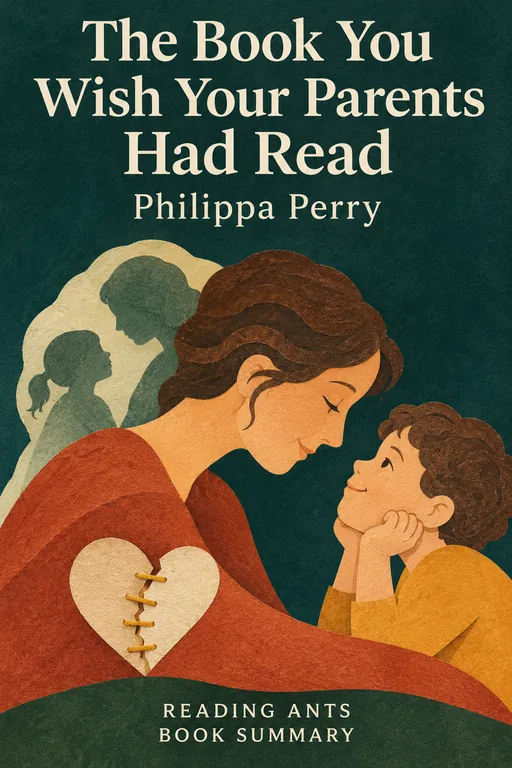
The Book You Wish Your Parents Had Read
Psychotherapist Philippa Perry argues that good parenting is less about technique than about the relationship, and that we help our children most when we understand our own past, name feelings and repair the rifts that are bound to happen.
Overview
The Book You Wish Your Parents Had Read (and Your Children Will Be Glad That You Did) was published in 2019 by Philippa Perry, a British psychotherapist and writer. It was a publishing success in Britain. Perry says that most parenting books offer rules and tricks, but that children are not problems to be solved. Instead, she focuses on how adults relate to their children, and on how the way we were treated affects the way we treat them. The book draws on psychology and her experience as a therapist and as a parent. It is written in a warm, sensible and sometimes funny voice, with few rules.
Full Summary
1. The ghosts of our own childhood
The idea: Perry says that we tend to repeat patterns from our own upbringing, often without noticing. When a child cries or misbehaves, we may react in the same way that our parents did, or we may swing to the opposite extreme. The first step is to become aware of our automatic reactions, and to ask where they come from. By understanding our past, we can choose how we respond now.
In real life: If you notice that you shout when your child is messy, you can ask whether it is what you heard when you were small.
2. Rupture and repair
The idea: A key idea of the book is that all relationships have moments of disconnection, which she calls ruptures, and that the important part is to repair them. No parent can be perfect, and the aim is to be what the pediatrician and psychoanalyst Donald Winnicott called a “good enough” parent, one who can say sorry, reconnect and talk it over. Repair teaches the child that relationships can survive conflict, and that mistakes are not the end.
In real life: After you lose your temper, going to your child and saying “I’m sorry I shouted, I was tired” can strengthen trust.
3. Feelings are not the problem
The idea: Perry encourages parents to accept their children’s feelings, even when the behavior needs to be limited. Naming feelings, such as “You seem very disappointed,” helps children to understand and manage them. She suggests that we also pay attention to our own feelings, and that we model how to deal with them. Feelings that are denied tend to emerge in other ways.
In real life: A child who is told “You’re fine, stop crying” may learn to hide upset, while one who is listened to learns to talk about it.
4. Behavior as communication
The idea: According to Perry, children’s behavior is a way of telling us something. A tantrum or a refusal may signal tiredness, fear or a need for attention. Instead of focusing only on stopping the behavior, she suggests that parents ask what the child is trying to say. She favors understanding a child’s behavior over simply punishing it, since punishment can teach children to fear rather than to understand.
In real life: A child who suddenly refuses to go to school may be anxious about something that has happened there.
5. Seeing the child as a separate person
The idea: Perry says that children are not extensions of their parents, and that they have their own temperaments and interests. She urges parents to be curious about who the child really is, and to treat children as people to relate to, not as projects to get right. She warns against forcing our own ambitions or fears on them, and suggests that love means supporting their growth, even when it leads them in different directions.
In real life: A parent who loves sports may need to learn to enjoy a child’s love of drawing.
6. Play, time and being present
The idea: The book suggests that attention matters more than elaborate activities. Listening closely, responding when a child reaches out for attention, playing together and being fully present show children that they matter. Perry also distinguishes helping a child from rescuing the child, so that children can work some things out for themselves. She reminds parents that they need support of their own, since parents who are cared for find it easier to care for others. She encourages parents to be kind to themselves, to question their inner critic, and to seek help when needed.
In real life: A short stretch of unhurried, attentive play can matter more than a day at a theme park spent distracted. This is the summary’s illustration, not a measured rule or an example from the book.
Why It Matters
Perry was already known to many readers as a newspaper writer, an advice columnist and the author of a graphic novel about therapy, Couch Fiction. The Book You Wish Your Parents Had Read was a major success, and helped to bring a relationship-based, psychological approach to parenting to a wide audience. It resonated with many adults who recognized their own childhoods in its pages, and who wanted to do things differently. The book was praised for being compassionate toward parents as well as children, and for resisting the pressure to be perfect. It fits a broader shift in thinking about child-rearing, away from strict discipline and toward understanding and repair.
Key Takeaways
- Know your own history. Our upbringing shapes our reactions.
- Repair matters more than perfection. Say sorry and reconnect.
- Accept feelings. Naming emotions helps children to manage them.
- Listen to behavior. It carries messages.
- Be present. Attention and unhurried time are the heart of any close relationship.
What We Can Learn
Whether or not you are a parent, you can use these ideas in your relationships. Notice how you react when someone is upset, and whether it echoes the way you were treated. Practice naming feelings, yours and others’, and apologize when you have hurt someone. If you are young, you may recognize some of the dynamics in your own family, and talk about them. The book also reminds us that adults need kindness, and that it is never too late to change a pattern. If painful memories arise, consider speaking with a counselor.
Criticism and Counterpoints
Some critics find the book admirable but simplistic, saying that it treats complex psychological issues too lightly, and some readers who already know the parenting genre find parts of it repetitive. An approach drawn from psychotherapy, which asks parents to look closely at their own history, will not suit every family or every moment. Supporters value its warmth, its common sense, and its refusal to treat children as projects to be got right.
Who Should Read It
This book is for parents, caregivers, teachers and anyone who wants to understand how childhood shapes relationships. It is accessible and kind in tone. Those who want a step-by-step program or advice for a specific disorder or crisis will want to consult other sources or a professional.
Want the whole book?
A summary is a taste, not the meal. Here is where to find the full book.
You reached the end 🎉
Nicely done. Mark this one as read, and we will suggest what to read next.
Read this next
Positive Discipline
Jane Nelsen
Jane Nelsen argues that children behave better when they are treated with both kindness and firmness, and she offers practical tools, such as family meetings and logical consequences, to teach them responsibility without punishment or pampering.
🎓 Parenting & Education
How to Raise an Adult
Julie Lythcott-Haims
A former dean at Stanford University argues that modern parents who do too much for their children, from homework to college applications, are leaving them anxious and unprepared, and she urges them to step back and let young people learn to stand on their own.
🎓 Parenting & Education
How Children Succeed
Paul Tough
Journalist Paul Tough argues that qualities like perseverance, curiosity and self-control matter more for children's success than test scores alone, and that these qualities can be nurtured, especially for children who face hardship.
🎓 Parenting & Education
Daring Greatly
Brene Brown
Researcher Brené Brown argues that vulnerability, the willingness to show up and be seen when outcomes are uncertain, is not weakness but the foundation of courage, connection and creativity.
🌱 Self-Improvement
The Body Keeps the Score
Bessel van der Kolk
Psychiatrist Bessel van der Kolk argues that trauma leaves lasting marks on the brain and body, and that healing needs more than talking: it involves restoring a sense of safety, body awareness and connection.
🧩 Mind & Psychology
How to Talk So Kids Will Listen and Listen So Kids Will Talk
Adele Faber and Elaine Mazlish
Parents can get better cooperation and closer relationships by acknowledging children's feelings, describing problems instead of blaming, and using simple, respectful communication skills.
🎓 Parenting & EducationWant something different?
Pick another topic and we will show you three books to start with.