 Reading Ants
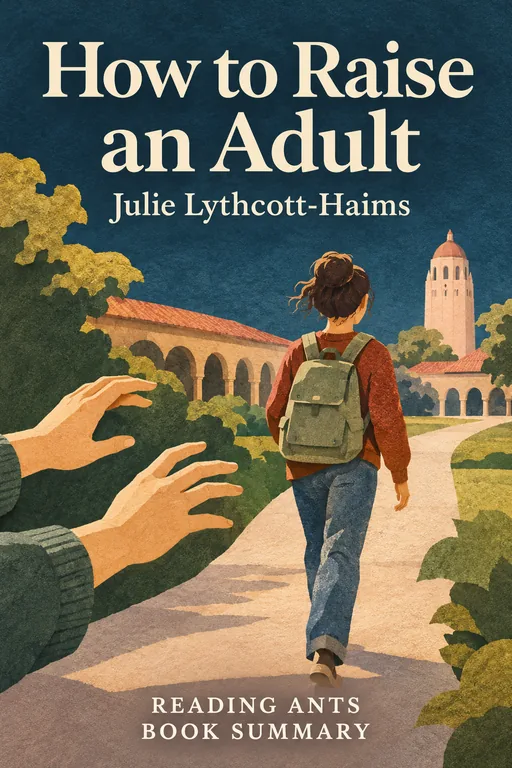
How to Raise an Adult
A former dean at Stanford University argues that modern parents who do too much for their children, from homework to college applications, are leaving them anxious and unprepared, and she urges them to step back and let young people learn to stand on their own.
Overview
How to Raise an Adult: Break Free of the Overparenting Trap and Prepare Your Kid for Success was published in 2015 by Julie Lythcott-Haims. She worked for years as dean of freshmen at Stanford, and noticed that many bright students arrived without the basic skills of independence. Some could not handle disagreements with roommates or make decisions, and sometimes their parents were still involved in their daily lives. She draws on her experience, interviews and research to argue that “helicopter parenting,” hovering and managing everything, harms the very children it aims to help. The book also offers a plan for change.
Full Summary
1. The overparenting problem
The idea: Lythcott-Haims describes a culture in which many parents, especially in comfortable communities, are afraid that their children will fall behind. They organize their lives, supervise homework, intervene with teachers, and even help with college essays and jobs. She says that this comes from love and anxiety, and from the belief that a child’s success reflects on the parent. But it sends the message that the child cannot manage alone.
In real life: A parent who calls a teacher about every low grade may stop the child from learning to speak up for themselves.
2. What overparenting costs
The idea: The author argues that over-involvement contributes to young people who are anxious, depressed and unsure of themselves. The research she cites shows links, not proof that overparenting is the only cause. They may lack life skills, such as doing laundry or cooking, and may find it hard to deal with failure. She cites studies and stories from colleges, which suggest that rising rates of anxiety are connected to a lack of autonomy. She also notes that when parents solve every problem, the child misses the chance to build confidence.
In real life: A young person who has never made a decision without help may feel panicked when the first big choice arrives.
3. The checklist childhood and a narrow idea of success
The idea: Lythcott-Haims says that many children grow up on a “checklist,” filled with scheduled activities, tutoring and test preparation, with little time for free play or rest. The aim of getting into a famous university becomes the center of family life. She argues that this narrow idea of success is stressful and unnecessary, since many paths lead to a happy and productive life, and that, as she sees it, how well a student is supported and mentored matters more than the brand name of the college.
In real life: A teenager who does a sport only to improve a college application may lose the joy of playing.
4. Real life skills and chores
The idea: One of the most practical parts of the book is the emphasis on giving children age-appropriate tasks and chores, from setting the table to doing laundry. She cites research suggesting that people who did chores as children tend to be more successful later in life. She also names the skills that a young adult needs, such as talking to strangers, managing deadlines and commitments, helping to run a household, making decisions and handling setbacks.
In real life: A ten-year-old who helps to prepare dinner learns that he or she is a useful member of the household.
5. Letting children struggle
The idea: The author says that parents should resist the urge to rescue children from every difficulty. Struggle, she says, is how children learn resilience and problem solving. She suggests asking questions instead of giving answers, such as asking what the child thinks they should do, and allowing natural consequences, within reason. She also advocates for unstructured play, which she says is essential to a child’s development. She does not mean withdrawing needed care: children with special needs, health problems or unsafe conditions need support, and speaking up for a child is not always overparenting.
In real life: If an older child with no special needs forgets a lunch, letting them manage once may teach more than rescuing them every time. The right choice depends on age, health and circumstances.
6. A different path for parents
The idea: In the final chapters, Lythcott-Haims describes what parents can do instead. She encourages them to focus on love and on their own lives, and to see their role as a guide, not a manager. She encourages parents to explain the reasons behind rules, to share their own struggles honestly and not only their successes, and to let children face the consequences of their choices. She also discusses the need to value many kinds of success, including trade schools and work, and to support the child’s own interests.
In real life: A parent who takes up a hobby of their own provides a model of a full life, and gives the child more space.
Why It Matters
How to Raise an Adult became a bestseller and part of a larger debate about parenting in an age of high pressure. It gave voice to concerns shared by many teachers, college officials and employers, and offered a framework for change. The book brought new attention to “helicopter parenting” and encouraged discussion of the mental health of young people. Its mix of personal stories and practical suggestions made it influential among parents and educators. It also prompted many to reflect on their own motives and fears, and on what it means to prepare a child for the future.
Key Takeaways
- Love is not the same as control. Doing too much for a child can hold them back.
- Skills grow through practice. Chores and responsibility build confidence.
- Struggle is part of learning. Do not rescue too quickly.
- Many paths lead to success. Not every child needs a famous university.
- Parents need lives of their own. It helps children to see adults who pursue their interests.
What We Can Learn
If you are a parent, ask yourself whether you are doing something for your child that he or she could do for themselves. Start by teaching a skill, such as cooking or washing clothes, and then step back. If you are a young person, you can take initiative by asking for more responsibility and learning basic life skills. Talk about fears openly, and ask what you can do about them. Remember that mistakes are part of growing up, and that people can learn from them when they have support but not control.
Criticism and Counterpoints
Some critics say that the book focuses mainly on affluent, well-educated families, and that for families dealing with poverty, discrimination or unsafe neighborhoods, the challenge is often not too much help but too little. Others argue that the book leans partly on stories, and that the picture of a generation of helpless young people may be exaggerated. Some feel that the book may add to parental guilt, or that it overlooks real pressures such as an economy that is competitive and costly. Others find that its advice is common sense.
Who Should Read It
This book is for parents of children of all ages, teachers, counselors and young adults who are interested in independence. It is clearly written and practical. Families in very different circumstances may find parts less relevant, and anyone worried about a child’s mental health should seek professional help.
Want the whole book?
A summary is a taste, not the meal. Here is where to find the full book.
You reached the end 🎉
Nicely done. Mark this one as read, and we will suggest what to read next.
Read this next
Positive Discipline
Jane Nelsen
Jane Nelsen argues that children behave better when they are treated with both kindness and firmness, and she offers practical tools, such as family meetings and logical consequences, to teach them responsibility without punishment or pampering.
🎓 Parenting & Education
The Book You Wish Your Parents Had Read
Philippa Perry
Psychotherapist Philippa Perry argues that good parenting is less about technique than about the relationship, and that we help our children most when we understand our own past, name feelings and repair the rifts that are bound to happen.
🎓 Parenting & Education
How Children Succeed
Paul Tough
Journalist Paul Tough argues that qualities like perseverance, curiosity and self-control matter more for children's success than test scores alone, and that these qualities can be nurtured, especially for children who face hardship.
🎓 Parenting & Education
Battle Hymn of the Tiger Mother
Amy Chua
Yale law professor Amy Chua tells, with humor and self-doubt, how she raised her two daughters with strict rules and high expectations in the style she calls Chinese, and what happened when her younger daughter pushed back.
🎓 Parenting & Education
Grit
Angela Duckworth
Psychologist Angela Duckworth argues that success depends not only on talent but on grit, a combination of passion and long-term perseverance, and shows how people can grow it in themselves and others.
🌱 Self-Improvement
How to Talk So Kids Will Listen and Listen So Kids Will Talk
Adele Faber and Elaine Mazlish
Parents can get better cooperation and closer relationships by acknowledging children's feelings, describing problems instead of blaming, and using simple, respectful communication skills.
🎓 Parenting & EducationWant something different?
Pick another topic and we will show you three books to start with.