 Reading Ants
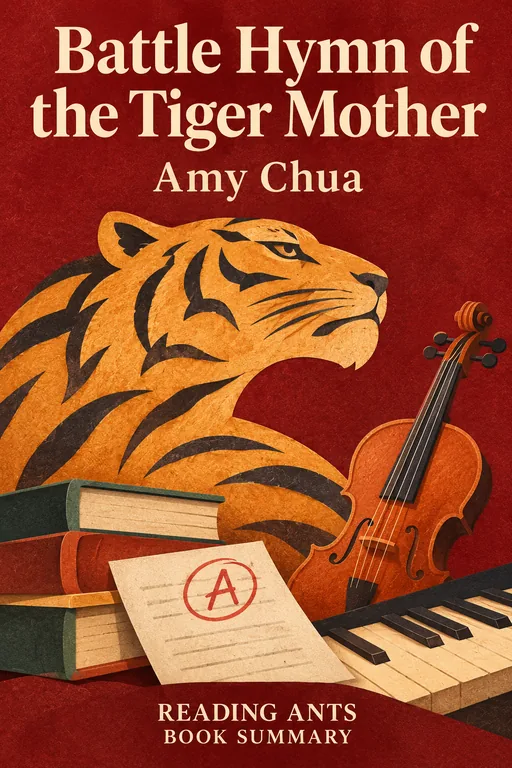
Battle Hymn of the Tiger Mother
Yale law professor Amy Chua tells, with humor and self-doubt, how she raised her two daughters with strict rules and high expectations in the style she calls Chinese, and what happened when her younger daughter pushed back.
Overview
Battle Hymn of the Tiger Mother was published in 2011 by Amy Chua, a law professor, the daughter of Chinese immigrants to the United States. It is a memoir about raising her daughters, Sophia and Lulu, with a demanding approach: no sleepovers, no playdates, no grades below an A, and hours of practice for the piano and the violin. Chua presents this as a contrast with the more permissive style of many Western parents. The book started a huge public debate about parenting, culture and success, which was heightened by an excerpt in a newspaper under a provocative headline. Chua later said that the book is not a how-to guide but a self-mocking memoir about her own change.
Full Summary
1. The Chinese way, as she sees it
The idea: Chua opens by listing the things that her daughters were never allowed to do, such as attend sleepovers, be in school plays, watch television or play computer games. She argues that many Chinese parents believe that children can do much more than Western parents think, and that it is the parent’s job to push them to excel. She says that strict expectations show belief in a child’s strength, and that they build confidence through achievement.
In real life: A parent who insists that a child continue practicing a difficult skill is showing faith that the child can master it.
2. Hours at the piano and violin
The idea: Music is the center of the family’s life. Sophia learns the piano, and Lulu the violin, and both are expected to practice for hours every day, even on vacation. Chua is present at every lesson and every session, taking notes and pushing them. She tells stories of practice in hotels, and of strict teachers. She believes that tough, repeated practice leads to real skill, and that children come to enjoy what they are good at.
In real life: Many skills are not fun at first, and become enjoyable when you get better at them.
3. Success and sacrifice
The idea: Sophia, the older daughter, is obedient and excels at school, and she plays at Carnegie Hall as a teenager. Chua is proud, but she also senses the pressures on her daughter. She also describes how she was raised by immigrant parents who expected excellence, and how she understands her approach as part of a family tradition, with its sacrifices and its toughness.
In real life: The way we were raised often shapes how we raise others, for better or worse.
4. Lulu rebels
The idea: Lulu, the younger daughter, has a strong will, and as she grows up, she resists her mother’s demands. She cries, argues and refuses to practice. In a famous scene on a family trip to Moscow, when Lulu is thirteen, she throws a glass to the ground at a café in Red Square and shouts that she hates the violin and the family, and Chua is shaken by it. The conflict between them grows, and Chua realizes that her methods are not working with this child. She has to face the possibility that her approach has hurt her daughter.
In real life: Two children in the same family can need very different kinds of parenting.
5. A turning point
The idea: After the blow-up in Moscow, Chua reconsiders, and she tells Lulu that the family is giving up the violin. Lulu takes up tennis, which she enjoys. She also tries to listen to her daughter’s feelings. She starts to see that the child’s own motivation matters, and that love means being flexible. The mother’s view of success starts to widen. The book’s own blurb says that it began as a plan to show how Chinese parents do better, and became the story of how a thirteen-year-old humbled her.
In real life: A change of plan, even a late one, can repair a relationship.
6. What she learned
The idea: In the closing chapters, Chua reflects on what she has learned. She still believes in high standards and hard work, but admits that she was sometimes too harsh. She accepts that each child is different and that she had to change her approach, though her competitive streak and her belief in high standards clearly remain. The book ends in a gentler tone than it began, with humor about her own flaws and a sense of affection.
In real life: Good parenting, like good teaching, adjusts to the individual.
Why It Matters
Battle Hymn of the Tiger Mother became a bestseller and triggered a worldwide discussion about parenting, cultural stereotypes and the pressures on children. The term “tiger mother” entered the language. The debate raised questions about academic pressure, mental health, the immigrant experience, and what we mean by success. The book also had defenders, who said that it showed the value of high expectations. Whether people agreed or not, it made many parents reflect on their own methods. It is a reminder that parenting styles are influenced by culture and by family history, and that no single method is right for every child.
Key Takeaways
- High expectations can build confidence. Believing in a child’s ability may lead to growth.
- Effort and practice matter. Skill requires repeated work.
- Children differ. A method that works for one may fail for another.
- Pressure has costs. Over-control can damage relationships.
- Parents can change. Chua adjusted her approach after listening to her daughter.
What We Can Learn
The book invites you to ask what you want for yourself or for a child: not only success, but also happiness and a good relationship. If you are a student, think about whether your goals are your own, and talk to your parents about them. If you are a parent, remember that high standards work best with warmth and flexibility. Respect each person’s temperament. And be careful about stereotypes: families of any culture include many styles of parenting, and the “Chinese” and “Western” labels are broad generalizations.
Criticism and Counterpoints
Many critics said that the book promotes an approach that can cause stress, anxiety and depression in children, and that research on parenting shows that warmth and autonomy support are important. Others said that the cultural generalizations about Chinese and Western parents are overly simple, and that many Asian American families do not follow this style. Some felt that the book’s account of cruelty, such as calling a daughter names, was alarming. Chua replied that the book is a memoir, not a how-to guide, and that much of it describes her retreat from the strict approach after her younger daughter rebelled at thirteen.
Who Should Read It
This book is for parents and teens who are interested in debates about success and family pressure, and for those who like memoirs with humor and conflict. It is not a how-to guide, and is not a model to copy. Readers should take it as a story and a prompt for discussion.
Want the whole book?
A summary is a taste, not the meal. Here is where to find the full book.
You reached the end 🎉
Nicely done. Mark this one as read, and we will suggest what to read next.
Read this next
Positive Discipline
Jane Nelsen
Jane Nelsen argues that children behave better when they are treated with both kindness and firmness, and she offers practical tools, such as family meetings and logical consequences, to teach them responsibility without punishment or pampering.
🎓 Parenting & Education
How to Raise an Adult
Julie Lythcott-Haims
A former dean at Stanford University argues that modern parents who do too much for their children, from homework to college applications, are leaving them anxious and unprepared, and she urges them to step back and let young people learn to stand on their own.
🎓 Parenting & Education
How Children Succeed
Paul Tough
Journalist Paul Tough argues that qualities like perseverance, curiosity and self-control matter more for children's success than test scores alone, and that these qualities can be nurtured, especially for children who face hardship.
🎓 Parenting & Education
The Book You Wish Your Parents Had Read
Philippa Perry
Psychotherapist Philippa Perry argues that good parenting is less about technique than about the relationship, and that we help our children most when we understand our own past, name feelings and repair the rifts that are bound to happen.
🎓 Parenting & Education
Educated
Tara Westover
A girl raised by survivalist parents in the mountains of Idaho, with no school, no birth certificate and no doctors, teaches herself enough to reach university and eventually earns a PhD from Cambridge, at the painful cost of her family.
👤 Real Lives
How to Talk So Kids Will Listen and Listen So Kids Will Talk
Adele Faber and Elaine Mazlish
Parents can get better cooperation and closer relationships by acknowledging children's feelings, describing problems instead of blaming, and using simple, respectful communication skills.
🎓 Parenting & EducationWant something different?
Pick another topic and we will show you three books to start with.