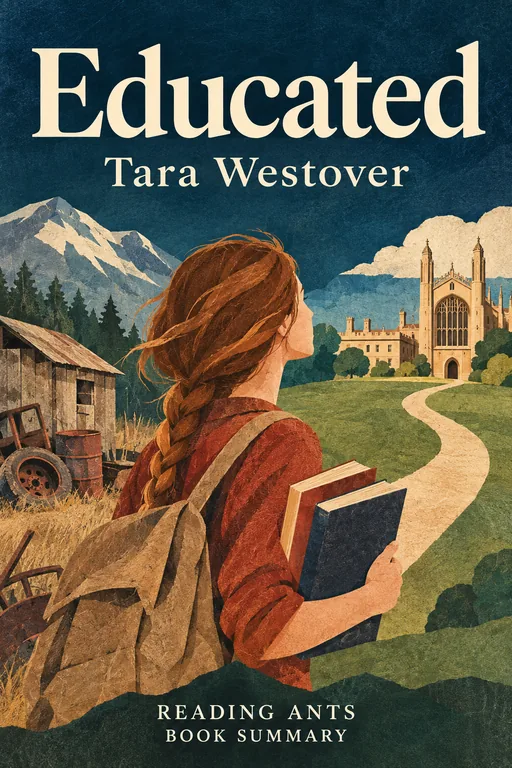
Educated
A girl raised by survivalist parents in the mountains of Idaho, with no school, no birth certificate and no doctors, teaches herself enough to reach university and eventually earns a PhD from Cambridge, at the painful cost of her family.
Overview
Tara Westover grew up on a mountain in rural Idaho, the youngest of seven children. Her father held extreme beliefs: he distrusted the government, schools and hospitals, and prepared for the end of the world by storing food and fuel. Tara never went to school and had no birth certificate until she was nine. She spent her childhood working in her father’s dangerous scrapyard and helping her mother, a self-taught herbalist and midwife. One of her brothers became violent toward her. At seventeen, having taught herself enough to pass a college entrance exam, she entered Brigham Young University and began a journey of learning that took her to Cambridge and Harvard. Educated is a story about the power of education and the struggle to find your own voice.
Full Summary
Life on Buck’s Peak
Tara’s family lives below a mountain called Buck’s Peak. Her father believes that the government is evil, that doctors and medicines are dangerous, and that the end of days is coming. The family stores supplies and buries fuel. The children are supposed to be homeschooled, but in practice they rarely study.
Tara works with her brothers in her father’s scrapyard, sorting and cutting metal with heavy machines, and serious accidents happen often. When family members are badly hurt, including in car crashes and burns, they are treated at home with her mother’s herbal remedies rather than by doctors. Tara’s mother herself suffers a head injury in a crash that changes her personality and causes lasting headaches.
Shawn
One of Tara’s older brothers, Shawn, becomes increasingly violent. He is charming one moment and cruel the next, calling her names, twisting her arms and forcing her head into the toilet. Her parents fail to protect her, and when she tries to speak about it, the family often denies or minimizes what happened. Tara begins to doubt her own memories, a pattern she later explores carefully, comparing her memories with those of her siblings.
The Way Out
Tara’s older brother Tyler had left home to go to college, and he encourages her to do the same. Tara teaches herself algebra, grammar and other subjects from books, struggling to understand them. After several attempts, she scores well enough on the ACT, a college entrance exam, to be admitted to Brigham Young University at seventeen.
University is a shock. In one of her first classes, she asks what the word “Holocaust” means, because she has never heard of it, and her classmates are horrified. She has to learn not only academic subjects but basic things about the world, like history, hygiene and how to ask for help. With the support of professors and church leaders, and with a grant she had been afraid to accept, she begins to succeed.
Cambridge and Harvard
A professor encourages Tara to apply for a study program at the University of Cambridge in England. There, a respected professor tells her that her worth was always in her, whatever her background, and that she can become whoever she chooses. She wins a prestigious scholarship to study at Cambridge, then spends time as a visiting fellow at Harvard, and eventually earns a PhD in history from Cambridge.
As her education grows, so does the distance between her and her family. Every visit home brings her back into her old role, and Shawn’s violence and her parents’ refusal to acknowledge it continue.
Breaking Away
When Tara finally confronts her family about Shawn’s abuse, her parents side with him. They demand that she accept their version of events and offer to “heal” her. Some siblings support her, while others turn against her. Tara suffers a breakdown, struggling with anxiety and depression, and with the support of a counselor she slowly recovers.
She realizes that she must choose between her family and her own sense of truth. She chooses to remain estranged from her parents and some siblings. In the end, she understands that her education was not only the knowledge she gained in libraries, but the ability to see with her own eyes and think with her own mind, even when that meant losing the people she loved.
Why It Matters
Educated became a huge bestseller after its publication in 2018, spending a long time on bestseller lists and selling millions of copies worldwide. It was translated into dozens of languages and recommended by many public figures, including Barack Obama and Bill Gates.
The book sparked conversations about education, family loyalty, abuse, mental health and the right to tell one’s own story. It shows how learning can transform a life, and also how painful it can be when growth separates us from the people and beliefs we were raised with. Many readers who grew up in difficult or isolated circumstances have found strength in Westover’s story.
Key Takeaways
- Education transforms lives. Learning gave Tara the tools to understand the world and herself.
- Self-education is powerful. Determination and curiosity can overcome a lack of schooling.
- Memory and truth are complex. People can remember the same events very differently.
- Loyalty has limits. Protecting yourself may require stepping away from family.
- Becoming yourself takes courage. Growth can mean leaving behind beliefs you were raised with.
What We Can Learn
Tara’s story reminds us never to take education for granted. Libraries, teachers and the chance to learn are precious, and curiosity can carry us further than we imagine.
It also teaches that asking for help is not a weakness. Tara’s success came partly from accepting support from professors, counselors and friends. If you are struggling, reaching out to a trusted adult or professional can change everything.
Finally, the book shows the importance of trusting your own experience. When others deny something that hurt you, it is okay to stand by your truth and protect yourself, even if it is painful.
Criticism and Counterpoints
Some members of Tara Westover’s family have disputed parts of her account, and her parents have rejected her description of their home. Westover addresses this in the book by including footnotes where siblings remember events differently, which many readers praise as unusually honest for a memoir.
Some critics have questioned whether certain details, such as the speed of her academic success, are presented too smoothly. Others worry that readers may unfairly generalize about rural people, homeschooling families or members of her religion based on one family’s extreme story. Westover herself has said the book is about her family, not about all religious or rural communities.
Who Should Read It
This memoir suits teenagers and adults, especially those interested in education, family relationships and personal growth. The descriptions of injury and abuse can be distressing. Students and anyone who has ever felt held back by their circumstances will find it inspiring.
Want the whole book?
A summary is a taste, not the meal. Here is where to find the full book.
You reached the end 🎉
Nicely done. Mark this one as read, and we will suggest what to read next.
Read this next
The Glass Castle
Jeannette Walls
Jeannette Walls recounts a childhood with brilliant but irresponsible parents who moved constantly, left their children hungry and unsafe, and still gave them a sense of wonder, and how she and her siblings made their own way out.
👤 Real Lives
Hillbilly Elegy
J. D. Vance
J. D. Vance recalls growing up in a struggling Ohio steel town in a family from Kentucky's Appalachian hills, marked by poverty and addiction, and uses his story to reflect on the troubles of white working-class America.
⚖️ Politics & Society
I Know Why the Caged Bird Sings
Maya Angelou
Maya Angelou tells of her childhood and youth in the segregated South and in California, a story of pain, silence and discovery in which words and books help her find her voice.
👤 Real Lives
Becoming
Michelle Obama
Michelle Obama tells her story from a working-class childhood on the South Side of Chicago to her years as First Lady, and shares what she has learned about becoming oneself.
👤 Real Lives
Angela's Ashes
Frank McCourt
Frank McCourt looks back at his childhood in the slums of Limerick, Ireland, where hunger, rain and a father's drinking could not quite silence the humor, stories and stubborn hope of a boy who dreamed of America.
👤 Real Lives
Man's Search for Meaning
Viktor E. Frankl
A psychiatrist who survived the Nazi concentration camps explains that even in the worst suffering, people can choose their attitude, and that finding a reason to live is what gives us the strength to endure.
👤 Real LivesWant something different?
Pick another topic and we will show you three books to start with.