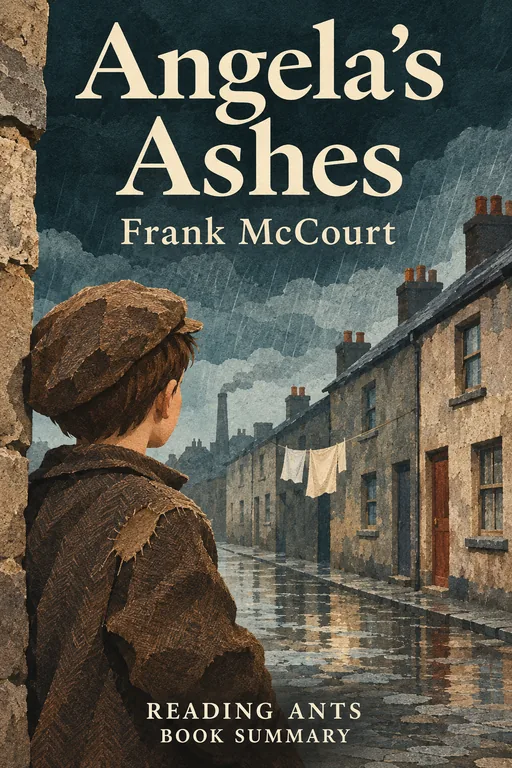
Angela's Ashes
Frank McCourt looks back at his childhood in the slums of Limerick, Ireland, where hunger, rain and a father's drinking could not quite silence the humor, stories and stubborn hope of a boy who dreamed of America.
Overview
Angela’s Ashes is a memoir by Frank McCourt, published in 1996, when he was in his sixties and had worked for many years as a teacher in New York City. It won the Pulitzer Prize and became an international bestseller. McCourt was born in Brooklyn in 1930 to Irish parents, and grew up mostly in Limerick during the Depression and the Second World War. He tells the story in the present tense, through the eyes of the child he was, in a voice that is funny, bitter and tender. The title refers to his mother, Angela, who holds the family together.
Full Summary
Brooklyn and the Journey Home
The book begins with the McCourt family in Brooklyn, where Frank’s parents, Malachy and Angela, have met after emigrating from Ireland. Malachy cannot keep a job because of his drinking, and when the family’s baby daughter dies, Angela falls into grief. With little hope in New York during the Depression, the family sails back to Ireland when Frank is about four. The family first stops in Northern Ireland, at the home of Malachy’s parents, who have no work to offer, and then settles in Angela’s hometown of Limerick, a gray, rainy city. Angela’s relatives disapprove of Malachy, but they help the family in their own grudging ways.
Hunger and Loss
In Limerick, the family lives in a succession of cramped, damp homes, including one next to the only lavatory on the street, where the ground floor floods for half the year and the family retreats upstairs to a room they jokingly call Italy. Malachy sometimes finds work, but spends his wages on drink, so that his children go to bed hungry. The family has to rely on the dole and on charity from the Saint Vincent de Paul Society, a humiliating process. Frank’s younger twin brothers, Oliver and Eugene, die a few months apart, and the family is struck again by grief. Angela sinks into depression, and Frank, still a small boy, learns early what death means.
School, Church and Stories
Frank is a clever boy, and he loves words. He goes to school, where he and his brother are teased as Yanks for their American accents, and where the Catholic Church shapes everything. He prepares for confession and First Communion, and he worries a great deal about hell. At home, he loves the stories that his father tells in the evenings, of heroes of Irish legend. Malachy is warm and loving when he is sober, and Frank holds on to those moments, though he also sees his father come home drunk. The boy also learns shame, as his poverty, and later a stubborn eye infection, set him apart.
Illness and a New Reader
When Frank is about ten, he is seriously ill with typhoid fever, and spends months in a hospital. There, a girl on the ward, Patricia Madigan, shares poetry with him, and he discovers books and the pleasure of having time to read them. The ward is a strange place of warmth, care, clean sheets and decent food. The experience gives him a first taste of a life in which words matter, and a sense that he might be meant for more than the life he has been given. The following year, he suffers from a chronic eye infection that needs treatment.
Fathers, Mothers and Shifting Homes
During the war, Malachy goes to England to work in a factory, and for a time, the family hopes that he will send money. After a first payment, the money stops, and he effectively disappears from their lives, so that Frank, still a boy, becomes the man of the house. Angela is forced to beg and to depend on relatives, and eventually on her cousin Laman Griffin, who lets the family live in his house in return for a sexual relationship with Angela, a situation that Frank finds shameful and hard to bear. Frank is ashamed, but he also sees how much his mother does to feed her boys. In this period, he finishes school and takes jobs to help.
Letters, Telegrams and a Plan
As a young teenager, Frank gets a job delivering telegrams, which brings him into many unexpected situations in his neighbors’ lives, including his first love. He also writes threatening letters, for a woman named Mrs. Finucane, to people who owe her money, and he tells no one about it. When she dies, he takes some of her money and throws her ledger of debts into the river. The money gives him the means to fulfill his plan of getting to America, which he has imagined since childhood. Until then, he hands most of his wages to his mother.
America at Last
By then, his brother Malachy has left home to join the British military, and Frank has worked for years at the post office and at a newspaper distributor to help his mother. At about nineteen, Frank sails to America. The book ends with a short, open scene on his arrival in a new country, where he agrees with a member of the ship’s crew that it is a great country, and where the story of the later parts of his life will be told. The author leaves the rest to a following book.
Why It Matters
Angela’s Ashes is one of the best-known memoirs of the late twentieth century. It gave readers a vivid and unsentimental picture of Irish poverty in the 1930s and 1940s, and brought the voice of a poor Irish child to a global audience. The book’s mix of comedy and tragedy is part of its power, as is its refusal to blame in a simple way. It is often seen as a landmark of the popular memoirs about difficult childhoods that followed. In Ireland it caused debate, since some felt that it dwelt on misery, while others thought that it told a truth that had been hidden. A film followed in 1999, and the sequel, ’Tis, continues the story in America.
Key Takeaways
- Poverty shapes a childhood. Hunger, damp and shame marked the author’s early years.
- Humor helps people to survive. McCourt finds comedy even in misery.
- Stories save. Books and his father’s tales gave him imagination and hope.
- Mothers carry families. Angela’s endurance holds the household together.
- Dreams are a form of strength. The plan to reach America pulls Frank forward.
What We Can Learn
The book invites us to look at the people around us with more understanding, since a child in ragged clothes may be carrying more than we see. It also shows how much a kind teacher, a nurse or a neighbor can matter in a young person’s life, and how reading can open a way out. If you are going through hard times, it reminds you that humor and curiosity can be forms of courage. And it encourages us to write down our own stories, since they can help others to feel less alone.
Criticism and Counterpoints
Some people in Limerick felt that McCourt’s account was exaggerated and unfair to the city, and other Limerick natives remembered a different childhood. His own mother is reported to have denied the accuracy of his stories. Critics also asked whether a memoir written decades later, with long, detailed conversations, could be literally accurate. Others noted that the book is bleak, with a very heavy focus on misery. Supporters say that a memoir is a work of memory and art, and that the main picture of poverty in the period is true. The author himself described it as a memoir, not an exact history.
Who Should Read It
This book is for readers who like memoirs, Irish writing and stories of overcoming hardship. It is funny and moving, but contains scenes of illness, death and neglect, as well as some mild adult content, so it is best for older teenagers and adults. Those who prefer an uplifting tone throughout may find it heavy.
Want the whole book?
A summary is a taste, not the meal. Here is where to find the full book.
You reached the end 🎉
Nicely done. Mark this one as read, and we will suggest what to read next.
Read this next

Educated
Tara Westover
A girl raised by survivalist parents in the mountains of Idaho, with no school, no birth certificate and no doctors, teaches herself enough to reach university and eventually earns a PhD from Cambridge, at the painful cost of her family.
👤 Real Lives
The Glass Castle
Jeannette Walls
Jeannette Walls recounts a childhood with brilliant but irresponsible parents who moved constantly, left their children hungry and unsafe, and still gave them a sense of wonder, and how she and her siblings made their own way out.
👤 Real LivesA Tree Grows in Brooklyn
Betty Smith
A poor, bookish girl named Francie Nolan grows up in the tenements of Williamsburg, Brooklyn, in the early twentieth century, and learns to find hope and strength in a family that has little but love and determination.
📜 Classics
Man's Search for Meaning
Viktor E. Frankl
A psychiatrist who survived the Nazi concentration camps explains that even in the worst suffering, people can choose their attitude, and that finding a reason to live is what gives us the strength to endure.
👤 Real Lives
The Diary of a Young Girl
Anne Frank
A Jewish teenage girl hiding from the Nazis in a secret apartment in Amsterdam records two years of fear, family quarrels, first love and big dreams in a diary that became one of the most famous books in the world.
👤 Real Lives
Long Walk to Freedom
Nelson Mandela
Nelson Mandela tells his own story, from a village childhood to twenty-seven years in prison to becoming South Africa's first democratically elected president, and shows how patience, courage and forgiveness helped end apartheid.
👤 Real LivesWant something different?
Pick another topic and we will show you three books to start with.