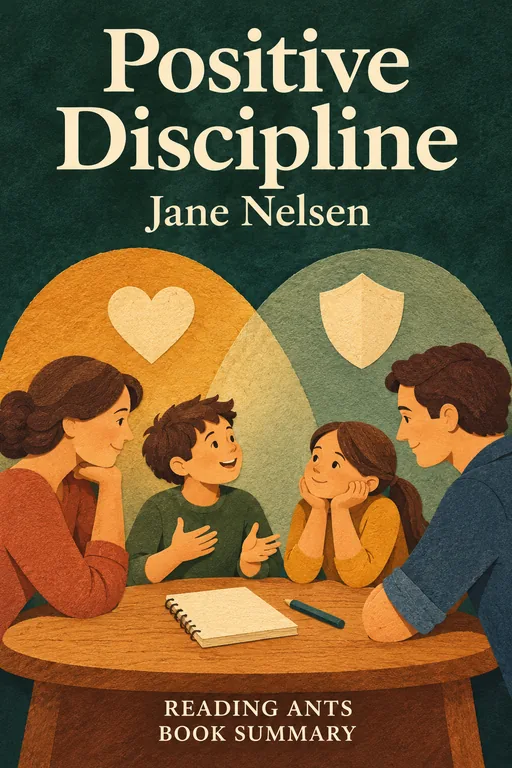
Jane Nelsen argues that children behave better when they are treated with both kindness and firmness, and she offers practical tools, such as family meetings and logical consequences, to teach them responsibility without punishment or pampering.
Overview
Positive Discipline was first published in 1981, when Jane Nelsen, an educator and mother of several children, printed the book herself. A major publisher took it up in 1987, and it has been revised several times since and has inspired a whole series of books and programs for parents and teachers. The approach comes from the work of the psychiatrists Alfred Adler and Rudolf Dreikurs, who believed that all people need to feel that they belong and matter. Nelsen says that misbehavior is usually a sign that a child is discouraged, and that adults should respond with respect, encouragement and cooperation, instead of with fear or bribes.
Full Summary
1. Kind and firm at the same time
The idea: Nelsen says that many parents swing between two extremes: being too strict and controlling, or too permissive and soft. She argues that the best approach combines kindness, which respects the child’s feelings, and firmness, which respects the needs of the situation and the rules. Being kind and firm together teaches children that they are valued and also that limits are real.
In real life: A parent who says, “I know you want to keep playing, and it is time to go,” and then calmly leaves with the child, is being kind and firm.
2. Belonging and significance
The idea: According to Nelsen, the basic need of every child is to feel connected and important. When children do not feel this, they may develop a mistaken belief about how to get it, which leads to misbehavior. She describes four mistaken goals: seeking attention, seeking power, getting revenge, and showing inadequacy, or giving up. Understanding the goal behind the behavior helps adults to respond to the need and not only to the action.
In real life: A child who interrupts all the time may be asking for connection, and a few minutes of focused attention may help more than scolding.
3. Connection before correction
The idea: Nelsen stresses that children are more willing to listen when they feel understood. Adults should first connect with the child, by acknowledging feelings and showing empathy, before trying to correct behavior. She explains that punishment may stop a behavior for a time but can also create resentment and fear. She prefers solutions in which the child can learn and contribute.
In real life: Saying “You sound really angry” before asking a child to apologize often leads to a calmer talk.
4. Natural and logical consequences
The idea: The book distinguishes between punishment and logical consequences. A consequence should be related to the behavior, respectful and reasonable, and, where possible, revealed in advance, so that the child understands it. Nelsen advises involving children in finding solutions, and asking questions to help them think, such as what happened and what they can do next time. This helps them to learn responsibility and problem solving.
In real life: If a child leaves a bicycle in the rain, a consequence might be to dry and oil it, not to be shouted at.
5. Family meetings and shared problem solving
The idea: Nelsen recommends regular family meetings, where everyone has a chance to speak, to give compliments and to help to solve problems. In these meetings, family members take turns leading, take notes and decide on solutions together. She says that this teaches communication, cooperation and respect, and gives children a real role in the household.
In real life: A weekly meeting where the family plans chores and meals gives even young children a voice in the way the home runs.
6. Encouragement and positive time-out
The idea: Instead of excessive praise, which can make children dependent on approval, Nelsen advises encouragement, which focuses on effort and improvement. She also reshapes the idea of time-out: rather than a punishment, it can be a “positive time-out,” a quiet place where a child can calm down and feel better, and then return to solve the problem. The adult can also take a time-out to cool off.
In real life: A cozy corner with books and soft toys can be a place to relax, not a place of shame.
Why It Matters
Positive Discipline has sold more than a million copies and has been translated into several languages. Its ideas have spread through classes and training programs for parents and teachers, and some schools have adopted its methods. The book was an early voice in favor of a gentler, more respectful approach to children, and its emphasis on cooperation and understanding has become part of mainstream parenting advice. It offers practical tools and examples, and appeals to people who want to avoid both harsh and permissive styles. Many parents say that it has helped them to build calmer homes and better relationships.
Key Takeaways
- Be kind and firm together. Respect the child and the limits.
- Misbehavior has a purpose. Look for the need behind it.
- Connect first. Children listen when they feel understood.
- Use related consequences. Avoid humiliating punishments.
- Include children. Family meetings build responsibility, cooperation and mutual respect at home.
What We Can Learn
If you are a parent, teacher or older sibling, try pausing before you respond to a difficult behavior and ask what the child might be feeling or needing. Practice speaking calmly and clearly about limits. Involve children in solving problems and give them real responsibilities. If you are a young person, you can use some of the ideas on yourself and in your friendships: listen first, and look for solutions together. Remember that the book is a general guide, and that every child and every family is different.
Criticism and Counterpoints
Some parents and experts say that the approach takes a great deal of time and patience, and that it can be hard to apply when tired, or in situations that need quick action. Others argue that it avoids punishments and rewards that some families find effective, or that its theory of the mistaken goals is not strongly supported by research. A few note that the language and examples reflect the culture and the time in which it was written, and that cultural differences in parenting should be respected. Supporters point to research that supports respectful, authoritative parenting in general.
Who Should Read It
This book is for parents, grandparents, teachers and caregivers who want a practical, respectful approach to guiding children. It is easy to read and full of examples. Those who need help with serious behavioral or mental health issues should consult a professional.
Want the whole book?
A summary is a taste, not the meal. Here is where to find the full book.
You reached the end 🎉
Nicely done. Mark this one as read, and we will suggest what to read next.
Read this next
How to Raise an Adult
Julie Lythcott-Haims
A former dean at Stanford University argues that modern parents who do too much for their children, from homework to college applications, are leaving them anxious and unprepared, and she urges them to step back and let young people learn to stand on their own.
🎓 Parenting & Education
How Children Succeed
Paul Tough
Journalist Paul Tough argues that qualities like perseverance, curiosity and self-control matter more for children's success than test scores alone, and that these qualities can be nurtured, especially for children who face hardship.
🎓 Parenting & Education
The Book You Wish Your Parents Had Read
Philippa Perry
Psychotherapist Philippa Perry argues that good parenting is less about technique than about the relationship, and that we help our children most when we understand our own past, name feelings and repair the rifts that are bound to happen.
🎓 Parenting & Education
Battle Hymn of the Tiger Mother
Amy Chua
Yale law professor Amy Chua tells, with humor and self-doubt, how she raised her two daughters with strict rules and high expectations in the style she calls Chinese, and what happened when her younger daughter pushed back.
🎓 Parenting & Education
The Absorbent Mind
Maria Montessori
Maria Montessori, a doctor and educator, explains that young children take in the world around them effortlessly, like a sponge, and that adults should prepare an environment in which they can learn freely through activity and concentration.
🎓 Parenting & Education
How to Talk So Kids Will Listen and Listen So Kids Will Talk
Adele Faber and Elaine Mazlish
Parents can get better cooperation and closer relationships by acknowledging children's feelings, describing problems instead of blaming, and using simple, respectful communication skills.
🎓 Parenting & EducationWant something different?
Pick another topic and we will show you three books to start with.