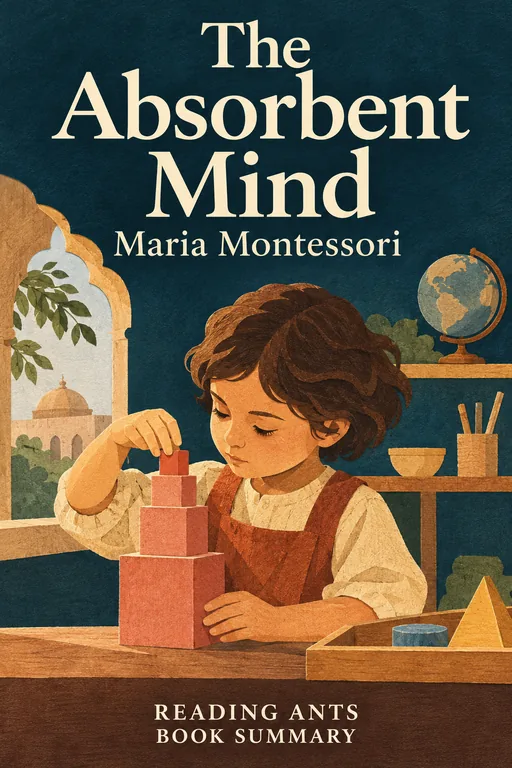
The Absorbent Mind
Original title: La mente del bambino
Maria Montessori, a doctor and educator, explains that young children take in the world around them effortlessly, like a sponge, and that adults should prepare an environment in which they can learn freely through activity and concentration.
Overview
The Absorbent Mind presents the ideas of Maria Montessori, an Italian physician who developed a method of education that is now used in thousands of schools around the world. The book grew out of lectures that she gave at a training course in Ahmedabad, India, during the Second World War, when she was living in India. It was first published in 1949, and its publication history across languages and editions is complicated. Montessori argues that the first six years of life are a special period, when the child builds his or her personality and abilities by living in the world. The book is written for parents and teachers, and mixes observation, theory and practical advice.
Full Summary
1. The child as a builder of himself
The idea: Montessori says that adults often think of a baby as a helpless creature that must be filled with knowledge. She argues the opposite: the child comes with a powerful inner drive to develop, and builds himself or herself through experience. Without being taught, babies learn to speak, to walk and to understand their culture. This achievement, she says, shows that the child has a special kind of mind.
In real life: A toddler learns a whole language simply by living among people who speak it.
2. The absorbent mind
The idea: Montessori uses the term “absorbent mind” for the young child’s way of learning, which is unconscious and effortless in the first three years, and more conscious in the following three. The child absorbs sounds, images, customs and feelings from the surroundings, and what is absorbed becomes part of the person. Because of this, the quality of the environment, and of the people in it, has a huge influence on development.
In real life: A child raised in a home where two languages are spoken may pick up both without lessons.
3. Sensitive periods
The idea: She describes sensitive periods, which are times when a child is especially drawn to and able to learn a particular skill, such as language or order. If the child can follow the interest, learning is joyful and quick. If the period passes without the chance, it becomes harder later. Observing which period a child is in helps adults to offer the right activities at the right time.
In real life: A small child who keeps stacking and sorting may be in a period of ordering, and benefits from objects to arrange.
4. The prepared environment
The idea: Montessori says that adults should create an environment suited to the child: tools and furniture that are the right size, objects built in proportion to the child, materials the child can reach and use, and an orderly, attractive setting. In such a place, children can choose tasks and work independently. She designed specific materials for developing the senses and for learning to count and read, which are self-correcting so that the child can see and fix mistakes. The teacher’s role is to observe and guide, not to lecture.
In real life: A child-sized sink and a stool let a child wash their own hands, which builds confidence.
5. Freedom, concentration and discipline
The idea: The method gives children freedom to choose their activities within limits, and the opportunity to repeat them. Montessori observed that when children are able to focus on a task that interests them, they become calm and absorbed, a state she called normalization, which in her view includes concentration, purposeful work, self-discipline and social harmony together. Discipline then comes from within, as a result of satisfaction, not from outside through rewards and punishments. She was convinced that children want to work, and that they are happiest when they are active.
In real life: A child who is absorbed in pouring water from jug to jug may be learning concentration and control.
6. Education for peace and society
The idea: In the final chapters, Montessori links education to the larger world. She believes that if children are respected, and if their natural development is supported, they will grow into adults who are independent, cooperative and peaceful. Having lived through two wars, she hoped that a new education could help to build a more peaceful world. She also stresses the responsibility of society to care for children in their earliest years.
In real life: A school where children help each other and look after their classroom is a small model of a community.
Why It Matters
The Absorbent Mind is one of the key texts of the Montessori movement, and has influenced early childhood education around the world. Ideas such as child-sized furniture, hands-on learning materials and the teacher as a guide have become familiar in many classrooms, including those that are not formally Montessori. The book also helped to change the idea of the young child from a passive recipient to an active learner. It appeared at a time when the study of child development was growing. Its emphasis on respecting the child’s pace and interests continues to inspire parents and teachers.
Key Takeaways
- Young children learn by absorbing. Their surroundings shape them deeply.
- Follow the child. Observe interests and sensitive periods.
- Prepare the environment. Order, beauty and accessibility support independence.
- Concentration matters. In Montessori’s theory, it is a sign of healthy development, so let children work on tasks that engage them.
- Respect creates peace. Education should support independence and cooperation.
What We Can Learn
If you spend time with young children, you can try to arrange the space so that they can reach things and do things for themselves, such as putting on shoes or pouring a drink. Observe what draws their attention, and give time to repeat it. Resist the urge to hurry or to do things for them. Notice the example that you set, since children absorb how you speak and behave. These ideas also apply to your own learning: you learn best when you are interested, and when you have time to concentrate.
Criticism and Counterpoints
Some educators and researchers say that Montessori’s claims about the absorbent mind and sensitive periods are not fully supported by modern research, and that development is more variable than she suggests. Others point out that her method can be rigid when applied strictly, and that it gives less emphasis to imaginative play and group learning than some experts would like. Because the name is not protected in many countries, the quality of schools using it varies. Her view of children also reflects the time in which she wrote. Still, many studies show benefits of aspects of the approach.
Who Should Read It
This book is for parents, teachers and anyone interested in early childhood. It is clearly written, though the style reflects the 1940s and is somewhat philosophical. Readers who want a short, practical guide to Montessori at home may prefer a modern handbook, and may then read this to understand the roots.
Want the whole book?
A summary is a taste, not the meal. Here is where to find the full book.
You reached the end 🎉
Nicely done. Mark this one as read, and we will suggest what to read next.
Read this next
Positive Discipline
Jane Nelsen
Jane Nelsen argues that children behave better when they are treated with both kindness and firmness, and she offers practical tools, such as family meetings and logical consequences, to teach them responsibility without punishment or pampering.
🎓 Parenting & Education
How Children Succeed
Paul Tough
Journalist Paul Tough argues that qualities like perseverance, curiosity and self-control matter more for children's success than test scores alone, and that these qualities can be nurtured, especially for children who face hardship.
🎓 Parenting & Education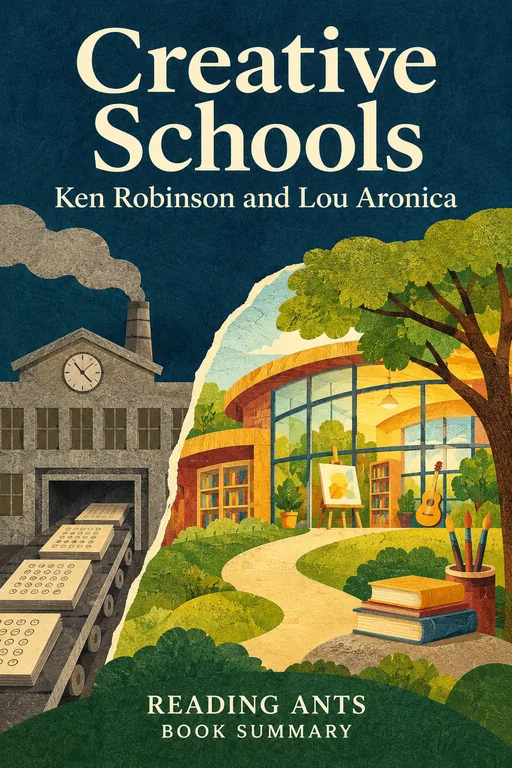
Creative Schools
Ken Robinson and Lou Aronica
Sir Ken Robinson and Lou Aronica argue that schools are held back by a factory-style model of standardized testing, and call for an approach built on personalization, creativity and the real interests of students and teachers.
🎓 Parenting & Education
The Read-Aloud Handbook
Jim Trelease
Jim Trelease argues that reading aloud to children, every day and from the earliest age, is the best way to build their vocabulary, imagination and love of books, and he shows parents and teachers how to do it.
🎓 Parenting & Education
Why Don't Students Like School?
Daniel T. Willingham
Cognitive scientist Daniel Willingham uses research on how the mind works to explain why thinking is hard, why knowledge matters and how teachers and students can make learning more effective and enjoyable.
🎓 Parenting & Education
How to Talk So Kids Will Listen and Listen So Kids Will Talk
Adele Faber and Elaine Mazlish
Parents can get better cooperation and closer relationships by acknowledging children's feelings, describing problems instead of blaming, and using simple, respectful communication skills.
🎓 Parenting & EducationWant something different?
Pick another topic and we will show you three books to start with.