 Reading Ants
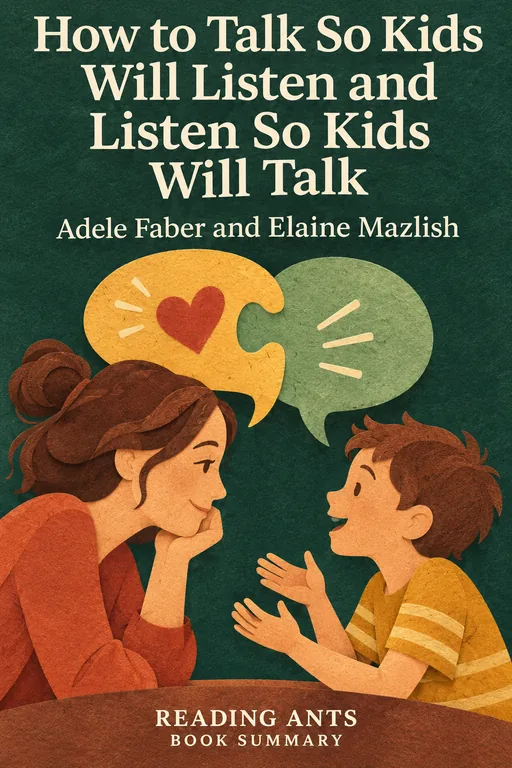
How to Talk So Kids Will Listen and Listen So Kids Will Talk
Parents can get better cooperation and closer relationships by acknowledging children's feelings, describing problems instead of blaming, and using simple, respectful communication skills.
Overview
How to Talk So Kids Will Listen and Listen So Kids Will Talk was written by Adele Faber and Elaine Mazlish and first published in 1980. Both authors were parents who studied with the child psychologist Haim Ginott, who believed that how adults talk to children shapes how children see themselves. The book grew out of workshops they led for parents, and it teaches practical skills with sample conversations and cartoons. Each chapter explains a skill, gives examples of what not to say and what to say instead, and includes exercises. It has sold millions of copies and has been updated several times.
Full Summary
1. Helping children deal with their feelings
The idea: The first skill is to acknowledge feelings. Children who are told that their feelings are wrong, silly or exaggerated tend to feel misunderstood and may stop sharing. The authors recommend listening fully, naming the feeling (“That sounds frustrating”) and accepting it without arguing, advising or denying. They show how denial (“You’re not really hungry”) can lead to more conflict, while acceptance often calms a child, who can then think more clearly about solutions.
In real life: A child who says “I hate school” may need to hear “It sounds like today was really hard” before talking about what happened.
2. Engaging cooperation
The idea: Instead of nagging, scolding or threatening, the authors recommend ways to invite cooperation. These include describing the problem (for example, mentioning that a wet towel is on the bed), giving information (such as that milk spoils when left out), offering a choice, saying it in one word (“Towel!”), describing your own feelings (“I don’t like it when...”) and writing a note. Such methods treat children as capable people and avoid blame and insults.
In real life: Saying “The dog is hungry” can work better than “You never feed the dog.”
3. Alternatives to punishment
The idea: The authors argue that punishment often leads children to feel resentful and to focus on revenge or on avoiding being caught. They suggest other approaches: express strong disapproval of the behavior without attacking the child’s character; state your expectations; show the child how to make amends; offer choices; take action, such as ending the activity; and allow the child to experience the consequences of their actions. They also encourage problem-solving together, where parent and child talk through the situation, list ideas and choose a plan.
In real life: If a child breaks a window, working together to decide how to repair it is more useful than only a lecture.
4. Encouraging autonomy
The idea: Children need chances to make decisions and solve their own problems. The authors advise letting children struggle a little, showing respect for their efforts, avoiding too many questions, and not rushing to answer every question. They also suggest not taking away hope by predicting failure. Gradually, children learn to rely on their own judgment and to take responsibility for their choices and their mistakes.
In real life: Letting a child choose between two outfits or help plan a family dinner builds confidence.
5. Praise and self-esteem
The idea: Instead of evaluating (“You’re so smart”), the authors suggest describing what you see and feel (noting that the whole floor is now clean and that you appreciate it). This kind of praise lets children draw their own positive conclusions about themselves. They caution that vague, exaggerated praise can make children anxious or doubtful, while specific descriptions help them know what they did well.
In real life: Telling a child “You kept trying until you got the puzzle done” values effort and builds persistence.
6. Freeing children from roles
The idea: Families often assign roles, such as “the lazy one,” “the troublemaker” or “the smart one,” which can trap children in a fixed picture. The authors urge parents to avoid labels, to show children evidence of other sides of themselves, and to let them overhear positive comments. They also suggest that parents should be careful with comparisons between siblings. By seeing children as changing individuals, parents help them grow beyond their roles.
In real life: Instead of calling a child shy, a parent can say “I noticed you said hello to your neighbor today.”
Why It Matters
This book became a classic of parenting advice. Its tone is practical, respectful and concrete, and the cartoons make the ideas easy to remember. It is widely used in parenting classes, schools and counseling, and the authors have written follow-up books on siblings, teenagers and school.
Its influence is seen in the common advice to “validate feelings” and to speak to children with respect. Many parents say that using these skills led to calmer homes and warmer relationships, and that they helped in other settings, such as the workplace.
Key Takeaways
- Acknowledge feelings. Naming emotions helps children calm down.
- Describe, don’t blame. State the problem or your feelings.
- Try alternatives to punishment. Solve problems together.
- Support independence. Let children try and decide.
- Praise by describing. Specific comments about what you see build real confidence.
- Avoid labels. Seeing children as changing people helps them grow.
What We Can Learn
The book reminds us that the words we use matter. A small change, such as saying “I see a mess” instead of “You’re so messy,” can lower tension and keep the focus on solving the problem.
It also shows the power of listening. When children feel heard, they are more willing to listen in return, and this applies to adults too, in friendships and at work.
Finally, it encourages patience and practice. The authors admit that new habits feel awkward at first and that parents will make mistakes, and offer the reassurance that it is never too late to improve.
Criticism and Counterpoints
Some parents and critics find that the scripted phrases can feel artificial, and that children may see through them or respond in unexpected ways. The advice may also seem unrealistic when parents are tired or when safety issues require immediate commands. Others point out that the book is based on the authors’ experience and workshops and not on controlled research, and that it reflects mostly middle-class, Western family situations.
Some readers also say the book offers too few strategies for serious behavior problems or for children with special needs. Supporters respond that the skills are a foundation, and that a parent can adapt them. Parents with serious concerns should seek professional help.
Who Should Read It
This book suits parents, grandparents, teachers and caregivers, and teenagers who want to understand communication. It is easy to read and can be used chapter by chapter. It is not a replacement for professional help with serious difficulties.
Want the whole book?
A summary is a taste, not the meal. Here is where to find the full book.
You reached the end 🎉
Nicely done. Mark this one as read, and we will suggest what to read next.
Read this next
The Whole-Brain Child
Daniel J. Siegel and Tina Payne Bryson
Understanding how a child's brain develops helps parents respond to tantrums, fears and conflicts in ways that connect, calm and teach, so that different parts of the brain work together.
🎓 Parenting & Education
How to Win Friends and Influence People
Dale Carnegie
People are driven by emotion and the desire to feel important, so the way to get along with them, and win them to your point of view, is to stop criticizing, show genuine interest and appreciation, and see things from their side.
🌱 Self-Improvement
Nonviolent Communication
Marshall B. Rosenberg
Psychologist Marshall Rosenberg teaches a method of speaking and listening, built on observations, feelings, needs and requests, that aims to replace blame, criticism and demands with honesty and empathy, so that conflicts can be resolved with compassion.
🌱 Self-Improvement
Positive Discipline
Jane Nelsen
Jane Nelsen argues that children behave better when they are treated with both kindness and firmness, and she offers practical tools, such as family meetings and logical consequences, to teach them responsibility without punishment or pampering.
🎓 Parenting & Education
Battle Hymn of the Tiger Mother
Amy Chua
Yale law professor Amy Chua tells, with humor and self-doubt, how she raised her two daughters with strict rules and high expectations in the style she calls Chinese, and what happened when her younger daughter pushed back.
🎓 Parenting & Education
The Book You Wish Your Parents Had Read
Philippa Perry
Psychotherapist Philippa Perry argues that good parenting is less about technique than about the relationship, and that we help our children most when we understand our own past, name feelings and repair the rifts that are bound to happen.
🎓 Parenting & EducationWant something different?
Pick another topic and we will show you three books to start with.