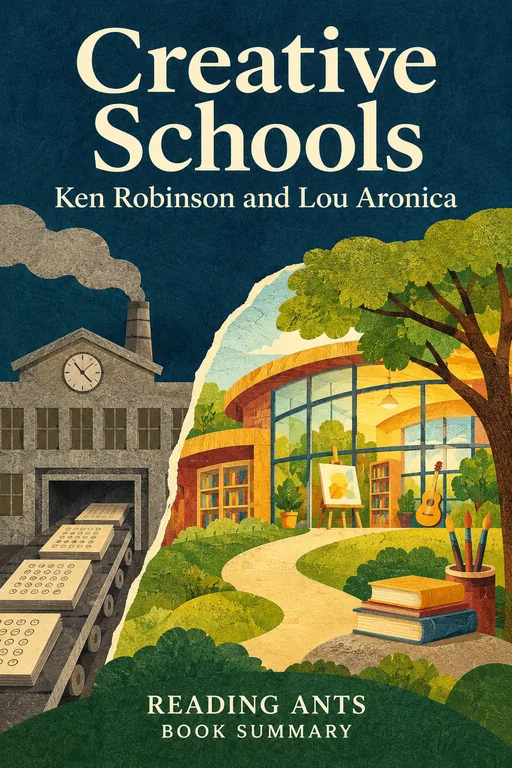
Sir Ken Robinson and Lou Aronica argue that schools are held back by a factory-style model of standardized testing, and call for an approach built on personalization, creativity and the real interests of students and teachers.
Overview
Creative Schools: The Grassroots Revolution That’s Transforming Education was published in 2015 by Ken Robinson, an English educator, and Lou Aronica, a writer. Robinson became famous for a TED talk, one of the most viewed ever, about whether schools kill creativity. This book expands his argument. The authors say that the problems in education are not just the fault of teachers or students, but come from an outdated system that focuses on standardization and testing. They describe examples of schools and programs that do things differently, and offer a vision of a more human approach.
Full Summary
1. The problem with the factory model
The idea: Robinson and Aronica argue that modern school systems arose during the Industrial Revolution, to produce workers for a factory age. This is their reading of history, not the whole story. Students are grouped by age, taught in standard subjects at set times and ranked by tests. They argue that this model treats children like products on an assembly line, and does not fit the needs of the twenty-first century, when creativity and adaptability matter more than the ability to follow instructions.
In real life: A school bell that rings every forty minutes, whether or not a child is in the middle of a thought, is a sign of this model.
2. Four purposes of education
The idea: The authors say that education should serve four purposes: personal, cultural, social and economic. It should help each person to discover and develop his or her talents; it should help young people to understand and value their own culture and others; it should prepare them for active citizenship; and it should equip them to earn a living. They argue that current systems focus too much on the economic side, and narrow it to test results. They also list eight competencies that schools should develop: curiosity, creativity, criticism, communication, collaboration, compassion, composure and citizenship. Instead of a factory, they prefer the image of organic farming or gardening, in which the task is to create the conditions in which things grow in their own way.
In real life: A student who learns to cook, play music and debate is gaining more than a job skill.
3. The trouble with standardized testing
The idea: A large part of the book is a critique of high-stakes testing. The authors say that it forces teachers to teach to the test, narrows the curriculum, and puts pressure on students and schools. They argue that tests measure a limited range of abilities, and that they can lower the interest in learning. They do not say that assessment is unnecessary, but that it should be more varied and should support learning instead of replacing it.
In real life: A student who is good at building models or telling stories might not shine in a multiple-choice exam.
4. Curriculum, teaching and assessment
The idea: According to the authors, a good education depends on three things: a curriculum that is broad and balanced, including the arts, physical education and the humanities as well as math and science; teaching that is a creative profession, not just the delivery of a script; and assessment that provides useful feedback. They stress that teachers need trust and freedom, and that students learn best when they are engaged and curious.
In real life: A teacher who lets students investigate a local river, using science, history and writing, is combining subjects.
5. Personalizing learning
The idea: Robinson and Aronica argue that students differ in their talents, interests and pace, and that education should adapt to them. This does not mean separate lessons for everyone, but that teachers should know their students and offer a range of ways of learning, including projects and choices. They give examples of schools where students work on tasks that matter to them, and where the school is a community of learners, including an English primary school, Grange Primary, where pupils took jobs in a mock town to build teamwork and responsibility.
In real life: A school that allows a young musician to spend more time on music, while still learning math, treats her as an individual.
6. A grassroots revolution
The idea: The authors do not expect change to come only from governments. They tell stories of teachers, principals and communities who are changing their own schools, and who show that it is possible to improve education in a variety of settings. They also point to countries that have done well with less testing and more trust in teachers, such as Finland. They encourage parents and teachers to act in their own communities, and to push for policy changes.
In real life: A parent group that organizes an arts night is making a small change in school culture.
Why It Matters
Creative Schools is part of a wider conversation about the purpose of education, and the book was widely read by teachers, parents and policymakers. Robinson’s gentle humor and storytelling made the arguments accessible. The book influenced the debate on testing and the value of the arts, and it encouraged many teachers to try new approaches. Robinson, who died in 2020, left a legacy through his talks and writing. The ideas in the book continue to stimulate discussion about how schools should prepare young people for a changing world, and about how much trust and freedom teachers and students should be given.
Key Takeaways
- Education is more than testing. Learning serves personal, cultural, social and economic aims.
- Creativity is essential. Schools should nurture imagination and problem solving.
- Teachers need trust. Good teaching is a creative profession.
- Students differ. Personalizing learning respects talents and interests.
- Change can start locally. Teachers, parents and communities can lead reform.
What We Can Learn
If you are a student, think about what you are most curious about and look for ways to explore it, inside and outside school. If you are a parent or teacher, ask whether the way you measure success leaves room for creativity and effort. Support arts, sports and the humanities in your school. Remember that grades are only one measure of learning. And see that you can help to change your own learning environment, by starting a club, asking questions or sharing ideas with teachers.
Criticism and Counterpoints
Some critics say that the book relies on anecdotes and attractive examples more than on rigorous evidence, and that its criticism of testing underestimates the value of accountability and of ensuring that all children, especially disadvantaged ones, learn the basics. Others argue that the emphasis on creativity can be vague, and that research suggests that knowledge and practice are the foundation for creativity. Some teachers feel that they are asked to do too much with too few resources. Supporters respond that the book is a call to rethink priorities, not to abandon standards.
Who Should Read It
This book is for teachers, parents, students and anyone who cares about education. It is engaging and often funny. Readers looking for a detailed research review of teaching methods might want to read more specialized studies, but it is a fine introduction to the creativity debate.
Want the whole book?
A summary is a taste, not the meal. Here is where to find the full book.
You reached the end 🎉
Nicely done. Mark this one as read, and we will suggest what to read next.
Read this next
Why Don't Students Like School?
Daniel T. Willingham
Cognitive scientist Daniel Willingham uses research on how the mind works to explain why thinking is hard, why knowledge matters and how teachers and students can make learning more effective and enjoyable.
🎓 Parenting & Education
How Children Succeed
Paul Tough
Journalist Paul Tough argues that qualities like perseverance, curiosity and self-control matter more for children's success than test scores alone, and that these qualities can be nurtured, especially for children who face hardship.
🎓 Parenting & Education
The Absorbent Mind
Maria Montessori
Maria Montessori, a doctor and educator, explains that young children take in the world around them effortlessly, like a sponge, and that adults should prepare an environment in which they can learn freely through activity and concentration.
🎓 Parenting & Education
How to Raise an Adult
Julie Lythcott-Haims
A former dean at Stanford University argues that modern parents who do too much for their children, from homework to college applications, are leaving them anxious and unprepared, and she urges them to step back and let young people learn to stand on their own.
🎓 Parenting & Education
Pedagogy of the Oppressed
Paulo Freire
Brazilian educator Paulo Freire argues that traditional teaching treats students as empty containers to be filled, and proposes instead a dialogue-based education in which oppressed people learn to read both the word and the world, and to change it.
⚖️ Politics & Society
How to Talk So Kids Will Listen and Listen So Kids Will Talk
Adele Faber and Elaine Mazlish
Parents can get better cooperation and closer relationships by acknowledging children's feelings, describing problems instead of blaming, and using simple, respectful communication skills.
🎓 Parenting & EducationWant something different?
Pick another topic and we will show you three books to start with.