Cognitive scientist Daniel Willingham uses research on how the mind works to explain why thinking is hard, why knowledge matters and how teachers and students can make learning more effective and enjoyable.
Overview
Why Don’t Students Like School? A Cognitive Scientist Answers Questions About How the Mind Works and What It Means for the Classroom was published in 2009 by Daniel T. Willingham, a psychology professor at the University of Virginia. He wrote it for teachers, and for parents and students who want to understand learning. Each chapter takes a question, such as why students remember things that are on television but not what is taught in class, and answers it using findings from cognitive science. The chapters end with practical advice. The book is organized around nine principles about how the mind works, which Willingham states in a clear and friendly way.
Full Summary
1. Thinking is hard, and curiosity needs the right conditions
The idea: Willingham says that people are naturally curious, but that they are not naturally good at thinking, because thinking is slow, effortful and uncertain. The brain prefers to rely on memory when it can. People enjoy thinking when the problem is not too easy and not too hard, and when they can make progress. So teachers should present problems at the right level of difficulty, and should spark interest by explaining the question behind a topic, so that students want to find out.
In real life: A puzzle that you can nearly solve is more fun than one that is obviously easy or impossible.
2. Knowledge comes first
The idea: The author argues that you cannot think critically about something that you know very little about. Facts in long-term memory are what make it possible to understand new ideas, to read with comprehension and to solve problems. Skills like critical thinking depend on background knowledge in each field. He says that schools should therefore make sure that students learn a solid base of facts, and not only skills.
In real life: It is easier to follow a news story about a country if you already know something about its history and geography.
3. Memory is the residue of thought
The idea: Willingham says that we remember what we think about. If a lesson makes students think about the meaning of material, they are more likely to remember it. If they pay attention only to the surface, such as the plot of a video, they may forget what the lesson was about. Teachers can therefore plan lessons so that the key ideas are what students will think about, and use stories and questions to make the material meaningful.
In real life: If you think about why a character acts as she does, you will remember the story better than if you only read the words.
4. Practice and the limits of working memory
The idea: The mind has a limited working memory, which holds what we are thinking about at the moment. Practice makes skills automatic, which frees up working memory for higher-level thought. For example, a child who has to concentrate on sounding out words cannot easily understand the meaning of the text. Willingham explains that extended practice is essential for mastery of any mentally demanding task, which is why drilling is worth doing.
In real life: Once you know your multiplication tables by heart, you can focus on solving the harder parts of a math problem.
5. Experts think differently, and learning styles are overrated
The idea: Willingham says that beginners should not be expected to think like experts too early, and that abstract ideas become clearer through varied, concrete examples and analogies. Willingham also challenges the popular idea that students have fixed “learning styles,” such as visual or auditory learners, who would learn better if taught in that style. He says that research does not support this, and that content determines the best way to teach it, so everyone benefits from seeing, hearing and doing where appropriate.
In real life: Learning to draw a map is better done by looking at maps, whether or not you consider yourself a verbal learner.
6. Intelligence can change, and teaching is a craft
The idea: The last principles are hopeful. Willingham says that intelligence can change with effort and environment, so teachers can help students see that practice pays off. In the final chapter he turns to the teacher’s own mind, and says that teaching is a skill that can be improved through deliberate practice and feedback, such as feedback from colleagues and the review of recordings of one’s own lessons.
In real life: A student who thinks, “I am not a math person,” may do better by trying a different approach and working steadily.
Why It Matters
Why Don’t Students Like School? has influenced discussions about how to teach well. It brings research from cognitive science into the classroom in clear language, and challenges a number of popular beliefs, such as the notion of learning styles and the idea that knowledge is less important than skills. The book supports practices such as extended practice, building background knowledge and using concrete examples. It is respected for its accessibility, and for its emphasis on evidence. It has been widely read by teachers and is often counted among the influential education books of recent years.
Key Takeaways
- Thinking takes effort. Enjoyment comes from manageable challenge.
- Facts matter. Knowledge makes critical thinking possible.
- Attention shapes memory. We remember what we think about.
- Practice builds skill. Repetition frees up mental space.
- Learning styles are a myth. Match the teaching method to the content, not to a label.
What We Can Learn
If you are a student, try to think about what you are learning, rather than merely re-reading. Practice the basics of a skill until they come easily, so that your mind is free for harder parts. Build your knowledge in areas that interest you, since it will help you to understand more. If you are a teacher or parent, offer problems that are neither too easy nor too hard, and give time for practice. Do not be discouraged by difficulty: it is a sign that the brain is working. And be open to changing your methods when evidence suggests that something works better.
Criticism and Counterpoints
Some readers worry that an emphasis on facts could lead to dull classrooms, and that the book gives less space to creativity, motivation and the social side of learning. Applying laboratory research directly to real classrooms is also difficult, and research findings change over time. For example, later studies have found that the effects of encouraging a growth mindset are small, so the hopeful message about intelligence should be read with care. Cognitive science is only one source of guidance for teachers, alongside their own experience and judgment.
Who Should Read It
This book is for teachers, parents, students and anyone interested in how people learn. It is short, clear and well organized. Those who want a deep technical review of the research will need to read the original studies, but this is an excellent starting point.
Want the whole book?
A summary is a taste, not the meal. Here is where to find the full book.
You reached the end 🎉
Nicely done. Mark this one as read, and we will suggest what to read next.
Read this next
How Children Succeed
Paul Tough
Journalist Paul Tough argues that qualities like perseverance, curiosity and self-control matter more for children's success than test scores alone, and that these qualities can be nurtured, especially for children who face hardship.
🎓 Parenting & Education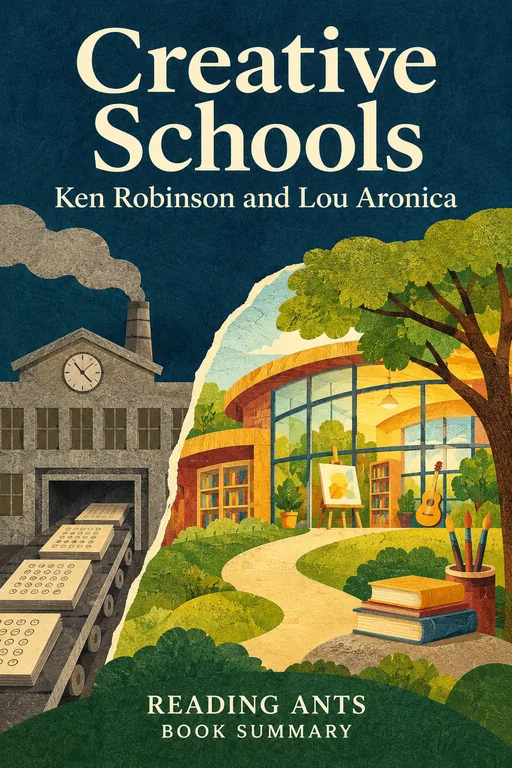
Creative Schools
Ken Robinson and Lou Aronica
Sir Ken Robinson and Lou Aronica argue that schools are held back by a factory-style model of standardized testing, and call for an approach built on personalization, creativity and the real interests of students and teachers.
🎓 Parenting & Education
The Absorbent Mind
Maria Montessori
Maria Montessori, a doctor and educator, explains that young children take in the world around them effortlessly, like a sponge, and that adults should prepare an environment in which they can learn freely through activity and concentration.
🎓 Parenting & Education
Thinking, Fast and Slow
Daniel Kahneman
Our minds run on two systems, a fast, intuitive one and a slow, careful one, and understanding how the fast system fools us can help us make better decisions about money, risk, work and happiness.
🧩 Mind & Psychology
Make It Stick
Peter C. Brown, Henry L. Roediger III and Mark A. McDaniel
A writer and two cognitive scientists explain, with research and stories, that effective learning is often effortful, and that retrieval practice, spacing, interleaving and other "desirable difficulties" help knowledge to stick, while popular habits such as rereading do not.
🌱 Self-Improvement
How to Talk So Kids Will Listen and Listen So Kids Will Talk
Adele Faber and Elaine Mazlish
Parents can get better cooperation and closer relationships by acknowledging children's feelings, describing problems instead of blaming, and using simple, respectful communication skills.
🎓 Parenting & EducationWant something different?
Pick another topic and we will show you three books to start with.