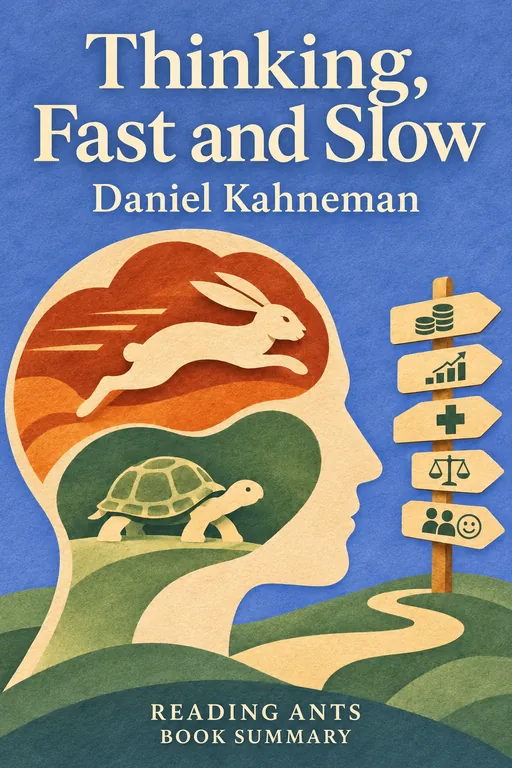
Thinking, Fast and Slow
Our minds run on two systems, a fast, intuitive one and a slow, careful one, and understanding how the fast system fools us can help us make better decisions about money, risk, work and happiness.
Overview
Thinking, Fast and Slow is the life’s work of Daniel Kahneman, a psychologist who won the Nobel Prize in Economics for research showing that people do not make decisions as rationally as economists had assumed. Much of this work was done with his longtime partner, Amos Tversky. The book explains that we have two ways of thinking: System 1, which is fast, automatic and emotional, and System 2, which is slow, effortful and logical. Most of the time System 1 runs our lives, and it is usually helpful, but it also makes predictable mistakes. Through many simple puzzles and experiments, Kahneman shows readers their own biases in action, then explains what they mean for investing, business, medicine, law and personal happiness.
Full Summary
1. Two systems run your mind
The idea: System 1 works automatically and instantly: reading emotions on a face, completing the phrase “bread and...”, driving on an empty road. System 2 is the deliberate thinker we believe ourselves to be: solving a math problem, comparing two phones, filling in a tax form. System 2 is lazy and tires easily, so it often accepts whatever System 1 suggests without checking.
From the book: A famous puzzle, associated with Shane Frederick’s cognitive reflection test, that Kahneman discusses: a bat and a ball cost $1.10 together, and the bat costs $1.00 more than the ball. How much is the ball? Most people instantly answer 10 cents. The right answer is 5 cents. The quick answer comes from System 1, and System 2 doesn’t bother to check.
In real life: When you are tired, hungry or rushed, System 2 is weaker, which is why impulse purchases and angry messages happen late at night.
2. What you see is all there is
The idea: System 1 builds a coherent story from whatever information is available and ignores what is missing. Kahneman calls this WYSIATI: “what you see is all there is.” We feel confident not because we have lots of evidence, but because the story we have built is neat. Less information can even make a story feel more convincing, because there are fewer facts that don’t fit.
In real life: After hearing one side of an argument between two friends, it is easy to feel certain who is right, even though you haven’t heard the other side at all.
3. Mental shortcuts lead us astray
The idea: To answer hard questions quickly, System 1 uses shortcuts called heuristics. The availability heuristic judges how common something is by how easily examples come to mind. Anchoring means an arbitrary number influences our estimates. The representativeness heuristic judges probability by how much something matches a stereotype, while ignoring base rates, the actual frequency of things.
From the book: In the famous “Linda problem,” people read about a bright, socially concerned woman and are asked whether it is more likely that she is a bank teller, or a bank teller who is active in the feminist movement. Most choose the second, even though it is logically impossible for it to be more likely, since it is a smaller group within the first.
In real life: After seeing news of a plane crash, many people feel flying is more dangerous than driving, even though car travel is far riskier. Dramatic stories are easier to recall.
4. We are overconfident
The idea: People, including experts, consistently overestimate how much they know and how well they can predict the future. We see patterns in randomness and explain the past as if it were obvious all along (hindsight bias). The planning fallacy makes us underestimate how long and how much projects will cost. Kahneman recommends taking the “outside view”: looking at how similar projects actually turned out.
From the book: Kahneman tells how he and a team planning a school textbook estimated it would take about two years. When they asked a colleague how long similar projects had taken, the answer was much longer, and many were never finished at all. Their own project took years longer than planned.
In real life: If your last three school projects all took twice as long as you expected, your best guess for the next one is not your optimistic plan, but twice that.
5. Losses hurt more than gains feel good
The idea: Kahneman and Tversky’s prospect theory, the work behind his Nobel Prize, shows that we judge outcomes as gains or losses from a reference point, not by total wealth. Losing something hurts roughly twice as much (the ratio varies with context) as gaining the same thing feels good. This loss aversion makes us cling to what we have (the endowment effect), avoid reasonable risks, and take foolish gambles to avoid a sure loss.
In real life: Many investors refuse to sell a falling stock because selling would make the loss feel real, even when moving the money elsewhere would be smarter.
6. Framing changes decisions
The idea: The same facts presented in different ways lead to different choices. People prefer a medical treatment described as having a 90 percent survival rate over one with a 10 percent death rate, even though they are identical. Our choices depend on wording, not just on reality.
In real life: Shops advertise “save 20 percent” rather than “pay 80 percent,” and food is labeled “90 percent fat-free” rather than “10 percent fat.”
7. Your remembering self tells the story
The idea: We have two selves: the experiencing self, who lives each moment, and the remembering self, who keeps score and makes decisions. The remembering self judges an experience mainly by its most intense moment and by how it ended (the peak-end rule), and largely ignores how long it lasted.
From the book: In studies of patients undergoing a painful medical procedure, those whose procedure ended more gently remembered it as less unpleasant, even when their total pain lasted longer.
In real life: A wonderful vacation can be remembered as disappointing because the last day went badly. Ending a lesson, a meeting or a party on a high note makes a big difference to how people remember it.
Why It Matters
Thinking, Fast and Slow brought decades of research in psychology and behavioral economics to millions of general readers, and it became one of the most influential nonfiction books of its time. Kahneman and Tversky’s work challenged the long-held assumption in economics that people make rational choices, and helped create the field of behavioral economics.
Ideas from the book, such as cognitive biases, anchoring, loss aversion and the planning fallacy, now shape how governments design policies, how companies market products, how doctors present risks, and how investors think about markets. It influenced books such as Nudge (2008), which drew on his earlier research, and Michael Lewis told the story of Kahneman and Tversky’s friendship in The Undoing Project.
Key Takeaways
- Two systems drive thinking. Fast intuition handles most decisions; slow reasoning is lazy and needs to be deliberately engaged.
- Biases are predictable. Shortcuts like anchoring and availability mislead everyone in similar ways.
- Confidence isn’t accuracy. A coherent story can feel true even when evidence is thin.
- Losses loom larger than gains. Fear of losing shapes many choices about money and risk.
- Memory distorts experience. We remember peaks and endings, not durations.
What We Can Learn
You can’t switch off System 1, but you can learn to recognize situations where it is likely to fail and slow down. For big decisions, such as choosing a school, a job or a major purchase, sleep on it, write down the alternatives and ask what information is missing.
Use the outside view for plans: ask how long similar tasks really took before. When negotiating, be aware that the first number mentioned will anchor everyone, so it often pays to make the first offer. When you feel strongly that something is true, ask what evidence would change your mind.
Kahneman also notes that it is far easier to spot biases in other people than in ourselves. This makes teams valuable: colleagues and friends can catch our mistakes if we invite their criticism.
Criticism and Counterpoints
Some studies described in the book, especially in the chapter on priming (how subtle cues can influence behavior), have failed to replicate in later experiments. Kahneman himself publicly acknowledged that he had placed too much trust in some of these studies.
Other researchers, notably psychologist Gerd Gigerenzer, argue that the book underrates intuition: mental shortcuts are often smart and efficient in real-world environments, not just sources of error. Readers also find the book long and dense in places. It reads more like a tour of research than a self-help guide, and it offers few step-by-step techniques for overcoming bias.
Who Should Read It
This book is ideal for anyone interested in psychology, economics, business or why people make strange decisions. Students, managers, investors and doctors will find it especially useful. It is long and sometimes demanding, so readers who want quick, practical tips may prefer Nudge or The Art of Thinking Clearly.
Want the whole book?
A summary is a taste, not the meal. Here is where to find the full book.
You reached the end 🎉
Nicely done. Mark this one as read, and we will suggest what to read next.
Read this next
Nudge
Richard H. Thaler and Cass R. Sunstein
Because people are not perfectly rational, the way choices are presented strongly affects what they choose, and designers of choices can gently steer people toward better decisions without taking away their freedom.
🧩 Mind & Psychology
Predictably Irrational
Dan Ariely
Behavioral economist Dan Ariely uses entertaining experiments to show that people's decisions are shaped by predictable mental quirks, such as relativity, the lure of "free" and social norms, rather than by cool, rational calculation.
🧩 Mind & Psychology
Thinking in Bets
Annie Duke
Former professional poker player Annie Duke argues that life's decisions are bets made with incomplete information, and shows how to judge decisions by their quality and not their results, by thinking in probabilities and by learning with the help of honest groups.
🧩 Mind & Psychology
The Black Swan
Nassim Nicholas Taleb
Rare, unpredictable events with huge impact, which Nassim Taleb calls Black Swans, shape history far more than we admit, and we should build lives and systems that can survive or even benefit from them instead of pretending to predict them.
🧩 Mind & Psychology
Stumbling on Happiness
Daniel Gilbert
Harvard psychologist Daniel Gilbert explains, with wit and research, that we are surprisingly poor at predicting what will make us happy, because the imagination fills in details wrongly, and he suggests that other people's experience is often a better guide than our own forecasts.
🧩 Mind & Psychology
The Happiness Hypothesis
Jonathan Haidt
Psychologist Jonathan Haidt tests ten ancient ideas about happiness and virtue against modern science, and concludes that happiness comes neither only from within nor only from outside, but from between: from getting the relationships between yourself, other people, your work and something larger right.
🧩 Mind & PsychologyWant something different?
Pick another topic and we will show you three books to start with.