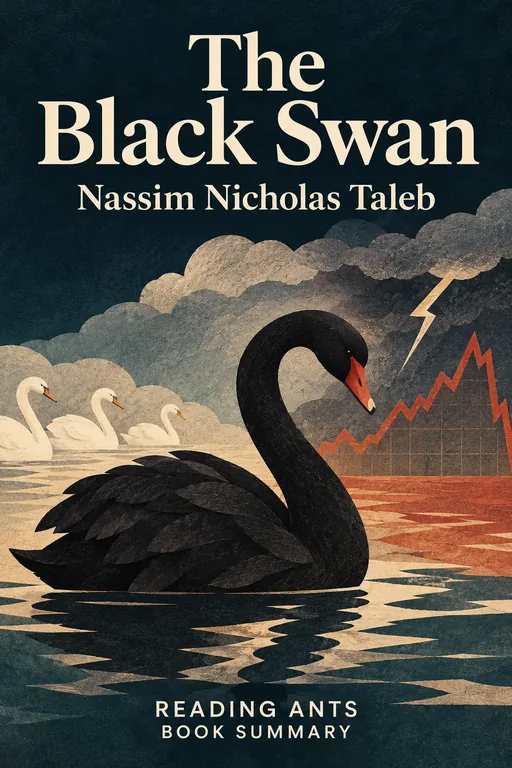
Rare, unpredictable events with huge impact, which Nassim Taleb calls Black Swans, shape history far more than we admit, and we should build lives and systems that can survive or even benefit from them instead of pretending to predict them.
Overview
The Black Swan: The Impact of the Highly Improbable was written by Nassim Nicholas Taleb, a former options trader and risk analyst of Lebanese origin, and published in 2007. A Black Swan, as Taleb defines it, is an event with three features: it is a surprise to the observer, it has a major effect and, after it happens, people invent explanations that make it seem predictable. The name comes from the old belief in Europe that all swans were white, until black swans were seen in Australia. Taleb argues that the world is shaped by such events, such as the rise of the internet or the September 11 attacks, while experts keep relying on models that ignore them. The book was a bestseller, and its argument seemed prophetic after the financial crisis of 2008.
Full Summary
1. What a Black Swan is
The idea: Taleb begins with the definition and with the problem of induction: seeing many white swans does not prove that all swans are white, since one black swan can disprove it. He explains that we tend to learn from what we have seen, but the biggest events are often those we have not seen. He uses the story of a turkey, fed every day for a thousand days, which feels more and more secure until the day before Thanksgiving. The turkey’s confidence, based on past data, was highest just when the danger was greatest.
In real life: A student who has never failed an exam may feel sure of success, but one unexpected question could change that.
2. Mediocristan and Extremistan
The idea: Taleb separates two worlds. In Mediocristan, things like height and weight follow a bell curve, and no single case can change the average much: adding the heaviest person you can imagine to a group of a thousand barely changes the average weight. In Extremistan, such as wealth, book sales or the size of wars, a single case can dominate the total: one billionaire in a room changes the average wealth enormously. Many mistakes come from treating Extremistan as if it were Mediocristan.
In real life: Most authors sell few copies, while a handful sell millions, so the average tells little about a typical case.
3. Why we get it wrong
The idea: The book lists mental habits that blind us to Black Swans. The narrative fallacy is our urge to create tidy stories to explain events after the fact. Confirmation bias leads us to look for examples that support our views. The ludic fallacy is the mistake of treating real life like a game with known rules and probabilities, as in a casino. Experts, Taleb says, are often overconfident, and in studies of political and economic forecasts their error rates were far higher than they had estimated.
In real life: After a stock market crash, commentators explain exactly why it happened, though few predicted it beforehand.
4. The critique of bell curves and forecasting
The idea: Taleb criticizes economists and financial institutions that use bell-curve statistics to measure risk. He says that these models underestimate the likelihood of extreme events and give false comfort, which can lead to disasters, as in the 1998 collapse of the hedge fund Long-Term Capital Management, which relied on such methods. He also criticizes forecasters who make predictions without being held accountable for failures, and argues that we should be more modest about what we can know.
In real life: A bridge designed for the average load might fail in the rare storm that matters, which is why engineers add safety margins.
5. Living with uncertainty
The idea: Taleb offers practical advice. Because we cannot predict Black Swans, we should focus on how exposed we are to them. He suggests a barbell strategy: be extremely cautious in most things, protecting against ruin, while taking small, bounded risks that could give a large positive payoff, such as investing most money safely and a small portion in speculative ventures. He urges readers to seek out positive Black Swans, like lucky meetings and discoveries, by staying curious and open.
In real life: Going to events, talking to new people and trying different projects increase the chance of a lucky break.
6. Humility and the antilibrary
The idea: Taleb emphasizes humility throughout. Early in the book he praises the scholar Umberto Eco’s habit of keeping a large library of unread books, which reminds him of how much he does not know, a so-called antilibrary. He argues that accepting our ignorance is a strength and that good decisions come from avoiding catastrophic risks rather than from trying to forecast the future. He ends with a call for a more modest and resilient way of living.
In real life: Keeping some savings and a backup plan is a simple way to prepare for the unexpected.
Why It Matters
The Black Swan sold millions of copies and was translated into dozens of languages. The financial crisis of 2008 made its warnings widely discussed, and Taleb became a prominent voice on risk. The term “black swan” is now common in news, business and politics, used for any surprising and consequential event.
The book influenced investors, regulators and risk managers, and many people outside finance, such as doctors and engineers, and encouraged more attention to tail risks, which are extreme events that models ignore. Its follow-up, Antifragile, developed the idea of systems that gain from disorder.
Key Takeaways
- Rare events matter most. A few surprises shape history.
- Past patterns can mislead. The turkey felt safe until the end.
- Know which world you are in. Some quantities are dominated by extremes.
- Beware simple stories. Hindsight makes events seem predictable.
- Protect against ruin. Build resilience rather than forecast.
What We Can Learn
The book teaches humility about prediction. When we hear confident forecasts, it is worth asking how often the forecaster has been right and what happens if they are wrong.
It also encourages practical caution. Keeping savings, avoiding too much debt and having alternatives can protect us from the shocks that no one sees coming.
Finally, it invites curiosity. If surprises can be positive, then staying open to new people, ideas and experiences increases the chance of fortunate events and helps us keep a sense of wonder about what we do not know.
Criticism and Counterpoints
Critics say that Taleb’s book is repetitive, rambling and written in an arrogant, combative tone, and that he insults many professionals. Some argue that the central idea, that rare events matter, is true but not new, and that many statisticians and economists were already aware of fat tails and extreme events.
Others point out that Taleb’s argument is difficult to test, since a Black Swan is defined partly by being a surprise, and that his advice for investors is hard to apply. Some say he sometimes understates how well forecasting works in stable areas. Still, his central warning about overconfidence is widely appreciated.
Who Should Read It
This book suits teenagers and adults who are interested in risk, probability and decision-making. It mixes stories, philosophy and opinion, and can be demanding. Some readers prefer to start with shorter summaries.
Want the whole book?
A summary is a taste, not the meal. Here is where to find the full book.
You reached the end 🎉
Nicely done. Mark this one as read, and we will suggest what to read next.
Read this next
Antifragile
Nassim Nicholas Taleb
Nassim Nicholas Taleb argues that some things, like muscles, immune systems and economies, actually benefit from shocks and stress, and that we should build lives and institutions that gain from disorder, not just resist it.
🧩 Mind & Psychology
Thinking, Fast and Slow
Daniel Kahneman
Our minds run on two systems, a fast, intuitive one and a slow, careful one, and understanding how the fast system fools us can help us make better decisions about money, risk, work and happiness.
🧩 Mind & Psychology
The Intelligent Investor
Benjamin Graham
Successful investing is less about being clever than about being disciplined: buy sound businesses at a price that leaves a margin of safety, and don't let the mood of the market push you around.
💰 Money & Economics
The Psychology of Money
Morgan Housel
How you behave with money matters more than how much you know about it, and good financial outcomes come from humility, patience and avoiding big mistakes, not from being the smartest person in the room.
💰 Money & Economics
Predictably Irrational
Dan Ariely
Behavioral economist Dan Ariely uses entertaining experiments to show that people's decisions are shaped by predictable mental quirks, such as relativity, the lure of "free" and social norms, rather than by cool, rational calculation.
🧩 Mind & Psychology
Nudge
Richard H. Thaler and Cass R. Sunstein
Because people are not perfectly rational, the way choices are presented strongly affects what they choose, and designers of choices can gently steer people toward better decisions without taking away their freedom.
🧩 Mind & PsychologyWant something different?
Pick another topic and we will show you three books to start with.