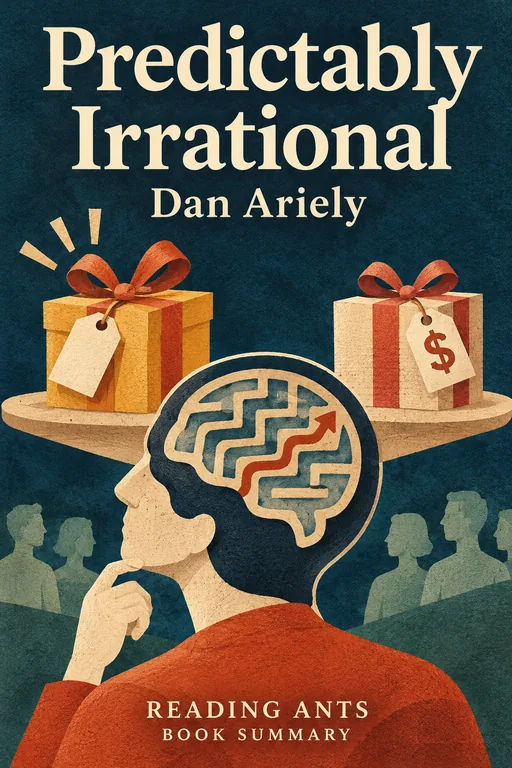
Predictably Irrational
Behavioral economist Dan Ariely uses entertaining experiments to show that people's decisions are shaped by predictable mental quirks, such as relativity, the lure of "free" and social norms, rather than by cool, rational calculation.
Overview
Predictably Irrational: The Hidden Forces That Shape Our Decisions was published in 2008 by Dan Ariely, a professor of psychology and behavioral economics, who taught at MIT until 2008 and then joined Duke University. Traditional economics assumes that people act rationally to maximize their interests. Ariely says that we are not rational, but that our errors are systematic, and therefore predictable. Each chapter describes a series of experiments, many of them with students, that reveal a kind of bias. The book is written in a light, conversational style, and a revised and expanded edition appeared later. The original 2008 edition came out long before the questions about some of Ariely’s research that are described below.
Full Summary
1 and 2. Relativity and arbitrary prices
The idea: Ariely shows that people judge things by comparison. In an example from a magazine subscription offer, adding a decoy option, a print-only option priced the same as the print-and-web package, made more people choose the more expensive package, because it now looked like a bargain by comparison. In Ariely’s test with 100 business students at MIT, 84 chose the print-and-web package when the decoy was there, but only 32 did when it was removed. We find it hard to assess the true value of things, and so rely on what is next to them. Marketers and others can exploit this.
Ariely also argues that prices are much more arbitrary than we think. In a class exercise, students wrote the last two digits of their social security number as if it were a price, and then bid on items such as wine, chocolates and computer accessories. Those with high digits bid far more than those with low digits, even though they denied that the number had influenced them. Ariely calls this “arbitrary coherence”: the first price we consider becomes an anchor that shapes what we will pay for related things later.
In real life: A mid-priced item next to a very expensive one may seem like a reasonable choice, and the first price you see can color how you judge every later one.
3. The cost of zero cost
The idea: The word “free” has a special power. In a chocolate experiment, Lindt truffles at 15 cents and Hershey’s Kisses at one cent led most people (73 percent) to take the truffle. When both prices were lowered by a cent, so that the Kiss became free, 69 percent took the free Kiss, though the value comparison had not changed. Ariely says that zero is not just another price, but an emotional hot button, since free things carry no risk of loss. We often take something just because it is free.
In real life: People may take a free gift they do not need, and spend more because of it.
4. Social norms and market norms
The idea: People live in two worlds: one of social norms, where favors are given for goodwill, and one of market norms, where payments are exchanged for goods. Mixing them causes trouble. For example, lawyers asked to help needy retirees for a low fee declined, but agreed when the work was offered for free. A gift of a dinner is appreciated, but offering to pay for it would be insulting. In an experiment with a dull computer task, people who were offered no payment worked about as hard as those paid five dollars, and harder than those paid 50 cents. A small gift did not spoil the effect, but a gift described by its price did. When market norms enter, social ones may disappear.
In real life: Offering to pay a friend who has helped you may spoil the friendship.
5. The influence of arousal
The idea: The author describes research that he and George Loewenstein carried out with male students at Berkeley. The students answered questions about unusual preferences and questionable behavior twice, once calm and once aroused, and when aroused they said they would be far more willing to do things that they would reject when calm. He says that we cannot predict our own behavior when we are in a heated state, such as anger, hunger or excitement, and that we tend to believe that we would act the same way as when cool. The lesson is to prepare in advance for such moments.
In real life: Shopping when hungry can lead you to buy too much.
6. The problem of procrastination and self-control
The idea: Ariely discusses why we put off tasks and struggle to save. He distinguishes between a cool state, in which we judge calmly and for the long term, and a hot state, in which immediate gratification takes over. In a study with his students, deadlines that they chose for themselves helped, but evenly spaced deadlines set by the teacher worked best. People will often use commitment devices to bind themselves. (The 2002 journal paper on which this chapter is based was retracted in September 2026; see Criticism and Counterpoints.) He suggests that we should use tools, such as automatic savings, to counter our weakness for short-term pleasure.
In real life: Booking a workout with a friend, or having savings taken automatically from your pay, can help you to follow through.
7 to 10. Ownership, open doors, expectations and the power of price
The idea: The book shows that people overvalue what they own, so that they demand a higher price for an object they possess than they would pay for it. At Duke, students who had won tickets to a big basketball game asked for around fourteen times what students without tickets were willing to pay. A chapter on keeping doors open shows that people waste effort and money trying to keep every option alive, even when it would pay to commit to one. It also shows that expectations shape experience: students who were told in advance that a beer contained a dash of balsamic vinegar liked it less, while those who learned of it only after tasting still enjoyed it. In a later chapter, a capsule that was really vitamin C eased the pain of electric shocks for almost everyone when it was described as costing $2.50, but for only about half when it was described as costing 10 cents.
In real life: A pill or drink that you paid full price for may seem to work better than the same thing bought at a discount.
11 and 12. The context of our character
The idea: Ariely and his colleagues tested honesty with simple tests that gave people a chance to cheat for small sums. The studies found that many people cheat a little, if they can, but not on a large scale, and that the risk of being caught made little difference. In one experiment, people who first tried to recall the Ten Commandments did not cheat, while those who recalled ten books they had read did. Signing a statement about an honor system had a similar effect. Another study found that students would take cans of Coke from a dorm fridge but left dollar bills alone, and that people cheated more when they were paid in tokens than in money. The studies behind these two chapters, and some of Ariely’s other research, have since been questioned (see Criticism and Counterpoints).
In real life: Being reminded of your own standards just before a tempting moment may make you more honest than a rule you read long before.
13. Beer and free lunches
The idea: In the final chapter, Ariely describes a study in a brewery in which people who ordered after others at the same table tended to choose a different beer from their neighbors, and were less satisfied with it than people who chose privately. He uses it to argue that behavioral economics can find “free lunches,” ways of making better decisions at no cost. The chapter also contrasts the standard economic view of people as rational with the view of behavioral economics, which starts from how people actually behave, and the book closes by arguing that understanding our predictable mistakes is the first step to avoiding them.
In real life: Choosing your order before you hear what everyone else will have may leave you with a dish you like better.
Why It Matters
Predictably Irrational was a popular book that helped to bring behavioral economics to a general audience. It showed how psychology can illuminate everyday choices, and encouraged readers to question the idea that they are fully rational. Along with works by Daniel Kahneman, Richard Thaler and others, it contributed to the interest of governments and companies in applying behavioral insights to policy and design. Its entertaining experiments made abstract ideas memorable. More recently, some of the research described, including some by Ariely, has been questioned or retracted, which has raised awareness of the need to check results.
Key Takeaways
- We judge by comparison. Context changes how we value things.
- ”Free” is powerful. It can lead us to choose poorly.
- Social and market norms differ. Mixing them can backfire.
- Emotion affects decisions. We cannot predict our behavior when aroused.
- Expectations color experience. What we believe affects what we perceive.
- Honesty is flexible. Many people cheat a little, and a moral reminder may help, though the evidence for this has been questioned.
What We Can Learn
You can use the book to catch yourself in the act of irrational decision-making. When you compare prices, ask whether the comparison is a trick. Be wary of freebies. Keep social favors separate from money. Make decisions in a calm state and set up systems, such as automatic saving, to protect yourself from impulse. And be humble about your own rationality, which can help you make better choices. Remember that some of the experiments in this book have been questioned, so keep a critical mind and treat the findings as ideas to test rather than settled facts. Notice your own habits, such as comparing, chasing free things or putting off a task, and try one small change at a time.
Criticism and Counterpoints
Critics note that many experiments involved university students in laboratory settings, which may not reflect real-world decisions, and that some findings in this field have not been replicated. Other economists argue that the picture of irrationality is exaggerated, and that people often make good decisions when the stakes are high. Some reviewers say that the book draws broad conclusions from small studies. Since the book appeared, questions have also been raised about some of Ariely’s published research. A 2012 paper on honesty (signing a statement at the top of a form), which is not part of this book, was retracted in 2021 after problems were found in its data; the notice does not say who was responsible, and Ariely has said that a university investigation found no evidence that he knowingly used false data. In September 2026, Psychological Science retracted the 2002 paper on deadlines that the procrastination chapter draws on, after doubts were raised about its data; Ariely has said that he does not know how the problems arose. Journals have also added expressions of concern to two other papers behind chapters of this book, one on the social-norms experiment (2021) and one on honesty and cheating (2024). Readers can enjoy the book’s ideas, but should treat its individual findings with care.
Who Should Read It
This book is for readers interested in psychology, economics and decision making. It is light and funny, and easy to read. Those who want a deeper treatment should read Kahneman’s Thinking, Fast and Slow, and anyone using the findings should check the status of the studies.
Want the whole book?
A summary is a taste, not the meal. Here is where to find the full book.
You reached the end 🎉
Nicely done. Mark this one as read, and we will suggest what to read next.
Read this next
Thinking, Fast and Slow
Daniel Kahneman
Our minds run on two systems, a fast, intuitive one and a slow, careful one, and understanding how the fast system fools us can help us make better decisions about money, risk, work and happiness.
🧩 Mind & Psychology
Nudge
Richard H. Thaler and Cass R. Sunstein
Because people are not perfectly rational, the way choices are presented strongly affects what they choose, and designers of choices can gently steer people toward better decisions without taking away their freedom.
🧩 Mind & Psychology
Freakonomics
Steven D. Levitt and Stephen J. Dubner
Economics is really the study of incentives, and by asking odd questions and following the data, we can discover surprising truths about cheating, crime, parenting and everyday life.
💰 Money & Economics
Drive: The Surprising Truth About What Motivates Us
Daniel H. Pink
Daniel Pink argues that, for creative and complex work, carrots and sticks such as bonuses are less effective than the inner drive provided by autonomy, mastery and purpose, and that businesses and schools should be redesigned around them.
🧩 Mind & Psychology
Blink
Malcolm Gladwell
Malcolm Gladwell explores how quick, unconscious judgments, made in the blink of an eye, can be remarkably accurate, but can also be misled by prejudice and pressure, and how we can learn to trust and improve our instincts.
🧩 Mind & Psychology
Stumbling on Happiness
Daniel Gilbert
Harvard psychologist Daniel Gilbert explains, with wit and research, that we are surprisingly poor at predicting what will make us happy, because the imagination fills in details wrongly, and he suggests that other people's experience is often a better guide than our own forecasts.
🧩 Mind & PsychologyWant something different?
Pick another topic and we will show you three books to start with.