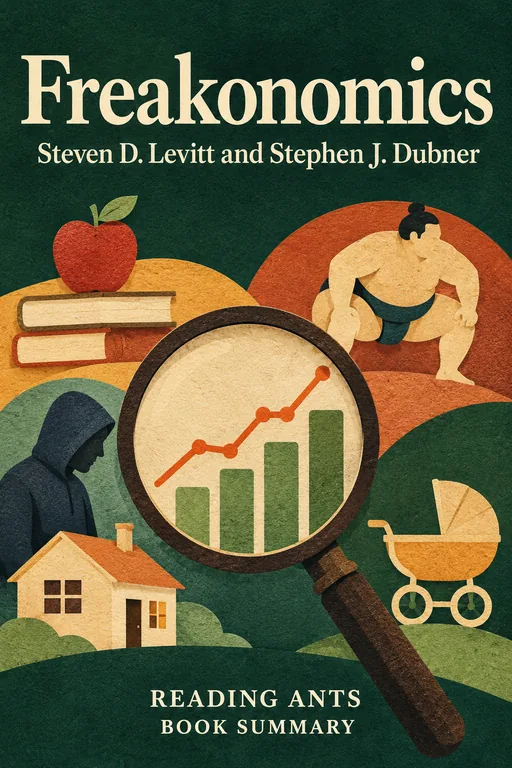
Freakonomics
Economics is really the study of incentives, and by asking odd questions and following the data, we can discover surprising truths about cheating, crime, parenting and everyday life.
Overview
Freakonomics was written by the economist Steven Levitt and the journalist Stephen Dubner and published in 2005. Levitt, a professor at the University of Chicago, was known for using economic tools on unusual subjects instead of on inflation or stock markets. Dubner wrote about him for a magazine and the two combined their efforts into this book. Its subtitle promises “the hidden side of everything.” The chapters are separate studies, each starting with a puzzling question: What do schoolteachers and sumo wrestlers have in common? Why do drug dealers still live with their mothers? The book became a huge bestseller and launched a series of follow-ups.
Full Summary
1. What do teachers and sumo wrestlers have in common?
The idea: Both groups, the authors argue, have a reason to cheat, because of the incentives they face. They explain that incentives, the rewards and penalties that guide people’s choices, come in economic, social and moral forms. Levitt studied data from standardized tests in Chicago schools and found patterns, such as answer sequences that looked identical in many classrooms, which suggested that some teachers were changing students’ answers when their jobs depended on test scores. He also studied sumo wrestling and found evidence suggesting that wrestlers sometimes arranged results in important matches.
In real life: When a school rewards teachers only for test scores, the pressure to push scores up can lead to cheating.
2. How is the Ku Klux Klan like a group of real-estate agents?
The idea: The authors argue that information is power, and that experts often use what they know that you don’t. A real-estate agent, for example, knows more about a house’s market than the seller and may have different incentives, because an agent gets only a small portion of an extra price. They compare this to the way the Klan once relied on secrecy for power, and how it lost influence when an activist leaked its secrets in the 1940s. The lesson is that the internet and other tools for sharing information can reduce the advantage of experts.
In real life: Comparing prices online before buying a car reduces a seller’s advantage.
3. Why do drug dealers still live with their moms?
The idea: Levitt analyzed records from a street gang’s finances, supplied by a sociologist who had spent time with the gang. They show that most low-level members earned very little, often less than the minimum wage, and the high pay went to a few leaders. The authors explain this by comparing the gang to a large corporation, with a small top and many people at the bottom hoping to rise. Many members, therefore, still lived with their mothers.
In real life: A tiny number of famous athletes or actors earn huge amounts while most who try earn little, the same structure as in the gang.
4. Where have all the criminals gone?
The idea: Crime in the United States fell sharply in the 1990s, surprising many experts. The authors discuss common explanations, such as more police, better economy, and tougher sentences, and give each some credit. They also offer a controversial explanation: the legalization of abortion in 1973, which they argue reduced the number of unwanted children, who they say were at higher risk of later crime. They present this as a statistical finding, not a moral judgment.
In real life: The argument shows how hard it is to explain big social changes, since many causes act at once.
5. What makes a perfect parent?
The idea: Using large surveys of children, the authors look at what parenting choices are linked with school success. They find that who the parents are, for instance their education and income, appears to matter more than what parents do, such as reading to children daily or taking them to museums. They caution that this is a statistical association and that parents should not feel guilty about choices that data suggest make little difference.
In real life: A parent who worries over small choices may gain more by simply providing a stable, caring home.
6. Perfect parenting, part two; or: Would a Roshanda by any other name smell as sweet?
The idea: The final chapter examines how parents choose names for their children, and whether names affect life outcomes. Using birth records from California, the authors show how names that were once popular among wealthy families gradually spread to others and then went out of fashion. They conclude that a name does not appear to cause success or failure by itself, but is a signal of the parents’ background.
In real life: A child’s later achievements depend more on family and opportunities than on whether their name is common or unusual.
Why It Matters
Freakonomics brought a style of economics to the general public: curious, data-driven and playful. It sold millions of copies, led to a film, a podcast and several sequels, and made many readers see economics as a tool for understanding everyday behavior, not just money. It also contributed to a wave of popular books on behavioral economics and data analysis.
The book showed that even odd questions can be tested with evidence, and it encouraged readers to question conventional wisdom, whether about parenting, crime or cheating. Many teachers use its chapters to show students how statistics can be applied to real questions, and its approach shaped the style of later popular economics writing and podcasts.
Key Takeaways
- Incentives drive behavior. People respond to rewards and penalties.
- Conventional wisdom is often wrong. Check it against data.
- Experts hold information. Their incentives may differ from yours.
- Correlation is not causation. Be careful about explanations.
- Ask unusual questions. Surprising answers can come from odd places.
What We Can Learn
The book teaches us to ask “why” more often and to look at the rewards in a situation. If a rule or reward system leads people to behave badly, the problem may be the system, not just the people.
It also shows the importance of reading numbers with care. The authors are careful to separate things that move together from things that cause each other, and readers can use the same caution when they see a headline about a study.
Finally, it encourages curiosity. A good question, followed by honest data, can reveal things that seem to be common sense but are not.
Criticism and Counterpoints
Some economists later found errors in parts of the abortion and crime analysis, including a coding mistake that was pointed out by other researchers, and the argument remains disputed. Critics have also said that the book’s lessons are sometimes too neat, with stories chosen because they are entertaining, and that it treats complicated social issues in a light, sometimes glib, tone.
Others note that the book relies on statistical associations that cannot prove cause, and that the findings on parenting can be misread. Some readers dislike the idea of reducing human behavior to incentives. Nevertheless, many find it an entertaining and thought-provoking introduction to thinking with data.
Who Should Read It
This book suits teenagers and adults who enjoy surprising facts and big questions. It needs no background in economics. A few passages deal with crime and other sensitive subjects in a factual way, so younger readers may want a parent’s guidance.
Want the whole book?
A summary is a taste, not the meal. Here is where to find the full book.
You reached the end 🎉
Nicely done. Mark this one as read, and we will suggest what to read next.
Read this next
Thinking, Fast and Slow
Daniel Kahneman
Our minds run on two systems, a fast, intuitive one and a slow, careful one, and understanding how the fast system fools us can help us make better decisions about money, risk, work and happiness.
🧩 Mind & Psychology
Nudge
Richard H. Thaler and Cass R. Sunstein
Because people are not perfectly rational, the way choices are presented strongly affects what they choose, and designers of choices can gently steer people toward better decisions without taking away their freedom.
🧩 Mind & Psychology
Predictably Irrational
Dan Ariely
Behavioral economist Dan Ariely uses entertaining experiments to show that people's decisions are shaped by predictable mental quirks, such as relativity, the lure of "free" and social norms, rather than by cool, rational calculation.
🧩 Mind & Psychology
The Undercover Economist
Tim Harford
Tim Harford shows how economic ideas explain everyday puzzles, from why coffee costs what it does to why used cars are risky and why poor countries struggle, in a lively and friendly style.
💰 Money & Economics
The Wealth of Nations
Adam Smith
A nation's true wealth is not its stock of gold but the goods and services its people produce, and that wealth grows fastest when people specialize, trade freely and compete, with government providing justice, defense and public goods.
💰 Money & Economics
Rich Dad Poor Dad
Robert T. Kiyosaki
Schools teach people to work for money, but the rich learn to make money work for them by understanding the difference between assets and liabilities and by building businesses and investments.
💰 Money & EconomicsWant something different?
Pick another topic and we will show you three books to start with.