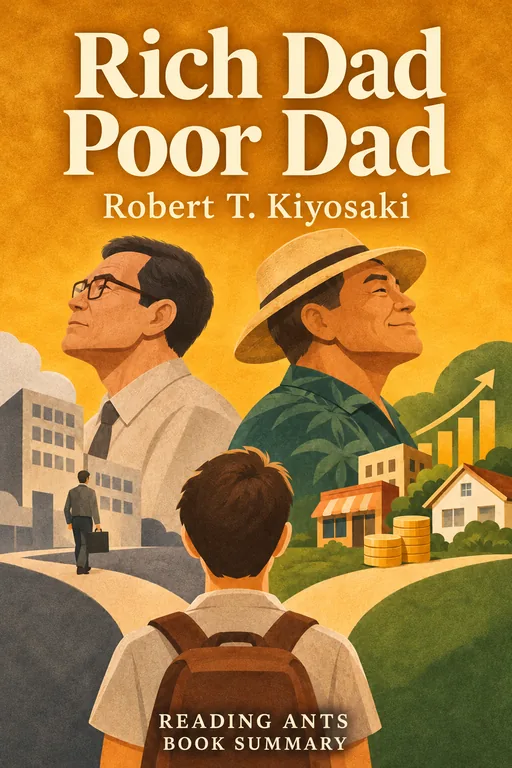
Schools teach people to work for money, but the rich learn to make money work for them by understanding the difference between assets and liabilities and by building businesses and investments.
Overview
Rich Dad Poor Dad is one of the best-selling personal finance books ever written. Robert Kiyosaki, an American businessman and investor, tells the story of growing up in Hawaii with two father figures. His “poor dad,” his own father, was a highly educated government official who worked hard all his life but always struggled with money. His “rich dad,” the father of his best friend, never finished school but became one of the wealthiest men in Hawaii through business and investments. The two men gave Kiyosaki opposite advice about money. Through simple stories and diagrams, the book argues that financial education, not just a good job, is the key to building wealth and freedom.
Full Summary
1. The rich don’t work for money
The idea: The poor dad believed in studying hard, getting a safe job and working for a salary. The rich dad taught that most people are trapped in the “rat race,” working for money because of fear (of not paying bills) and desire (for nicer things), so they never get ahead. Instead, the rich learn to make money work for them.
From the book: As a nine-year-old, Kiyosaki and his friend Mike asked the rich dad to teach them how to make money. He gave them a job in his store for very little pay, then took away their pay entirely. When the boys complained, he explained that most adults spend their lives in the same trap. The lesson was to look for opportunities rather than wages.
In real life: Many people get a raise and immediately buy a bigger car or phone, so they never feel any richer. Their spending rises with their income.
2. Know the difference between assets and liabilities
The idea: The book’s most famous lesson is simple, and rests on Kiyosaki’s own cash-flow definitions rather than standard accounting: an asset puts money in your pocket, and a liability takes money out. The rich buy assets, such as businesses, stocks, bonds, rental property and royalties. The poor and middle class buy liabilities they think are assets, such as expensive cars or houses with large mortgages. Kiyosaki controversially argues that your home is usually not an asset, because it costs you money every month.
In real life: A car bought on loan costs money every month in payments, fuel and insurance. A small rental property, if well managed, can bring in money each month.
3. Mind your own business
The idea: Kiyosaki distinguishes between your profession, the job you do for someone else, and your business, your asset column. Keep your day job if you need it, he says, but start building assets on the side. Over time, the income from those assets can cover your expenses, giving you financial freedom.
In real life: A teacher who writes and sells study guides online, or a nurse who invests a little every month, is “minding their own business” while still working a regular job.
4. Understand taxes and corporations
The idea: Kiyosaki argues that taxes fall most heavily on employees, while business owners and investors can legally reduce their taxes by using companies and spending money on business expenses before paying tax. He encourages readers to learn the rules of taxes and corporations so they can use them to their advantage.
In real life: Learning even basic facts about how taxes work, such as what deductions are or how retirement accounts work, can make a big difference over a lifetime.
5. The rich invent money
The idea: Financial intelligence means spotting opportunities others miss: buying property cheaply when markets fall, starting businesses or making deals. Kiyosaki encourages taking calculated risks and learning from mistakes, rather than being paralyzed by fear of losing money.
From the book: Kiyosaki tells how, as boys, he and Mike set up a small library of used comic books, which a local shop would otherwise have thrown away. They charged other children a small fee to read them, making money from something that cost them nothing.
In real life: Some people buy old furniture at garage sales, repair it and resell it for a profit, creating value from something others overlooked.
6. Work to learn, not just to earn
The idea: Kiyosaki advises choosing jobs for the skills they teach, not just the salary. He believes the most important skills for wealth are sales, communication, marketing and management, and he points out that many talented people stay poor because they lack these skills.
In real life: A young person might take a sales job for a year, even if it pays less, because the skills of persuading and understanding customers will help in any future business.
7. Overcoming obstacles
The idea: Kiyosaki lists the main obstacles that stop people from becoming wealthy: fear, cynicism, laziness, bad habits and arrogance. He recommends “paying yourself first,” setting aside money for investing before paying other bills, so that you are forced to find ways to earn more.
In real life: Setting up an automatic transfer to a savings or investment account on payday is a simple way to pay yourself first.
Why It Matters
Rich Dad Poor Dad has sold tens of millions of copies and been translated into dozens of languages, and it remains one of the best-selling personal finance books of all time. It launched a large “Rich Dad” brand of books, games and seminars.
The book changed how many people think about money. Its simple definitions of assets and liabilities, and its message that schools rarely teach financial literacy, have inspired many readers to start investing, build side businesses and teach their children about money. It also contributed to a wider public conversation about the importance of financial education.
Key Takeaways
- Make money work for you. Wealth comes from assets that produce income.
- Assets put money in, liabilities take money out. Spend on things that pay you back.
- Financial education matters. Understanding money is as important as earning it.
- Build your own business on the side. Grow your asset column while you work.
- Learn sales and communication. These skills unlock opportunities.
What We Can Learn
The book encourages us to think about where our money goes. Writing down income and expenses for a month, and sorting purchases into assets and liabilities, can be eye-opening.
It also teaches the value of starting early. Even young people can begin learning about saving, investing and small business ideas. Small amounts invested regularly, even from a part-time job or birthday money, can grow over time.
Finally, it reminds us to keep learning. Reading about personal finance, asking experienced people for advice and taking small, careful risks can help anyone build a more secure future.
Criticism and Counterpoints
Rich Dad Poor Dad is also one of the most criticized finance books. Some critics question whether the “rich dad” actually existed, since his identity has never been independently confirmed. Financial experts argue that some advice is vague, risky or misleading, such as encouraging heavy borrowing to invest in real estate, or downplaying the benefits of steady jobs, education and low-cost index funds.
The book offers few specific, practical steps, and some of its tax advice applies mainly to the United States. Critics also point out that Kiyosaki’s own business ventures have faced lawsuits and financial problems. Many readers find it most useful as a motivational introduction, best balanced with more careful, evidence-based finance books such as The Psychology of Money or The Simple Path to Wealth.
Who Should Read It
This book suits teenagers and adults who are new to thinking about money and want a simple, motivating introduction. It is easy to read. Readers looking for detailed, reliable investment advice should pair it with more cautious, research-based books.
Want the whole book?
A summary is a taste, not the meal. Here is where to find the full book.
You reached the end 🎉
Nicely done. Mark this one as read, and we will suggest what to read next.
Read this next
The Psychology of Money
Morgan Housel
How you behave with money matters more than how much you know about it, and good financial outcomes come from humility, patience and avoiding big mistakes, not from being the smartest person in the room.
💰 Money & Economics
The Millionaire Next Door
Thomas J. Stanley and William D. Danko
Most wealthy Americans don't look rich: they live below their means, work steadily and save a lot, while many people who appear wealthy are really spending everything they earn.
💰 Money & Economics
The Richest Man in Babylon
George S. Clason
Through simple stories set in ancient Babylon, this short classic teaches that wealth comes from saving part of everything you earn, making that money work for you, and protecting it from loss.
💰 Money & Economics
Think and Grow Rich
Napoleon Hill
Napoleon Hill claims that wealth and success begin with a burning desire, firm belief and persistent action, and presents thirteen principles he says were distilled from the habits of successful people.
🌱 Self-Improvement
I Will Teach You to Be Rich
Ramit Sethi
Ramit Sethi gives young adults a practical six-week program to set up accounts, automate saving and investing, and spend freely on what they love, without having to track every coffee.
💰 Money & Economics
The Wealth of Nations
Adam Smith
A nation's true wealth is not its stock of gold but the goods and services its people produce, and that wealth grows fastest when people specialize, trade freely and compete, with government providing justice, defense and public goods.
💰 Money & EconomicsWant something different?
Pick another topic and we will show you three books to start with.