 Reading Ants
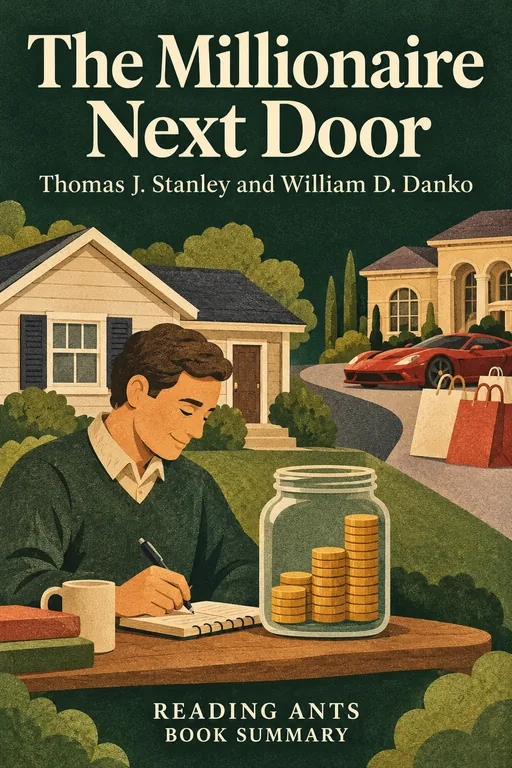
Most wealthy Americans don't look rich: they live below their means, work steadily and save a lot, while many people who appear wealthy are really spending everything they earn.
Overview
The Millionaire Next Door was written by Thomas Stanley, a marketing researcher, and William Danko, a professor, and published in 1996. Stanley had spent years studying the wealthy through surveys and interviews, and was surprised by what he found. Instead of the flashy lifestyle people expected, most millionaires were ordinary-looking people who owned small businesses, drove modest cars and lived in unremarkable houses. The authors separated people into three groups: prodigious accumulators of wealth (PAWs), who build a large net worth for their income, average accumulators of wealth (AAWs), who fall in between, and under accumulators of wealth (UAWs), who earn well but have little to show for it. The book became a surprise bestseller.
Full Summary
1. Who is really wealthy?
The idea: The authors argue that we are poor judges of wealth. We assume that people with large homes, expensive cars and designer clothes are rich, but these are things people buy by spending money, not by keeping it. Their research found that many real millionaires lived in modest neighborhoods and bought ordinary cars, often used. Appearing rich and being rich, they say, are very different things.
In real life: A neighbor who fixes up an old house and drives the same car for ten years may have far more in savings than the family with a new luxury vehicle.
2. Live well below your means
The idea: The first and most important trait of their millionaires was frugality. They spent less than they earned, year after year, and put the difference into savings and investments. The authors contrast PAWs, who budget and plan their spending, with UAWs, who spend as much as they make and assume wealth will come later.
From the book: The authors describe many wealthy people who bought their clothes on sale, kept their cars a long time and did not feel the need to show off.
In real life: A teenager who saves half of their part-time job earnings will have more at twenty-five than a friend who spends it all.
3. The seven common traits
The idea: The authors list common traits among the millionaires they studied: they lived well below their means; they used time, energy and money in ways that built wealth; they believed that financial independence was more important than displaying high social status; their parents did not give them financial support as adults; their adult children were economically self-sufficient; they were good at finding market opportunities; and they chose the right occupation.
In real life: Many of the wealthy people they met were business owners who found a need and filled it, such as running a small trade or service company.
4. Economic outpatient care
The idea: One of the most original ideas in the book is economic outpatient care, the money parents give to their grown children, from cash gifts to help with down payments. The authors found that the more help adult children received, the less they tended to save and the more they relied on their parents. They argue that generous support can make people less able to take care of themselves, and that the children of wealthy families often accumulate less than the self-made.
In real life: A young adult who has to budget for rent often learns skills that a child who is always bailed out never gets.
5. The wealth formula
The idea: To measure whether someone is building wealth, the authors propose a rough rule of thumb that is only a guide and fits some people’s circumstances better than others: multiply your age by your annual pretax income and divide by ten. The result is what your net worth should be if you are average for someone of your age and income. If your net worth is more than twice that, you are a PAW; if it is less than half, you are a UAW.
In real life: Using the formula can be a way to check, honestly, whether your savings match your income.
6. Careers and choices
The idea: The book points out that many millionaires worked in ordinary, unglamorous industries, such as welding, trucking or pest control. They chose fields where competition was lower and demand steady, and they worked long hours to build their businesses. They also tended to be careful about large purchases and to see their home and car as tools, not as symbols.
In real life: A job that looks boring may pay well because fewer people want it.
7. Investing time and money wisely
The idea: The authors observe that the wealthy tend to spend time on planning their finances and investments, and to be patient. They also teach their children to value money and work. In the final chapters, the authors give advice to those who want to become PAWs: spend less than you earn, avoid chasing status, invest steadily and teach your children to be independent.
In real life: Setting aside a regular time each month to review your money can be a simple, powerful habit.
Why It Matters
The Millionaire Next Door spent years on bestseller lists and became one of the most widely read personal finance books in America. It changed how many people thought about wealth, showing that building a large net worth depends more on habits than on high income. It also challenged the idea that spending signals success.
Stanley’s research influenced later authors and the fast-growing “financial independence” community, which promotes saving and frugal living. The term “PAW” and the idea of being a “millionaire next door” have entered popular discussion about money.
Key Takeaways
- Looks deceive. True wealth is often hidden.
- Spend less than you earn. Frugality is the base of saving.
- Be independent. Don’t rely on handouts or status symbols.
- Choose work wisely. Steady, unglamorous fields can build wealth.
- Teach children to be self-sufficient. Too much help can harm.
What We Can Learn
The book invites us to separate what we show from what we have. Before buying something to impress others, we can ask whether it helps us reach our long-term goals.
It also shows the value of steady, boring habits: saving regularly, avoiding unnecessary debt and being careful with large purchases. These actions are not exciting, but they make a big difference over decades.
Finally, it encourages parents and grandparents to think about how much help to give. Teaching a young person to work, budget and save may be a more lasting gift than a large sum of money.
Criticism and Counterpoints
Critics point out that the research is based on surveys from the 1980s and 1990s in the United States, and may not apply today, when housing, education and healthcare cost far more. The book’s examples also focus on business owners and may overlook people who build wealth through other means.
Some argue that the stress on frugality blames individuals for their financial position and ignores factors like inheritance, discrimination and luck. Others note that surveys of the wealthy suffer from survivorship bias, since they only include those who succeeded. The formula for net worth is also a rough guide. Still, the main lesson, that spending and saving habits matter, remains widely accepted.
Who Should Read It
This book suits older teenagers and adults interested in money, saving and wealth. It is easy to read, though a few chapters have many statistics. It is especially useful for people who feel pressure to look successful.
Want the whole book?
A summary is a taste, not the meal. Here is where to find the full book.
You reached the end 🎉
Nicely done. Mark this one as read, and we will suggest what to read next.
Read this next
The Richest Man in Babylon
George S. Clason
Through simple stories set in ancient Babylon, this short classic teaches that wealth comes from saving part of everything you earn, making that money work for you, and protecting it from loss.
💰 Money & Economics
The Psychology of Money
Morgan Housel
How you behave with money matters more than how much you know about it, and good financial outcomes come from humility, patience and avoiding big mistakes, not from being the smartest person in the room.
💰 Money & Economics
Rich Dad Poor Dad
Robert T. Kiyosaki
Schools teach people to work for money, but the rich learn to make money work for them by understanding the difference between assets and liabilities and by building businesses and investments.
💰 Money & Economics
Your Money or Your Life
Vicki Robin and Joe Dominguez
Vicki Robin and Joe Dominguez teach that money is something you trade your life energy for, and they offer a step-by-step program to track every cent, spend on what truly matters and reach financial independence.
💰 Money & Economics
I Will Teach You to Be Rich
Ramit Sethi
Ramit Sethi gives young adults a practical six-week program to set up accounts, automate saving and investing, and spend freely on what they love, without having to track every coffee.
💰 Money & Economics
The Wealth of Nations
Adam Smith
A nation's true wealth is not its stock of gold but the goods and services its people produce, and that wealth grows fastest when people specialize, trade freely and compete, with government providing justice, defense and public goods.
💰 Money & EconomicsWant something different?
Pick another topic and we will show you three books to start with.