 Reading Ants
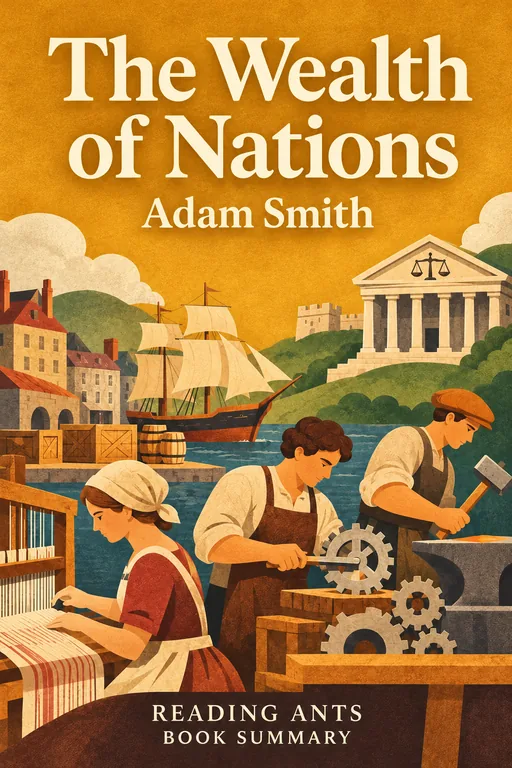
A nation's true wealth is not its stock of gold but the goods and services its people produce, and that wealth grows fastest when people specialize, trade freely and compete, with government providing justice, defense and public goods.
Overview
An Inquiry into the Nature and Causes of the Wealth of Nations, usually called The Wealth of Nations, was published in 1776 by Adam Smith, a Scottish philosopher and professor. At the time, most European governments followed “mercantilism,” the belief that a country grows rich by piling up gold and silver, exporting as much as possible and blocking imports. Smith argued the opposite. Wealth, he said, comes from productive work, and it grows through the division of labor, free markets and trade. He explained how prices, wages and profits are set, how capital builds up, and what governments should and shouldn’t do. This long, wide-ranging book founded modern economics and remains one of the most influential works ever written.
Full Summary
1. The division of labor
The idea: Smith begins by explaining why some countries are richer than others. The main cause, he says, is the division of labor: splitting work into specialized tasks. When each worker focuses on one task, they become more skilled, waste less time switching jobs, and invent better tools. The result is an enormous increase in productivity.
From the book: Smith’s famous example is a pin factory. One untrained worker making pins alone could produce perhaps one pin a day, certainly not twenty. But in a small factory where ten workers each perform one or two steps, such as drawing out the wire, cutting it and sharpening the point, they could make around forty-eight thousand pins a day together.
In real life: A modern smartphone is designed, assembled and shipped by thousands of specialized workers in many countries. No single person could build one alone.
2. Trade comes from self-interest
The idea: People naturally tend to trade and exchange. Smith argues that markets work not because people are generous, but because each person benefits from trading. We get our dinner not from the kindness of the butcher, brewer or baker, but from their concern for their own interests. By serving others’ needs in order to earn a living, people end up benefiting society as a whole.
In real life: A bakery opens early not out of love for its customers, but to earn money. Yet because it wants their business, it works hard to bake good bread at fair prices.
3. How prices are set
The idea: Smith distinguishes between the “natural price” of a good, which covers the normal costs of wages, profit and rent, and the “market price,” set by supply and demand. When a good is scarce, its price rises above its natural level, attracting more producers; when it is plentiful, the price falls. Competition keeps pulling prices toward their natural level. The size of the market also matters: the bigger the market, the more specialization is possible.
In real life: When a new toy becomes a craze, prices shoot up and shops sell out. Soon more companies make similar toys, and prices fall again.
4. Capital and growth
The idea: Wealth grows when people save and invest in capital, such as tools, machines and buildings, that makes future work more productive. Smith praises thrift and warns that wasteful spending, whether by individuals or governments, slows growth.
In real life: A farmer who saves money to buy a better tractor can farm more land next year, producing more food and income.
5. Against mercantilism
The idea: Smith devotes a long section to attacking mercantilism. Gold and silver are not wealth themselves; they are just tools for exchange. Real wealth is the goods people can consume. Trade is not a contest where one country’s gain is another’s loss: both sides benefit by specializing in what they do best. Taxes on imports, special privileges and monopolies help a few merchants but hurt consumers. In this context he uses his famous phrase, the “invisible hand”: individuals seeking their own gain are led, without intending it, to promote the good of society.
In real life: If one country is very good at growing coffee and another at making cars, both are better off trading than trying to produce everything themselves.
6. Beware of powerful merchants
The idea: Smith is not simply a champion of business. He warns that merchants and manufacturers constantly try to limit competition, fix prices and lobby governments for special favors. He notes that people in the same trade rarely meet, even for fun, without the conversation turning to a plot against the public to raise prices. He also expresses sympathy for workers, arguing that no society can be prosperous when most of its people are poor and miserable.
In real life: Laws against price-fixing and monopolies, such as when companies secretly agree to raise prices, reflect Smith’s concerns.
7. What government should do
The idea: In the final book, Smith outlines the proper duties of government: defending the nation, providing justice through courts and laws, and building public works that private businesses wouldn’t, such as roads, bridges and canals. He also supports public education, worrying that repetitive factory work could dull workers’ minds. He sets out principles for fair taxation: taxes should be proportional to ability to pay, certain, convenient and not wasteful to collect.
In real life: Public schools, highways and police are examples of the services Smith thought governments should provide, because markets alone wouldn’t supply them well.
Why It Matters
The Wealth of Nations is often called the founding text of modern economics. It explained how markets coordinate the activities of millions of people without central planning, and it developed and popularized ideas such as the division of labor, the benefits of trade and the role of competition that remain at the heart of economics today.
The book influenced policymakers across the world. It helped Britain move toward free trade in the nineteenth century and shaped debates about the role of government in the economy that continue today. Smith’s name is invoked by people across the political spectrum, from free-market advocates to those who stress his warnings about monopolies and poverty. His earlier book, The Theory of Moral Sentiments, shows that he also believed deeply in sympathy and moral behavior.
Key Takeaways
- Wealth is production, not gold. A nation is rich when its people produce many useful goods and services.
- Specialization boosts productivity. Dividing work into tasks creates enormous gains.
- Self-interest can serve the public. In competitive markets, people meet others’ needs while pursuing their own.
- Free trade benefits both sides. Trade is not a zero-sum game.
- Government has key roles. Defense, justice, public works and education are essential.
What We Can Learn
Smith’s ideas help us understand everyday life. Specializing in what you do well, and cooperating with others who have different skills, often leads to better results, whether in a school project, a business or a household.
His book also teaches us to look at who benefits from rules and policies. When a company or group asks for special protection, it is worth asking whether it helps the public or just a few.
Finally, Smith reminds us that economics is about people. A healthy economy is measured not just by profits, but by whether ordinary workers can live decent lives.
Criticism and Counterpoints
Critics argue that Smith’s ideas have been used to justify extreme free-market policies, inequality and the exploitation of workers, although Smith himself warned about powerful business interests and the poverty of laborers. Karl Marx and later thinkers criticized the capitalist system Smith described, arguing that it concentrates wealth and power.
Economists have also pointed out limits to Smith’s theories. For example, he wrote before problems like modern pollution and the scale of giant corporations, though he did discuss banking failures, speculative credit and monopoly power; some modern problems can require more government action than he imagined. The book is also very long, around a thousand pages, and full of eighteenth-century examples, so most readers only read selections.
Who Should Read It
This book is for students of economics, politics and history, and for anyone curious about how markets work. Its length and old-fashioned style make it challenging, so beginners may prefer selected chapters or a modern introduction. Readers interested in today’s debates about free trade and government will find it surprisingly relevant.
Want the whole book?
A summary is a taste, not the meal. Here is where to find the full book.
You reached the end 🎉
Nicely done. Mark this one as read, and we will suggest what to read next.
Read this next
Capital
Karl Marx
Karl Marx argues that capitalism produces wealth by making workers create more value than they are paid for, and that this built-in exploitation and the system's cycle of growth and crisis push society toward change.
💰 Money & Economics
The General Theory of Employment, Interest and Money
John Maynard Keynes
Keynes argues that an economy can get stuck with high unemployment because total spending is too low, and that governments can and should act to raise demand when private spending falls short.
💰 Money & Economics
Economics in One Lesson
Henry Hazlitt
Henry Hazlitt argues that most economic mistakes come from looking only at the immediate effect of a policy on one group, and that good economics means tracing the long-term effects on everyone.
💰 Money & Economics
Capitalism and Freedom
Milton Friedman
Milton Friedman argues that economic freedom and political freedom support each other, and he applies this idea to a range of public issues, from money and schools to licensing and poverty, always asking what the government should and should not do.
💰 Money & Economics
Rich Dad Poor Dad
Robert T. Kiyosaki
Schools teach people to work for money, but the rich learn to make money work for them by understanding the difference between assets and liabilities and by building businesses and investments.
💰 Money & Economics
The Intelligent Investor
Benjamin Graham
Successful investing is less about being clever than about being disciplined: buy sound businesses at a price that leaves a margin of safety, and don't let the mood of the market push you around.
💰 Money & EconomicsWant something different?
Pick another topic and we will show you three books to start with.