 Reading Ants
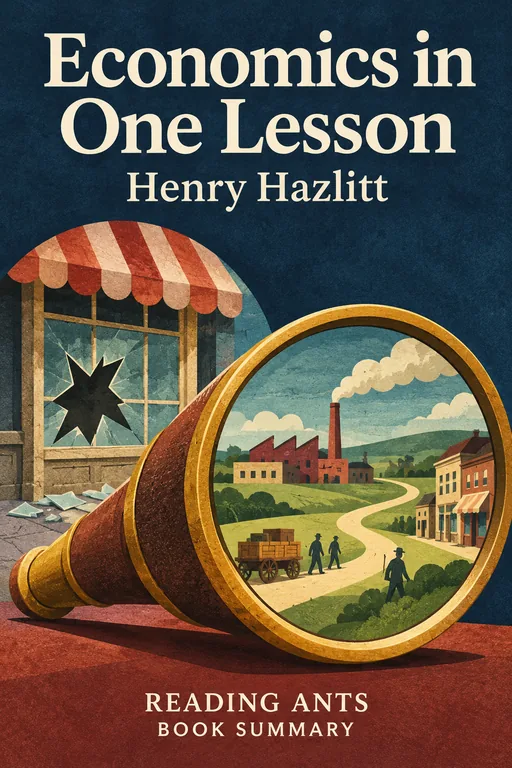
Henry Hazlitt argues that most economic mistakes come from looking only at the immediate effect of a policy on one group, and that good economics means tracing the long-term effects on everyone.
Overview
Economics in One Lesson was published in 1946 by Henry Hazlitt, a journalist and writer on economics. He wrote it for readers who were not experts, and it has since sold over a million copies. The lesson in the title is simple: judge any act or policy by its longer-term effects, and by its effects on all groups, not just the one that is easiest to see. Each chapter applies the lesson to a common idea, such as public works, taxes, machines, tariffs and minimum wages. Hazlitt builds on the nineteenth-century French writer Frédéric Bastiat.
Full Summary
1. The broken window
The idea: Hazlitt starts with a parable. A young hoodlum throws a brick through a baker’s shop window, and a crowd says it is good for the economy, since the glazier will earn money. But, Hazlitt says, the shopkeeper would have spent the same money on something else, such as a new suit. We see the glazier’s gain, but not the loss that is hidden. Destruction does not create wealth; it only moves spending around while making the community poorer.
In real life: If a storm damages houses, repairs keep workers busy, but the town would be richer if the storm had never happened.
2. Public works and the unseen
The idea: Hazlitt says that when a government builds a bridge or a dam, people see the jobs and the finished project, but not what was given up. The money was taken from taxpayers, who would otherwise have spent it elsewhere. A project may still be worth it, but it should be judged on whether the benefits are greater than the cost, and not on the number of jobs created.
In real life: A town may point to the new sports ground, and forget the books or the repairs that the same money could have paid for.
3. The curse of machinery
The idea: A common fear is that machines destroy jobs. Hazlitt answers that, while a machine may take away a particular job, it lowers costs and prices, which leaves consumers with more to spend elsewhere, and creates new work in making and servicing the machines and in new industries. He says that the long-run record shows that technology raises living standards, even though the changes can be painful for those affected.
In real life: When washing machines became common, people did not run out of things to do; they gained time and money for other activities.
4. Tariffs and trade
The idea: Hazlitt says that taxes on imports protect some producers at the expense of consumers and of other industries. A tariff makes a product more expensive for everyone who buys it, and it also hurts the country’s own exporters, because foreigners who sell less earn fewer dollars to buy its goods. Drawing on Adam Smith, he argues that trade works for the same reason that a household buys what it would cost more to make at home: each country does best by concentrating on what it can produce efficiently, so that both sides gain. He also stresses that exports are paid for by imports, so that cutting imports means cutting exports too.
In real life: If a country protects its shoe makers with a tariff, families pay more for shoes, and have less to spend on other things.
5. Price controls and minimum wages
The idea: The book argues that setting prices by law often causes problems: a binding price ceiling can cause shortages, and a price floor can cause a surplus. Hazlitt says that rent control can reduce the supply of housing and make landlords neglect repairs, and that a legal minimum wage can leave the least skilled workers without jobs if the wage is higher than their productivity. He believes that prices carry information, and that overriding them has hidden costs.
In real life: If a store is forced to sell a popular toy at a very low price, it may sell out early, and many children will not get one.
6. Taxes, credit and saving
The idea: Hazlitt discusses taxes and says that those that discourage work, saving or investment can reduce the wealth of everyone. He criticizes government credit programs, arguing that government lenders take risks that private lenders would avoid, and that the money is diverted from more productive uses. He also defends saving as the source of investment, arguing that it is not a drag on the economy, but that it provides the funds for new tools and businesses.
In real life: A family that saves part of its income helps to fund the bank loans that others use to start businesses.
7. Look at everyone, and look ahead
The idea: In the closing chapters, Hazlitt returns to the lesson. He says that the central fallacy arises from the division of labor: each person gains as a producer from a high price for what he sells, while gaining as a consumer from low prices for everything else, so groups press for policies that help themselves and show only the benefits they would gain, while the costs fall on everyone else. He recalls William Graham Sumner’s Forgotten Man, the person who pays for other people’s good intentions. The habit he urges is to look at every effect of a policy, on every group, and to ask what happens next and who pays.
In real life: When a proposal is presented as a gift, a good habit is to check where the money comes from.
Why It Matters
Economics in One Lesson has sold over a million copies and has been used in classrooms and by people who want a simple guide to economic thinking. Its clear style and one big idea make it easy to remember, and it has introduced many readers to the idea of hidden costs and unintended consequences. It is regarded as a classic in American conservative, free-market and libertarian circles. The book is also a reminder that policies should be judged by their long-term effects. Its parable of the broken window is a standard example in teaching. Hazlitt revised the book later, so the contents differ between editions.
Key Takeaways
- Look beyond the first effect. Trace what happens later and to other people.
- See the unseen. Costs that are hidden or spread out are still real.
- Destruction is not progress. Fixing damage does not make a society richer.
- Trade creates value. Imports, not just exports, are a benefit.
- Ask who pays. Every program is paid for by someone.
What We Can Learn
The one lesson is useful in many parts of life. When a plan sounds wonderful, ask what it will cost, who will pay and what will change in the long run. When you choose how to spend your time or money, remember that every choice means giving up something else. In news about economic policy, notice who is speaking and who benefits. Do not forget, though, that the future is uncertain, and that costs and benefits are sometimes hard to measure. Treating the lesson as a question, rather than as a rule that gives all the answers, makes it more powerful.
Criticism and Counterpoints
Critics say that Hazlitt oversimplifies. His strong opposition to government spending, minimum wages and unions ignores evidence that such policies can sometimes help, particularly in a recession when resources are idle, as Keynes had argued. Some of his claims about minimum wages and rent control have been questioned by later research, which finds mixed effects. His treatment of unseen costs is persuasive, but it sometimes neglects unseen benefits. Others note that the book’s tone is more that of an advocate than of a neutral teacher. As a result, it is best read as one lively argument within a larger debate.
Who Should Read It
This book is for beginners who want a short, readable introduction to economic thinking, and for readers who enjoy a strong argument. It is easy to follow. Those looking for a balanced presentation of all schools of economics should also read other authors, and those interested in modern data may want to check the newer research.
Want the whole book?
A summary is a taste, not the meal. Here is where to find the full book.
You reached the end 🎉
Nicely done. Mark this one as read, and we will suggest what to read next.
Read this next
Basic Economics
Thomas Sowell
Thomas Sowell explains how economies work in plain language, with no graphs or jargon, by showing how prices, incentives and trade-offs shape everything from rents and wages to trade between nations.
💰 Money & Economics
The Road to Serfdom
Friedrich A. Hayek
Friedrich Hayek argues that when governments try to plan the whole economy from the center, they must gradually limit personal and political freedom, and that the road leads toward a dictatorship that nobody intended.
💰 Money & Economics
Capitalism and Freedom
Milton Friedman
Milton Friedman argues that economic freedom and political freedom support each other, and he applies this idea to a range of public issues, from money and schools to licensing and poverty, always asking what the government should and should not do.
💰 Money & Economics
The Undercover Economist
Tim Harford
Tim Harford shows how economic ideas explain everyday puzzles, from why coffee costs what it does to why used cars are risky and why poor countries struggle, in a lively and friendly style.
💰 Money & Economics
Freakonomics
Steven D. Levitt and Stephen J. Dubner
Economics is really the study of incentives, and by asking odd questions and following the data, we can discover surprising truths about cheating, crime, parenting and everyday life.
💰 Money & Economics
The Wealth of Nations
Adam Smith
A nation's true wealth is not its stock of gold but the goods and services its people produce, and that wealth grows fastest when people specialize, trade freely and compete, with government providing justice, defense and public goods.
💰 Money & EconomicsWant something different?
Pick another topic and we will show you three books to start with.