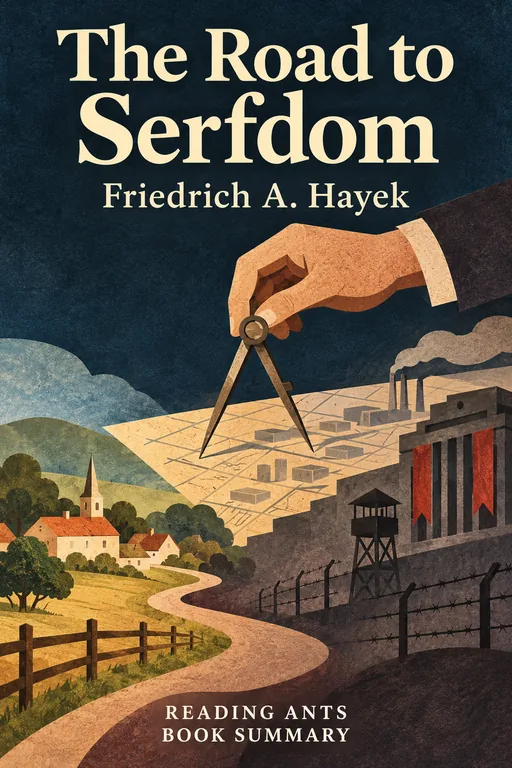
The Road to Serfdom
Friedrich Hayek argues that when governments try to plan the whole economy from the center, they must gradually limit personal and political freedom, and that the road leads toward a dictatorship that nobody intended.
Overview
The Road to Serfdom was published in 1944 by Friedrich A. Hayek, an Austrian-born economist who had settled in Britain. He wrote it during the Second World War, when many thinkers in Britain and the United States believed that wartime planning could be kept and used for social goals in peacetime. Hayek had seen the rise of fascism and communism in Europe, and he warned that economic planning on a large scale could undermine liberty. The book was written for a wide readership, not only for experts, and it started a major debate that continues to this day about the role of government.
Full Summary
1. The abandoned road
The idea: Hayek says that Western civilization was built on respect for the individual and for freedom, including freedom in economic affairs. Around the turn of the twentieth century, many people began to abandon those principles for the promise of planning, partly because habits of thought from science and engineering were carried over into the way people thought about society. He argues that this change of mind, and not a failure of capitalism, set the stage for the dangers that followed.
In real life: A group of friends who give up making their own choices for the sake of a single leader’s plan may find it is hard to take back the freedom later.
2. What central planning would require
The idea: A planned economy must decide what is produced, how much and for whom. Hayek says that this requires someone to rank all the goals of a society, which no one can do fairly because people disagree about what is most important. A planner must therefore impose a single scale of values, so that the plan can work. He says that this is the point where freedom of choice begins to disappear.
In real life: If a school had to decide in advance exactly what every student should read, eat and do, someone would have to choose for all, and many would be unhappy.
3. The problem of knowledge
The idea: One of Hayek’s key arguments is that the knowledge needed to run an economy is scattered among millions of people, and cannot be collected by a single authority. Prices, which rise and fall as people buy and sell, carry information about what is scarce and what is not. Competition allows people to use their local knowledge. A central planner who tries to replace prices with orders loses this information.
In real life: A shopkeeper knows that umbrellas will sell today because it is raining, and a distant office would not.
4. The rule of law versus arbitrary power
The idea: Hayek says that a free society is based on general rules, known in advance, that apply to everyone, so that individuals can plan their lives. Planning, in contrast, requires giving officials wide powers to decide cases one by one, which opens the way to arbitrary power. He claims that when a government controls the economy, it must also control people’s work, and so their lives.
In real life: Traffic rules are clear and apply to all, but a traffic officer who could decide each day who may drive would be able to favor friends.
5. Why the worst get on top
The idea: Hayek argues that in a system with total control, the ruthless and unscrupulous are the ones most likely to rise, since they are willing to do what is needed to hold power. People who want to keep their conscience find it hard to succeed. He also says that propaganda and the suppression of dissent follow, because the plan needs everyone to agree.
In real life: In a group where the leader demands that nobody question decisions, the most loyal followers, not the most honest, get rewarded.
6. Security and freedom
The idea: Hayek does not say that there should be no government action. He accepts a basic minimum of food, shelter and clothing for everyone, social insurance against the common hazards of life, and rules against fraud and against harmful methods of production. He distinguishes between security from extreme hardship, which a society can provide, and a guarantee of a fixed income or position, which would require control over who may do what. He warns that the demand for complete security can undermine liberty.
In real life: A school can ensure that all students have lunch, without deciding exactly who becomes what.
7. A warning for the future
The idea: The later chapters look at the hopes for international order. Hayek says that economic planning carried out separately by each nation would lead to friction and conflict between nations, and he also warns against planning on an international scale. He argues instead for an international rule of law that limits what states may do to individuals. He ends by saying that the task is to free the creative energy of individuals rather than to plan progress, and that a policy of freedom for the individual is the only truly progressive policy.
In real life: Countries that share clear rules for trade have a reason to cooperate, and fewer reasons to quarrel.
Why It Matters
The Road to Serfdom became an international bestseller, helped by a condensed version published in a popular magazine in 1945. It established Hayek as a leading thinker for people who believe in free markets and limited government, and influenced political figures and economists in the second half of the twentieth century. It also drew replies from well-known figures: Keynes wrote to Hayek that he agreed with much of it morally and philosophically but did not draw the same practical conclusions, and George Orwell praised part of its argument while criticizing other parts. Hayek later won the Nobel Prize in economics, in 1974, shared with another economist. Today it is read as a classic statement of the case against central planning, and as a warning about the loss of liberty. It is still widely discussed, praised and criticized, in discussions of the economy and politics.
Key Takeaways
- Planning concentrates power. Controlling the economy means controlling many parts of life.
- Knowledge is dispersed. No planner can know what millions of people know.
- Prices carry information. Markets help people coordinate without commands.
- Rules should be general. The rule of law protects freedom better than discretion.
- Security has limits. Demanding complete security can cost liberty.
What We Can Learn
The book asks you to think about the trade-offs between order and freedom. When you hear a proposal to solve a problem by control, ask what information the controllers would need, who decides, and what happens if they are wrong. It also encourages you to value clear, general rules over favors. At the same time, a careful reader will notice that Hayek accepts a role for government, and that the real question is how much and what kind. Reading the book alongside others can help you to judge both its insights and its limits.
Criticism and Counterpoints
Many critics say that Hayek exaggerates the link between planning and dictatorship, pointing out that democratic countries have built welfare states and extensive regulation without losing their freedoms. Others note that he wrote under the pressure of the war, and that his claim that fascism and Nazism grew from socialist roots was controversial. Some economists argue that markets have failures that justify more government action than he accepted. Supporters respond that his central argument about knowledge and power remains valid. Hayek himself allowed a role for the state, and wrote that in no system that could be rationally defended would the state simply do nothing.
Who Should Read It
This book is for readers interested in politics, economics and history, and for anyone who wants to understand a foundational argument for free markets. It is clearly written but dense in places, and its style reflects the 1940s. Readers who want an opposing view might pair it with Keynes or with later writers who defend a stronger role for the state.
Want the whole book?
A summary is a taste, not the meal. Here is where to find the full book.
You reached the end 🎉
Nicely done. Mark this one as read, and we will suggest what to read next.
Read this next
Capitalism and Freedom
Milton Friedman
Milton Friedman argues that economic freedom and political freedom support each other, and he applies this idea to a range of public issues, from money and schools to licensing and poverty, always asking what the government should and should not do.
💰 Money & Economics
Economics in One Lesson
Henry Hazlitt
Henry Hazlitt argues that most economic mistakes come from looking only at the immediate effect of a policy on one group, and that good economics means tracing the long-term effects on everyone.
💰 Money & Economics
The General Theory of Employment, Interest and Money
John Maynard Keynes
Keynes argues that an economy can get stuck with high unemployment because total spending is too low, and that governments can and should act to raise demand when private spending falls short.
💰 Money & Economics
On Liberty
John Stuart Mill
John Stuart Mill argues that society may limit a person's freedom only to prevent harm to others, and that free thought, free speech and individuality benefit everyone.
🕊️ Philosophy & Religion
The Origins of Totalitarianism
Hannah Arendt
Hannah Arendt examines how antisemitism, imperialism and the breakdown of society in Europe prepared the ground for the totalitarian regimes of Nazi Germany and Stalin's Soviet Union, and what made these regimes new and uniquely terrible.
🏛️ History
The Wealth of Nations
Adam Smith
A nation's true wealth is not its stock of gold but the goods and services its people produce, and that wealth grows fastest when people specialize, trade freely and compete, with government providing justice, defense and public goods.
💰 Money & EconomicsWant something different?
Pick another topic and we will show you three books to start with.