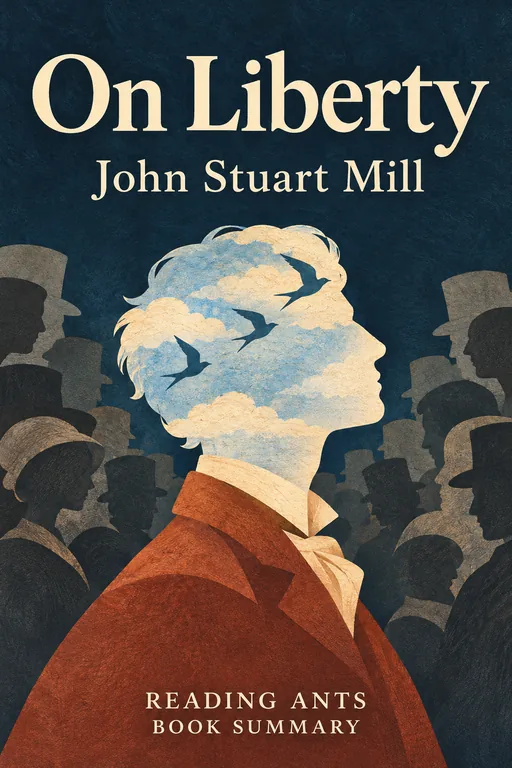
John Stuart Mill argues that society may limit a person's freedom only to prevent harm to others, and that free thought, free speech and individuality benefit everyone.
Overview
On Liberty is an essay by the British philosopher and economist John Stuart Mill, published in 1859. Mill, who lived from 1806 to 1873, wrote it with the strong influence of his wife, Harriet Taylor Mill, who died before it was published; he said it was a joint work. The essay deals with the limits of the power that society can legitimately exercise over the individual. Mill was worried not only about harsh governments but also about the pressure of public opinion and custom, which he called the tyranny of the majority. The book has five chapters and is one of the most famous defenses of individual freedom ever written.
Full Summary
1. The problem of power and the harm principle
The idea: In the opening chapter, Mill explains that, as democratic government spreads, the main danger is no longer only rulers oppressing the people, but the majority oppressing individuals and minorities, through laws and also social disapproval. He states his central rule, known as the harm principle: the only reason to use power against someone against their will is to prevent harm to others. A person’s own good, physical or moral, is not enough reason for interference.
In real life: Wearing unusual clothes or choosing an unpopular hobby harms no one, so Mill would say society has no business forcing a change.
2. Freedom of thought and discussion
The idea: The second chapter is the most famous. Mill defends the right to express opinions, even false or unpopular ones, and gives several reasons. If the opinion is true, silencing it deprives us of truth. If it is false but contains a part of the truth, it may fix the mistakes of the majority view. If it is completely false, the clash with it keeps the true view alive, preventing it from becoming a dead dogma held without understanding. Finally, an opinion that is never challenged loses its meaning and force.
In real life: A student who has to defend an idea against objections understands it better than one who simply memorizes it.
3. Individuality as a part of well-being
The idea: In the third chapter, Mill argues that people should be free to live in their own way, in “experiments of living,” and that this variety is valuable to society. Conformity to custom, he says, makes people dull and weak, whereas developing one’s own character and choices makes life richer. He criticizes the habit of following the crowd without thinking, and praises original, eccentric individuals as a source of progress.
In real life: A community that welcomes different talents and lifestyles tends to find more creative solutions to its problems.
4. The limits of society’s authority
The idea: Chapter four sets out where the individual’s freedom ends and society’s authority begins. Actions that affect only oneself should be free from control, though others may offer advice, argue or avoid the person. Actions that harm others may be restricted. Mill also says that people have duties to one another, and that failing to act, for example by not saving a child from drowning, may sometimes justify compulsion. He gives examples, such as debates on drinking, religious practice and gambling, and explains how to apply the principle to them.
In real life: A person may choose to eat unhealthy food, but not to drive recklessly in a way that endangers others.
5. Applications
The idea: In the last chapter, Mill applies his ideas to practical matters, including education, trade and government interference. He argues that the state should require education for children but should not run all schools, to avoid enforced uniformity. He considers cases where governments should or should not interfere with commerce, and he warns that increasing the power of government can make individuals dependent. He closes by saying that a state that stunts its citizens in order to make them docile tools will find that no great thing can be accomplished.
In real life: Debates about school choice, regulation and public services still use arguments similar to Mill’s.
Why It Matters
On Liberty is one of the foundational texts of liberal political thought. Its harm principle has been debated in discussions about free speech, drug laws, censorship, religious freedom and personal choice, and it is regularly cited in courts, newspapers and classrooms. Its argument for open debate has shaped views on universities and the press.
The essay also influenced reformers who fought for women’s rights and for greater tolerance. Mill’s later work, The Subjection of Women, applied similar principles to argue for equality. Few essays have been as widely quoted in defense of freedom.
Key Takeaways
- The harm principle. Society may restrict freedom only to prevent harm to others.
- Free speech helps truth. Debate corrects errors and keeps ideas alive.
- Beware social pressure. The majority can be a tyrant too.
- Value individuality. Different ways of living enrich us all.
- Freedom needs responsibility. Mill expects people to care about others.
What We Can Learn
The essay encourages us to think twice before trying to force our opinions or habits on others. Before demanding that someone be silenced or changed, we can ask whether they are actually harming anyone.
It also encourages us to listen to opposing views. Mill’s point that we only fully understand our beliefs when we know the arguments against them is a good guide for students, citizens and friends.
Finally, it invites us to be brave in forming our own opinions. Following the crowd is easy, but Mill suggests that a good life involves thinking for ourselves and respecting others’ right to do the same.
Criticism and Counterpoints
Critics point out that “harm” is hard to define, since almost any action can affect others in some way, and that Mill’s line between self-regarding and other-regarding actions is blurry. Some argue that his view ignores the importance of shared values and community, while others say that he is too optimistic that open debate leads to truth.
His principle was also limited to people “in the maturity of their faculties,” and he excluded children and what he called backward societies, remarks that reflect imperial attitudes of his time and that modern readers find troubling. Today, debates continue over hate speech, misinformation and public health, where his principle is stretched. The essay remains an important starting point.
Who Should Read It
This book suits older teenagers and adults interested in freedom, politics and ethics. The essay is short but has long, dense sentences, so a modern edition with notes is helpful. It works well for discussion and debate.
Want the whole book?
A summary is a taste, not the meal. Here is where to find the full book.
You reached the end 🎉
Nicely done. Mark this one as read, and we will suggest what to read next.
Read this next
The Republic
Plato
Plato, through the character of Socrates, asks what justice is and imagines an ideal city, arguing that a just person and a just state are ruled by wisdom, with reason guiding the whole.
🕊️ Philosophy & Religion
Democracy in America
Alexis de Tocqueville
After touring the United States in the 1830s, the young Frenchman Alexis de Tocqueville wrote a penetrating study of American democracy, praising its energy and liberty, and warning about its dangers, such as the tyranny of the majority and a retreat into private life.
⚖️ Politics & Society
The Art of War
Sun Tzu
The greatest victory is the one won without fighting, achieved through careful planning, knowing both yourself and your opponent, and using deception, flexibility and timing.
🕊️ Philosophy & Religion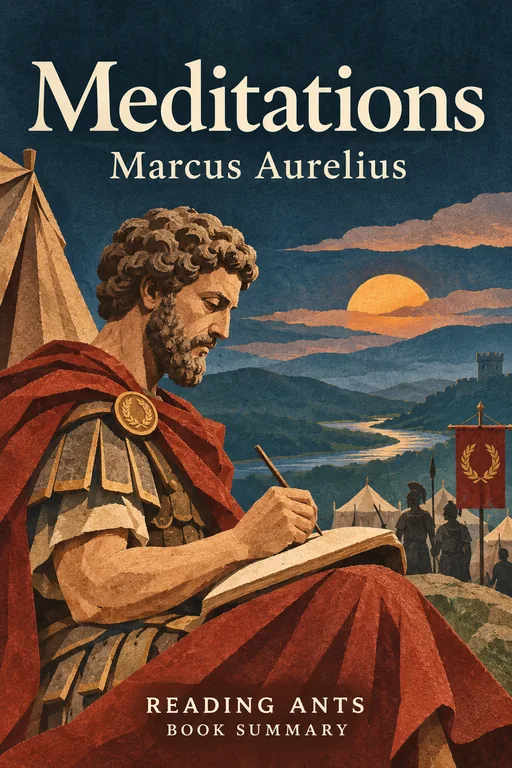
Meditations
Marcus Aurelius
The private notebook of a Roman emperor, reminding himself daily to accept what he cannot control, to act with justice and kindness, and to remember that life is short.
🕊️ Philosophy & Religion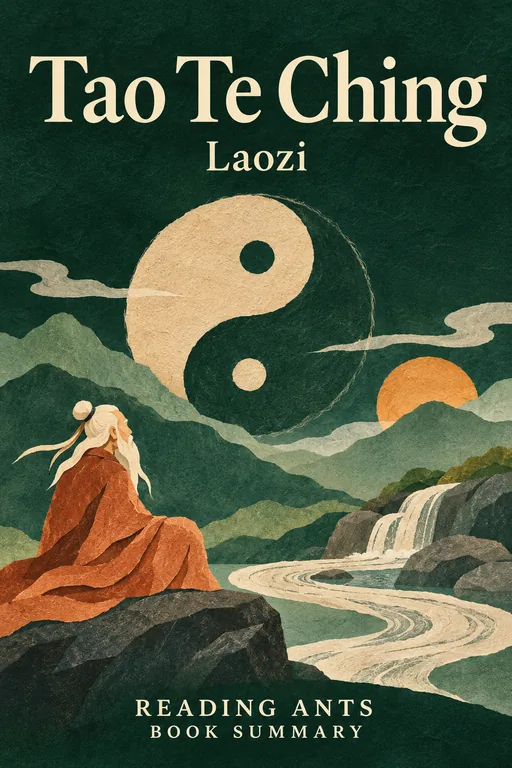
Tao Te Ching
Laozi
The deepest wisdom is to live in harmony with the Tao, the natural way of the universe, by being humble, gentle and simple, and by acting without force.
🕊️ Philosophy & Religion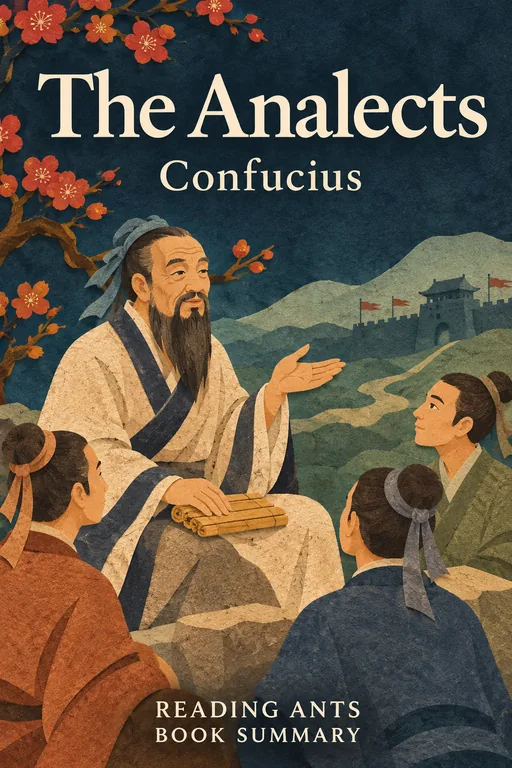
The Analects
Confucius
A good life and a good society are built on personal virtue: being kind, respectful and honest, learning constantly, honoring family, and leading others by example rather than by force.
🕊️ Philosophy & ReligionWant something different?
Pick another topic and we will show you three books to start with.