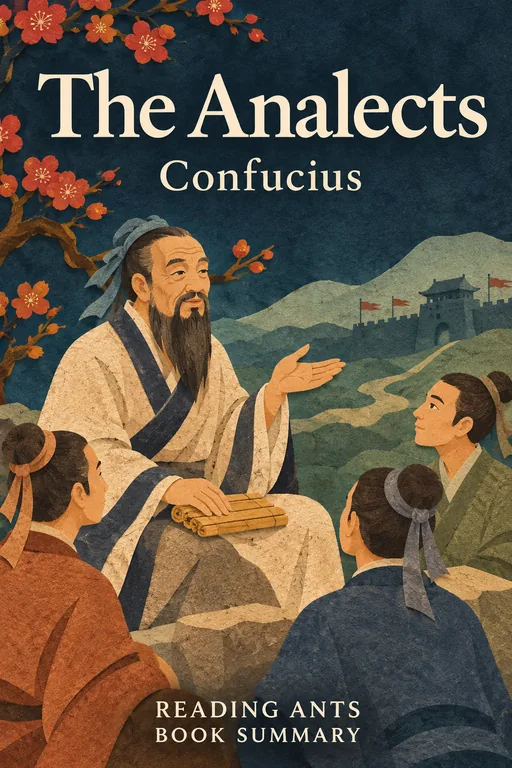
A good life and a good society are built on personal virtue: being kind, respectful and honest, learning constantly, honoring family, and leading others by example rather than by force.
Overview
The Analects (Lunyu, meaning “Selected Sayings”) is a collection of the teachings of Confucius (Kong Fuzi, “Master Kong”), a teacher and thinker who lived in China from about 551 to 479 BCE. During his lifetime, China was divided into rival states and troubled by war and corruption. Confucius traveled from court to court hoping to persuade rulers to govern wisely, and he taught many students. After his death, his followers gathered his conversations and sayings into twenty short books. The Analects became the foundation of Confucianism, which shaped the values, education and government of China, Korea, Japan and Vietnam for more than two thousand years.
Full Summary
1. Become a person of noble character
The idea: Confucius’s ideal is the junzi, often translated as “gentleman” or “exemplary person.” Originally the word meant someone of noble birth, but Confucius used it for anyone of noble character. The junzi cares about doing what is right rather than what is profitable, is calm, honest and humble, and is more concerned with improving himself than with blaming others. The opposite is the “small person,” who chases gain and status.
In real life: A student who quietly helps a struggling classmate without seeking praise is acting like a junzi. Character is shown in everyday choices, not titles.
2. Humaneness is the highest virtue
The idea: The central virtue in the Analects is ren, often translated as “humaneness,” “goodness” or “benevolence.” It means caring for others and treating them as fully human. When a student asked for one word to guide his whole life, Confucius suggested reciprocity, and explained it this way: do not do to others what you would not want done to yourself.
In real life: Before saying something unkind online, imagine how you would feel if someone said it to you. This simple test is Confucius’s teaching in action.
3. Learning never ends
The idea: The Analects opens with a celebration of learning: isn’t it a pleasure to study and practice what you have learned? Confucius describes how, from the age of fifteen, he set his heart on learning, and how his understanding grew throughout his life. He stresses that learning without thinking is useless, and thinking without learning is dangerous. True knowledge, he says, is knowing what you know and admitting what you don’t know.
In real life: Saying “I don’t know, but I’ll find out” in class is not a weakness; for Confucius, it is the beginning of wisdom.
4. Ritual and respect hold society together
The idea: Confucius placed great importance on li, usually translated as “ritual” or “propriety.” This includes ceremonies and customs, but also everyday manners: greeting people properly, showing respect, behaving appropriately in each situation. These forms, practiced sincerely, train people’s feelings and create harmony. Without inner goodness, though, ritual is empty.
In real life: Saying please and thank you, greeting elders politely, or taking off your shoes in someone’s home are small rituals that show respect and make life together smoother.
5. Family comes first
The idea: Confucius taught that goodness begins at home, especially through xiao, or filial piety: love and respect for one’s parents and ancestors. Caring for parents is not only about providing food, he said, since even dogs and horses are fed; it requires genuine respect. A person who is respectful at home will be respectful in society.
In real life: Calling grandparents regularly, helping parents with chores, or listening patiently to their advice are everyday expressions of the respect Confucius valued.
6. Lead by example
The idea: Confucius believed that good government depends on good leaders. If rulers govern by laws and punishments, people will avoid punishment but feel no shame. If rulers lead by virtue and set a good example, people will develop a sense of shame and correct themselves. A virtuous ruler is like the North Star, which stays in place while all the other stars turn around it. He also stressed the “rectification of names”: people should truly fulfill the roles their titles describe, so that a ruler acts like a ruler and a father like a father.
In real life: A team captain who arrives early, trains hard and treats everyone fairly inspires teammates far more than one who simply gives orders.
7. Choose friends and words carefully
The idea: Confucius advises choosing friends who are honest, sincere and well-informed, and avoiding those who flatter or are dishonest. He values actions more than speeches: an exemplary person is slow to speak and quick to act, and is ashamed when their words exceed their deeds. He also teaches that when we see someone good, we should try to become like them, and when we see someone bad, we should look inside ourselves for the same faults.
In real life: Instead of announcing big plans to everyone, quietly start working on them. Results speak louder than promises.
Why It Matters
The Analects is one of the most influential books in human history. For about two thousand years, Confucian teachings were the basis of education and government in China, and for centuries the imperial civil service exams tested candidates on the Confucian classics. Confucianism also shaped the cultures of Korea, Japan and Vietnam, influencing family life, respect for elders and teachers, and the high value placed on education.
Many common ideas in East Asian societies, such as honoring parents, respecting teachers and valuing harmony, have Confucian roots. Today, the Analects is read around the world as a classic of ethics, and its version of the “Golden Rule” is often compared with similar teachings in other cultures and religions.
Key Takeaways
- Character matters more than status. A noble person is defined by virtue, not birth.
- Treat others as you wish to be treated. Reciprocity is the heart of goodness.
- Learning is lifelong. Study, reflect and admit what you don’t know.
- Respect creates harmony. Good manners and rituals hold families and societies together.
- Leaders should set an example. Virtue inspires more than punishment.
What We Can Learn
Confucius reminds us that becoming a good person is a daily practice. Small acts of kindness, honesty and respect, repeated every day, build character over time.
His emphasis on learning encourages us to stay curious throughout life. Reading, asking questions and reflecting on what we learn, at any age, makes us wiser.
Finally, his teachings on family and leadership show that the best way to influence others is to live well ourselves. Whether as a parent, a sibling, a teacher or a team member, setting a good example is often more powerful than giving orders.
Criticism and Counterpoints
Critics argue that Confucianism, as it was used over the centuries, supported rigid social hierarchies, demanding obedience from children to parents, subjects to rulers and, especially, wives to husbands. Women had a strongly subordinate role in traditional Confucian societies. In the early twentieth century, Chinese reformers attacked Confucianism as a barrier to modernization, and it was harshly criticized during the Cultural Revolution.
Others note that the Analects itself is a loose collection of sayings, sometimes repetitive or obscure, and that many interpretations reflect later scholars rather than Confucius himself. Defenders argue that its core values of humaneness, learning and moral leadership remain wise and relevant.
Who Should Read It
This book suits readers of almost any age interested in ethics, philosophy or East Asian culture. Its short sayings can be read a few at a time. A good translation with notes, such as those by Arthur Waley or Edward Slingerland, helps explain the historical background.
Want the whole book?
A summary is a taste, not the meal. Here is where to find the full book.
You reached the end 🎉
Nicely done. Mark this one as read, and we will suggest what to read next.
Read this next
Tao Te Ching
Laozi
The deepest wisdom is to live in harmony with the Tao, the natural way of the universe, by being humble, gentle and simple, and by acting without force.
🕊️ Philosophy & Religion
The Art of War
Sun Tzu
The greatest victory is the one won without fighting, achieved through careful planning, knowing both yourself and your opponent, and using deception, flexibility and timing.
🕊️ Philosophy & Religion
Meditations
Marcus Aurelius
The private notebook of a Roman emperor, reminding himself daily to accept what he cannot control, to act with justice and kindness, and to remember that life is short.
🕊️ Philosophy & Religion
Nicomachean Ethics
Aristotle
Aristotle argues that the best human life is one of flourishing, achieved by building good character through habit, finding the balance between extremes, using practical wisdom and cultivating friendship.
🕊️ Philosophy & Religion
The Republic
Plato
Plato, through the character of Socrates, asks what justice is and imagines an ideal city, arguing that a just person and a just state are ruled by wisdom, with reason guiding the whole.
🕊️ Philosophy & Religion
Apology (The Trial and Death of Socrates)
Plato
Plato's account of the speech that Socrates gave when he was put on trial in Athens in 399 BCE shows a philosopher who refuses to give up questioning, even if it costs him his life.
🕊️ Philosophy & ReligionWant something different?
Pick another topic and we will show you three books to start with.