 Reading Ants
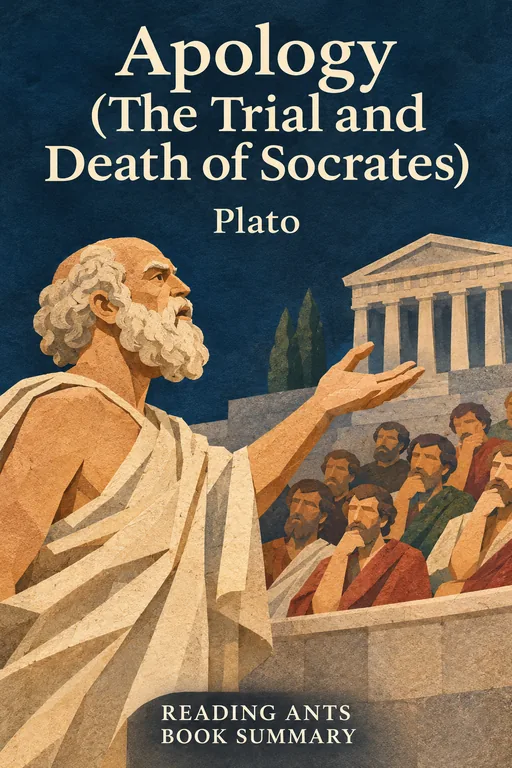
Apology (The Trial and Death of Socrates)
Original title: Απολογία Σωκράτους
Plato's account of the speech that Socrates gave when he was put on trial in Athens in 399 BCE shows a philosopher who refuses to give up questioning, even if it costs him his life.
Overview
The Apology is a short work by the philosopher Plato, in which he records, in his own way, the defense speech of his teacher Socrates at his trial. In Greek, the word apologia means a defense, not an expression of regret. Socrates, an elderly Athenian known for questioning people about justice and goodness, was accused of not believing in the city’s gods, of introducing new ones, and of corrupting the young. A jury of several hundred citizens decided his fate. Plato was present at the trial. The work is one of the most famous in the history of philosophy.
Full Summary
1. A plain-spoken defense
The idea: Socrates begins by saying that his accusers have spoken so cleverly that he almost forgot who he was. He says that he will speak the truth in plain words, as he usually does in the marketplace, and not in the polished style of professional speakers. He admits that he has been accused of many things for years, and that these old rumors, including that he was a clever man who studied the heavens and made the weaker argument appear the stronger, are harder to answer than the new charges.
In real life: Rumors that have followed someone for a long time can be harder to deal with than a single accusation.
2. The oracle and the search for wisdom
The idea: Socrates explains where his reputation came from. A friend of his had asked the oracle at Delphi whether anyone was wiser than Socrates, and the oracle said that no one was. Puzzled, Socrates set out to test this by questioning people who had a reputation for wisdom: politicians, poets and craftsmen. He found that they thought they knew things that they did not. He concluded that he was wiser in only one small way: he did not think that he knew what he did not know. This is not the same as claiming to know nothing.
In real life: A person who admits that they do not know something is often better placed to learn than one who pretends.
3. Answering the charges
The idea: Socrates then addresses the accusation of corrupting the young. He questions his main accuser, Meletus, and shows that Meletus’s claims are confused and contradictory. He argues that no one deliberately makes their neighbors worse, since this would harm himself, and so if he did harm them, it was unintentional, and a correction, not a punishment, would be called for. He also denies being an atheist and says that he follows a divine sign that has guided him since childhood.
In real life: Asking a person to explain exactly what they mean can reveal that their accusation does not hold together.
4. The gadfly and the duty to question
The idea: Socrates says that he cannot give up philosophy, even if they offer to release him on that condition. He believes that the god has given him the task of urging his fellow citizens to care about wisdom and about the state of their souls, rather than about money and reputation. He compares himself to a gadfly, an insect that stings a large and sluggish horse to keep it awake. He says that if they kill him, it will not be easy to find another. He also says that a life without this kind of questioning is not worth living for a human being.
In real life: A friend who asks uncomfortable questions can be annoying, but may also help you to think more clearly.
5. The verdict and the penalty
The idea: The jury finds Socrates guilty, by a narrow margin. According to custom, he is allowed to propose a penalty, and the prosecution has called for death. He first says, half in jest but with a serious point, that he deserves free meals at public expense, as a benefactor of the city. He then suggests a small fine, and finally, with friends including Plato guaranteeing the money, a larger fine of thirty minae. The jury then votes for the death penalty.
In real life: Refusing to show fear in front of those who judge you can come across as pride, but may also reflect conviction.
6. Facing death
The idea: In his last words, Socrates speaks to those who voted to condemn him and to those who voted to acquit. He says that death is either a dreamless sleep or a journey to another place where he might meet the great figures of the past and continue his questioning. In either case, he says, it is nothing to fear, and a good man cannot be truly harmed. He asks his friends to reprove his sons when they are grown, as he reproved others, if they seem to care more for wealth than for virtue.
In real life: A person who has lived by their principles may face the end of life with calm.
Why It Matters
The Apology is one of the founding texts of Western philosophy. It presents the figure of Socrates as the model of the philosopher: someone who follows reason, questions assumptions and puts truth ahead of safety. The work has inspired thinkers, reformers and ordinary people who have stood up for principle in the face of pressure. It is also a central text on freedom of speech and the relationship between the individual and the state. Many readers see in the trial of Socrates a warning about how societies treat those who challenge them. It remains one of the most accessible and moving works of ancient philosophy.
Key Takeaways
- Wisdom begins with knowing your limits. Socrates claimed only to know that he did not know.
- Question everything. Examining ideas is a duty, not a danger.
- Integrity matters more than safety. He would not stop philosophizing to save himself.
- The state can be wrong. Authority does not guarantee justice.
- Death need not be feared. A good life prepares us to face it.
What We Can Learn
Try practicing the Socratic habit: ask what a word really means, and what evidence supports a belief, including your own. Be willing to say, “I don’t know,” and to learn from others. Think about what you would be unwilling to give up for safety or approval. Listen to those who challenge you, and consider whether they may be serving you as a gadfly. At the same time, note that Socrates was convicted by a democratic jury, which invites us to think about the limits of majority rule and the importance of protecting dissenters.
Criticism and Counterpoints
Scholars point out that the Apology is Plato’s version, and may not be an exact record, so it is hard to separate the historical Socrates from Plato’s portrait. Others say that Socrates’s behavior at the trial, which struck some jurors as arrogant, may have contributed to his sentence, and that his questioning could undermine the beliefs of the community. Some modern readers argue that Athens had reasons to be worried after a period of political turmoil involving former students of Socrates. Others see him as a martyr for free thought. The debate is part of its enduring interest.
Who Should Read It
This book is for anyone who wants an easy and rewarding introduction to philosophy. It is short and vivid and can be read in an hour. Those who would like to go deeper can read the related dialogues, which tell of the days before and after the trial.
Want the whole book?
A summary is a taste, not the meal. Here is where to find the full book.
You reached the end 🎉
Nicely done. Mark this one as read, and we will suggest what to read next.
Read this next
The Republic
Plato
Plato, through the character of Socrates, asks what justice is and imagines an ideal city, arguing that a just person and a just state are ruled by wisdom, with reason guiding the whole.
🕊️ Philosophy & Religion
Meditations
Marcus Aurelius
The private notebook of a Roman emperor, reminding himself daily to accept what he cannot control, to act with justice and kindness, and to remember that life is short.
🕊️ Philosophy & Religion
Enchiridion
Epictetus
Epictetus, a former slave turned Stoic teacher, offers a short handbook of advice on staying calm and free by focusing on what we can control, and accepting what we cannot.
🕊️ Philosophy & Religion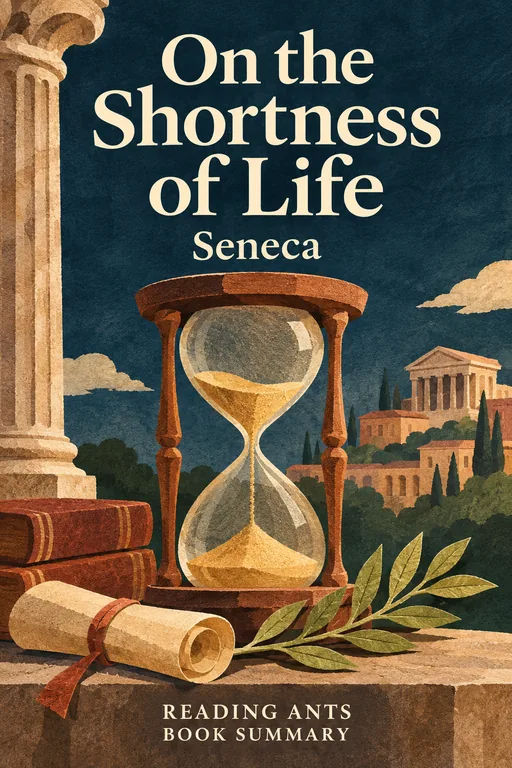
On the Shortness of Life
Seneca
The Roman Stoic Seneca argues that life is not short but wasted, and that we can have plenty of time if we use it for what matters, instead of squandering it on busyness, worry and distraction.
🕊️ Philosophy & Religion
The Prince
Niccolo Machiavelli
A Renaissance diplomat advises rulers to judge their actions by results rather than morality, arguing that a successful leader must sometimes be cunning and ruthless to win and keep power.
⚖️ Politics & Society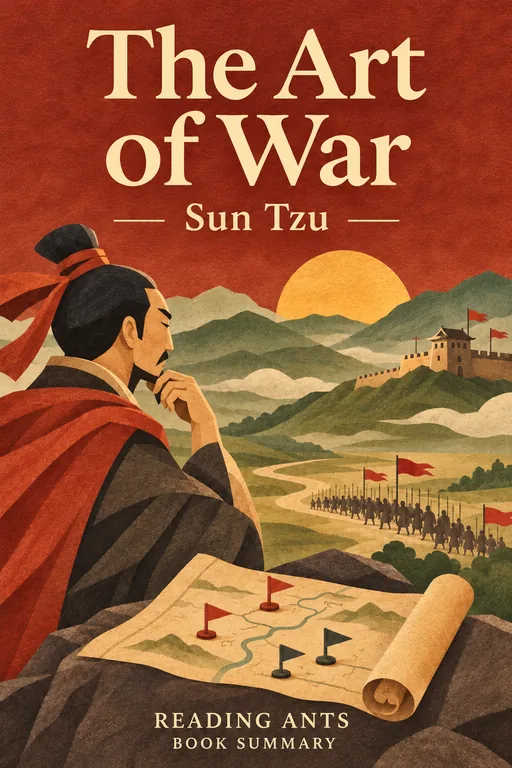
The Art of War
Sun Tzu
The greatest victory is the one won without fighting, achieved through careful planning, knowing both yourself and your opponent, and using deception, flexibility and timing.
🕊️ Philosophy & ReligionWant something different?
Pick another topic and we will show you three books to start with.