 Reading Ants
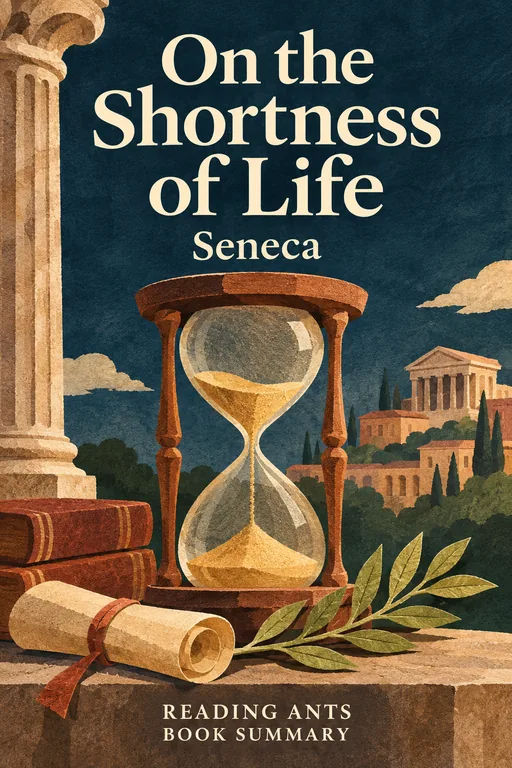
On the Shortness of Life
Original title: De brevitate vitae
The Roman Stoic Seneca argues that life is not short but wasted, and that we can have plenty of time if we use it for what matters, instead of squandering it on busyness, worry and distraction.
Overview
On the Shortness of Life, in Latin De Brevitate Vitae, is an essay written by Seneca around the middle of the first century CE, in the form of a letter to a friend named Paulinus, who held an important administrative post in Rome, in charge of the grain supply. The date is traditional and approximate. Seneca was a philosopher, a playwright and, for a time, an adviser to the emperor Nero. The work belongs to the philosophy of Stoicism, which taught that wisdom lies in focusing on what is within our control, and in living in line with reason. The essay is short, direct and forceful, with vivid images, and speaks to readers across the centuries.
Full Summary
1. A wrong complaint
The idea: Seneca opens by saying that most people complain that life is short and that nature has been unkind. He disagrees. Life, he says, is long enough, and would be sufficient for great things, if it were used well. The problem is that people waste a great part of it, and do not notice. They are generous with money, but careless with time, though time is the one thing that cannot be recovered.
In real life: A person who would never throw away money may spend hours scrolling without noticing.
2. The busy and the occupied
The idea: Seneca turns to those who are always busy, with business, ambition and social duties, who look important but are not truly living. They put off living until some future time when their work will be done, and so they reach the end of life unprepared. He describes how people are consumed by the pursuit of wealth, honors and pleasure, and by the need to please others. He suggests that being busy is not the same as having a purposeful life.
In real life: A person who says, “I’ll relax when this project is finished,” and then starts another, may never find a time to rest.
3. Time is stolen
The idea: Seneca says that others can take our time, if we let them. He recommends guarding it as carefully as property. He notes that people guard their property fiercely but hand out their time freely, and he imagines asking an old man to add up how much of his years went to creditors, clients and quarrels. He also says that busy people forget the past, neglect the present and dread the future. Seneca claims that the present is very brief, and that busy people lose even that.
In real life: Worrying about a test while you are supposed to be enjoying a day out spoils both.
4. Learning from the wise
The idea: Seneca argues that the best use of time is philosophy, the study of how to live well. Those who spend time on the wisdom of the great thinkers of the past, he says, gain an enormous gift: they can talk with the wisest people of all ages, and add the experience of others to their own lives. In this way, a person who studies can live many lives, and is never alone. Seneca says that the past is safe, since fortune cannot harm it.
In real life: Reading a good book is like having a conversation with someone who lived centuries ago.
5. The folly of postponing
The idea: The essay returns repeatedly to the danger of waiting for the right time to live. Seneca notes that people make plans for retirement, as if it were guaranteed, and forget that death can come at any time. Even those who live long, he says, have often lived little. He urges his readers to live now instead of waiting, since everything in the future is uncertain.
In real life: If you want to learn an instrument or visit a friend, starting this week is better than waiting for a quieter year.
6. Advice to his friend
The idea: Finally, Seneca advises Paulinus to give up his demanding public office and to turn to a quieter life of study and reflection. He says that the greater part of Paulinus’s life has already been given to his country, and that it is time to take some of it for himself. Seneca points out that managing the grain supply is a risky job, since a hungry people will not listen to reason, and he urges Paulinus to move on to larger subjects while he is still strong. He ends by describing busy men who cling to work even in old age and who die with their affairs unfinished.
In real life: Sometimes the wisest decision is to step back from commitments that no longer serve you.
Why It Matters
On the Shortness of Life is among the most widely read works of Stoic philosophy, and it has been translated into many languages. Its message that time is our most precious resource, and that we waste it through distraction, resonates in a world of constant demands and notifications. The essay is short enough to be read in a sitting, which makes it a common introduction to Stoicism, and it has been quoted by writers, teachers and thinkers for generations. Its warning against postponing life, and its encouragement to learn from the great minds of the past, remain useful and inspiring today.
Key Takeaways
- Life is long enough if used well. The problem is waste, not shortness.
- Guard your time. It is more valuable than money.
- Busyness is not purpose. Being occupied can hide an empty life.
- Do not postpone living. The future is never guaranteed.
- Learn from the wise. Books connect us with the best minds of history.
What We Can Learn
You can start by looking at how you spend a typical day, and asking what is essential and what is waste. Try to set aside time for what you value, such as study, friends, exercise or quiet. Practice saying no to demands that do not matter. Limit the time you give to things that distract, and be present in what you are doing. Make a list of what you hope to do, and take one step today. And read old books, since they can offer perspective on current worries.
Criticism and Counterpoints
Some readers note that Seneca himself was a wealthy statesman, who made a fortune and served an emperor, so that his advice to give up worldly pursuits seems at odds with his own life. Critics have pointed out that his call to retire into study is a luxury that few can afford, and that people with jobs and families cannot simply withdraw. Others find his tone moralizing, or his view of ordinary life too negative. Philosophers also question whether philosophy is the only worthwhile use of time. Defenders say that the essay’s central point about attention is universal.
Who Should Read It
This book is for anyone who feels that time is slipping away, and who would like a short and challenging reminder. It is easy to read in modern translations. Those who want a fuller picture of Stoicism can continue with Seneca’s letters, or with the writings of Epictetus and Marcus Aurelius.
Want the whole book?
A summary is a taste, not the meal. Here is where to find the full book.
You reached the end 🎉
Nicely done. Mark this one as read, and we will suggest what to read next.
Read this next
Meditations
Marcus Aurelius
The private notebook of a Roman emperor, reminding himself daily to accept what he cannot control, to act with justice and kindness, and to remember that life is short.
🕊️ Philosophy & Religion
Enchiridion
Epictetus
Epictetus, a former slave turned Stoic teacher, offers a short handbook of advice on staying calm and free by focusing on what we can control, and accepting what we cannot.
🕊️ Philosophy & Religion
Letters from a Stoic
Seneca
In friendly letters to a younger friend, the Roman Stoic Seneca offers practical advice on how to use time well, face death, handle wealth and misfortune, and train the mind to find peace.
🕊️ Philosophy & Religion
Walden
Henry David Thoreau
Henry David Thoreau describes the two years he spent living simply in a small cabin by Walden Pond in Massachusetts, and argues that people should simplify their lives, spend time in nature and think for themselves.
🕊️ Philosophy & Religion
The Art of War
Sun Tzu
The greatest victory is the one won without fighting, achieved through careful planning, knowing both yourself and your opponent, and using deception, flexibility and timing.
🕊️ Philosophy & Religion
Tao Te Ching
Laozi
The deepest wisdom is to live in harmony with the Tao, the natural way of the universe, by being humble, gentle and simple, and by acting without force.
🕊️ Philosophy & ReligionWant something different?
Pick another topic and we will show you three books to start with.