 Reading Ants
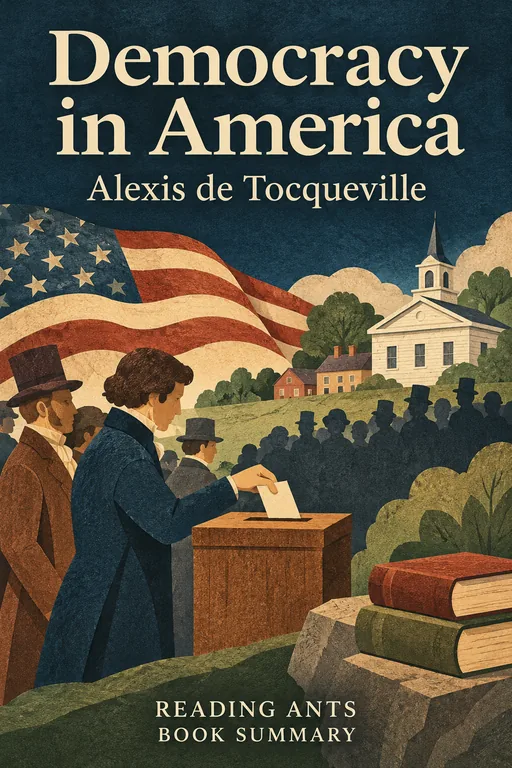
Democracy in America
Original title: De la démocratie en Amérique
After touring the United States in the 1830s, the young Frenchman Alexis de Tocqueville wrote a penetrating study of American democracy, praising its energy and liberty, and warning about its dangers, such as the tyranny of the majority and a retreat into private life.
Overview
Democracy in America was published in two volumes, in 1835 and 1840, by Alexis de Tocqueville, a French aristocrat and political thinker. In 1831, he and his friend Gustave de Beaumont traveled across the United States for nine months, officially to study the prison system, but also to observe the new democratic society. Tocqueville was interested in what democracy might mean for the future of Europe, where old aristocracies were being challenged. His book is both a description of American institutions and customs, and a reflection on the effects of equality on society, politics and the human spirit.
Full Summary
1. The great fact of equality
The idea: Tocqueville says that what struck him most in America was the equality of conditions: the lack of a hereditary aristocracy and the general belief that all people are equal. He sees this as a historical trend that is advancing in Europe too, and which cannot be stopped. The question is whether democracy will lead to liberty or to a new kind of servitude. He wants to understand what makes it work well in America, in order to guide those at home.
In real life: In a school where every student is treated as equal, the questions of who leads and who follows become more open.
2. Local government and associations
The idea: Tocqueville praises the New England town meetings and local institutions, in which citizens learn to manage common affairs and to take part in public life. He is also impressed by the American habit of forming voluntary associations for every purpose, from founding schools and hospitals to building inns and churches, which allows people to do together what none could do alone. These habits, he says, are schools of liberty, and protect against a distant, powerful state.
In real life: A neighborhood group that organizes a cleanup learns how to cooperate and solve problems.
3. The tyranny of the majority
The idea: One of his most famous warnings is about the tyranny of the majority. In a democracy, he says, the opinion of the majority may become so powerful that it crushes dissent, not through violence but by social pressure, and by making unpopular views seem unthinkable. He observes that in America there is little real independence of thought, because people fear to differ from the crowd. He suggests that the American habit of leaving administration to local officials, the influence of the legal profession and the jury system help to soften it, though he warns that no sure barrier exists in the laws themselves.
In real life: A student who disagrees with the class may stay silent to avoid ridicule.
4. Religion, morals and the spirit of liberty
The idea: Tocqueville notes that religion, especially Christianity in its various forms, plays a large role in American life, and that it supports democratic society by teaching moral restraint and a sense of purpose, even though it is separate from the government. He claims that the spirit of religion and the spirit of liberty work together in America, unlike in France. He also describes the American habit of “self-interest rightly understood,” in which people find it in their interest to help one another.
In real life: A person who volunteers may do so out of kindness and also because a good community benefits everyone.
5. Race, slavery and the Native peoples
The idea: Tocqueville gives a serious and sad account of the situation of Black Americans and Native Americans. He sees slavery as a great evil, and doubts that the two races can live together in equality, expressing racist assumptions of his time. He describes the dispossession and removal of Native nations, such as the forced march of tribes from the southeastern states, with dismay. He predicts that the problem of race will be a serious threat to the Union.
In real life: The ideals of equality in a country may be contradicted by its treatment of some of its people.
6. The dangers of soft despotism
The idea: In the second volume, Tocqueville warns of a new kind of tyranny that democracy might produce. Citizens, absorbed in their private pursuits, comfort and individualism, may withdraw from public life and leave it to a vast, benevolent state that takes care of their needs, but treats them like children. This “soft despotism” does not break the will but softens and guides it. He urges that people take part in public affairs to avoid this fate.
In real life: A community that leaves all decisions to officials may find that it can no longer make them for itself.
Why It Matters
Democracy in America is regarded as one of the most insightful books ever written about American society, and a major work of political science. Tocqueville anticipated many features of democratic life that remain relevant, such as individualism, conformity, the power of public opinion and the role of civil associations. His warnings about the tyranny of the majority and soft despotism are widely cited. The book has been studied by politicians, scholars and citizens, and quoted in debates about civil society, equality and freedom. It is also a valuable record of the United States in the 1830s as seen by a thoughtful outsider.
Key Takeaways
- Equality is a powerful force. It shapes politics and culture.
- Local participation builds liberty. Citizens learn self-government in small groups.
- Majorities can oppress. Social pressure can limit freedom of thought.
- Civic associations matter. Voluntary groups strengthen democracy.
- Beware of passivity. Withdrawal into private life invites soft despotism.
What We Can Learn
Think about how you can take part in your community, by joining clubs, helping neighbors or voting. Be willing to speak up when you hold a minority view, and to listen to those who do. Notice how public opinion can shape what you feel able to say, and ask whether you are free to think for yourself. Support institutions that protect individual rights. And reflect on the gap between ideals and practice, in your own country and in others, and what can be done to close it.
Criticism and Counterpoints
Historians point out that Tocqueville’s view of America was limited, since he saw only part of the country, and relied on the views of upper-class informants. His assumptions about race and gender reflect his time. Some say that he overestimated the conformity of Americans and underestimated the role of conflict and inequality, including the growth of industrial capitalism. Others note that his predictions were not always correct, though some were strikingly accurate. His aristocratic background shaped his views, and the book is occasionally repetitive. Still, its insight is widely recognized.
Who Should Read It
This book is for readers interested in politics, history and how societies work. It is long, and the translation matters, but it can be read in selected chapters. Those who prefer a shorter introduction may start with a summary or an abridged edition.
Want the whole book?
A summary is a taste, not the meal. Here is where to find the full book.
You reached the end 🎉
Nicely done. Mark this one as read, and we will suggest what to read next.
Read this next
The Federalist Papers
Alexander Hamilton, James Madison and John Jay
A series of eighty-five essays written in 1787 and 1788 by three of the founders of the United States to persuade the people of New York to approve the new Constitution, explaining how its system of government would work and why it was needed.
⚖️ Politics & Society
The Social Contract
Jean-Jacques Rousseau
Rousseau asks how people can live together under laws and still be free, and argues that legitimate government rests on an agreement in which citizens obey only the "general will" that they make together.
🕊️ Philosophy & Religion
Bowling Alone
Robert D. Putnam
Political scientist Robert Putnam shows with a wealth of data that Americans have become less connected to one another in clubs, churches, unions and neighborhoods since the 1960s, and argues that this loss of social capital weakens democracy and well-being.
⚖️ Politics & Society
The End of History and the Last Man
Francis Fukuyama
Francis Fukuyama argues that the end of the Cold War suggests that liberal democracy may be the final stage of political development, and asks whether people who live in such a system will be satisfied or will long for new struggles.
🏛️ History
The Souls of Black Folk
W. E. B. Du Bois
In fourteen eloquent essays, W. E. B. Du Bois examines the lives, struggles and hopes of Black Americans at the start of the twentieth century, and argues that the great problem of the age is the color line.
⚖️ Politics & Society
The Prince
Niccolo Machiavelli
A Renaissance diplomat advises rulers to judge their actions by results rather than morality, arguing that a successful leader must sometimes be cunning and ruthless to win and keep power.
⚖️ Politics & SocietyWant something different?
Pick another topic and we will show you three books to start with.