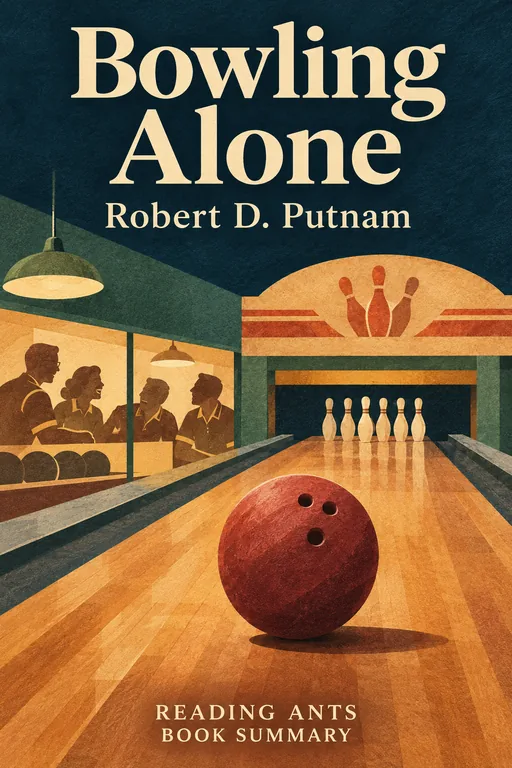
Political scientist Robert Putnam shows with a wealth of data that Americans have become less connected to one another in clubs, churches, unions and neighborhoods since the 1960s, and argues that this loss of social capital weakens democracy and well-being.
Overview
Bowling Alone: The Collapse and Revival of American Community was published in 2000 by Robert D. Putnam, a professor at Harvard University. It grew out of an essay in 1995, which used a striking example: the number of Americans who bowl has increased, but the number in bowling leagues has fallen sharply, so people bowl alone. Putnam gathered data from many sources to show a broad decline in civic and social participation. He uses the term social capital for the networks, norms and trust that allow people to cooperate. The book is a detailed study, and a call to action.
Full Summary
1. The concept of social capital
The idea: Putnam introduces social capital, the value of social connections, which he compares to physical and human capital. Just as tools and education make people more productive, networks of trust make communities function better. He distinguishes between bonding capital, which ties together people like each other, and bridging capital, which connects different groups. Both are valuable, though they work differently, and both can have downsides.
In real life: A neighborhood where people know and trust each other can solve problems faster.
2. The decline of civic and political participation
The idea: The author shows that, since the 1960s, Americans have become less likely to vote, attend public meetings, work for a political party or serve on committees. Membership in many civic organizations, such as parent-teacher associations, fraternal groups and the League of Women Voters, has declined. Though many people now give money to causes, active involvement has fallen. Putnam says that these trends are consistent and widespread across a variety of groups.
In real life: A school club that once had many active members may now have only a few.
3. Religion, work and informal connections
The idea: The decline appears also in other areas. Attendance at religious services has dropped somewhat, and the share of workers in unions has fallen. Even informal connections have weakened: families eat dinner together less often, people have fewer friends over, and play cards and picnic less. Putnam documents these trends with surveys and time-use studies, showing a slow erosion in the habits of togetherness.
In real life: Evenings that were once spent visiting neighbors are now spent on the couch.
4. Why the change? Four main causes
The idea: Putnam looks for the reasons. He finds that pressure of time and money, including the rise of two-career families, plays a part, but not a large one. Suburban sprawl and commuting have also reduced contact. The biggest factor, he says, is generational change: the civic-minded generation that grew up during the Depression and the war is being replaced by less engaged generations. Next comes the effect of electronic entertainment, especially television, which privatized leisure.
In real life: Spending hours watching television at home leaves less time to meet people.
5. Consequences of lost social capital
The idea: The book argues that social capital matters. Communities with high levels of it have better schools, safer neighborhoods, better health, stronger economies and more effective governments. People who are socially connected tend to be happier and healthier, and live longer. Putnam presents data comparing states in the United States, showing that those with high social capital do better in many measures of child welfare and public safety.
In real life: Neighborhoods where people look out for each other often have less crime.
6. What can be done? A new Progressive Era
The idea: In the final part, Putnam looks to the past. About a hundred years earlier, in the Gilded Age and Progressive Era, Americans faced similar problems of social disruption, and responded by creating many new organizations, from the Boy Scouts to the NAACP. He calls for a new wave of civic invention, in schools, workplaces, religious institutions, cities and the arts, and in using technology to connect people. He offers general directions rather than a detailed program, saying that the specific reforms of the earlier era would no longer fit but that its spirit of invention should.
In real life: Starting a neighborhood group or a team is a small way to build connections.
Why It Matters
Bowling Alone was highly influential, and its title became a shorthand for the decline of community life. The book was widely discussed by politicians and commentators, and helped to put the idea of social capital on the public agenda. It inspired research in many fields, and efforts to rebuild community in neighborhoods, schools and online. Putnam later wrote other books on inequality and on religion in America. Whether or not one accepts every part of his analysis, the book’s central message, that relationships matter for the health of societies and individuals, is widely accepted.
Key Takeaways
- Social ties have value. Networks of trust help communities function.
- Participation has declined. Fewer people join clubs, vote or meet informally.
- Technology and generational change played a role. Entertainment and new cohorts shifted habits.
- Connected communities do better. They show better outcomes in many areas.
- Renewal is possible. Past generations created new institutions.
What We Can Learn
You can apply the book by joining or starting a group, such as a sports team, a choir or a volunteer project, and by showing up regularly. Make a point of getting to know your neighbors, and invite friends over. Limit time spent alone on screens, and use technology to meet in person. If you are in a position of leadership, think about how to make it easier for people to take part. And look for ways to build bridges between groups that may not usually meet.
Criticism and Counterpoints
Critics say that Putnam focuses on traditional forms of association, and overlooks new forms of connection, such as online communities, support groups and informal networks, that have grown. Others argue that the decline may be exaggerated, since some measures show different trends, and that his nostalgia for the mid-century era overlooks the exclusion of women and minorities in many of the old organizations. Scholars have also questioned the claim that television is the main culprit. Some say that his proposals are vague. Still, the book is widely respected.
Who Should Read It
This book is for readers interested in community, politics and society. It is long, with many charts and statistics, but the main ideas are clear. Those who want a shorter version may read the original article, and those who prefer stories may find the data heavy.
Want the whole book?
A summary is a taste, not the meal. Here is where to find the full book.
You reached the end 🎉
Nicely done. Mark this one as read, and we will suggest what to read next.
Read this next
Democracy in America
Alexis de Tocqueville
After touring the United States in the 1830s, the young Frenchman Alexis de Tocqueville wrote a penetrating study of American democracy, praising its energy and liberty, and warning about its dangers, such as the tyranny of the majority and a retreat into private life.
⚖️ Politics & Society
Hillbilly Elegy
J. D. Vance
J. D. Vance recalls growing up in a struggling Ohio steel town in a family from Kentucky's Appalachian hills, marked by poverty and addiction, and uses his story to reflect on the troubles of white working-class America.
⚖️ Politics & Society
The Death and Life of Great American Cities
Jane Jacobs
Jane Jacobs argues that the best cities are lively, mixed and walkable neighborhoods, and that the planning fashions of her day, with highways, towers and rigid zoning, were destroying the very things that make cities work.
⚖️ Politics & Society
Nickel and Dimed
Barbara Ehrenreich
Journalist Barbara Ehrenreich spent months working low-wage jobs in three American cities, to see whether a person could live on such pay, and found that even hard, full-time work often did not cover basic needs.
⚖️ Politics & Society
The Righteous Mind
Jonathan Haidt
Jonathan Haidt argues that moral judgments come mainly from intuition and emotion, not reason, that people's moral instincts rest on several foundations that differ across political groups, and that understanding this can help us to disagree without hating each other.
🧩 Mind & Psychology
The Prince
Niccolo Machiavelli
A Renaissance diplomat advises rulers to judge their actions by results rather than morality, arguing that a successful leader must sometimes be cunning and ruthless to win and keep power.
⚖️ Politics & SocietyWant something different?
Pick another topic and we will show you three books to start with.