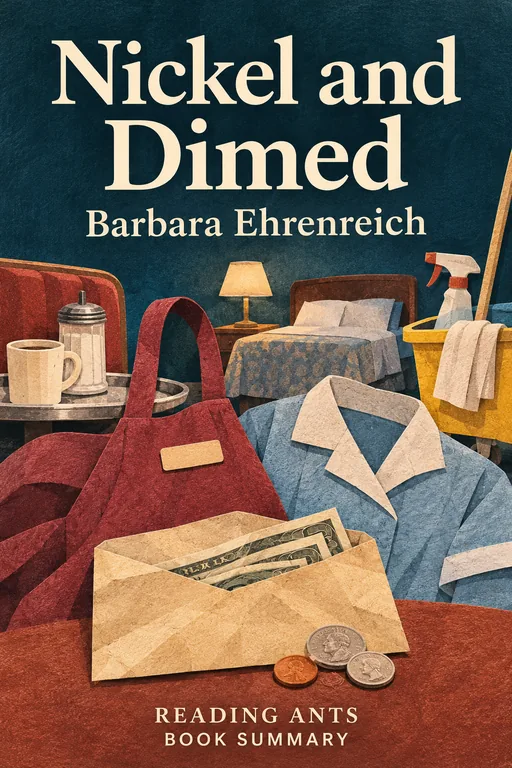
Nickel and Dimed
Journalist Barbara Ehrenreich spent months working low-wage jobs in three American cities, to see whether a person could live on such pay, and found that even hard, full-time work often did not cover basic needs.
Overview
Nickel and Dimed: On (Not) Getting By in America was published in 2001 by Barbara Ehrenreich, an author and social critic who held a doctorate in biology. At a time when welfare reform required many poor people to find jobs, she wondered how they could survive on the wages. In the late 1990s, she took on a series of jobs, as a waitress and hotel housekeeper in Florida, a house cleaner with a maid service and a dietary (kitchen) aide in a nursing home in Maine, and a Wal-Mart employee in Minnesota, living on what she earned. She set rules for herself, such as taking the best-paying job she could find, and recorded the experience. The result was a bestseller.
Full Summary
1. The experiment and the rules
The idea: Ehrenreich explains her aim. She would leave behind her writing career, take the jobs open to an unskilled person, and try to cover rent, food and other costs with her pay. She would not rely on her education or earlier career, and would take the best-paying job offered and the cheapest housing she could find. She acknowledges that she has advantages that real workers do not have, such as good health and no children to support, and that the experiment is limited, since she could leave at any time.
In real life: Trying something for a month is different from living with it for life, and the author knows it.
2. Waitressing in Florida
The idea: In Key West, she works as a waitress in a family restaurant, and later also as a hotel housekeeper. Wages are low, and the tips are unpredictable. She struggles to find affordable housing, and lives in cheap lodgings such as a trailer and a residential motel, with her earnings barely covering the rent. She sees coworkers who live in cars or share rooms. Working two jobs, she finds herself exhausted. She learns that the work is physically demanding and mentally stressful, and the bosses are strict.
In real life: A job that looks easy from the outside may be very tiring when you do it all day.
3. Cleaning houses in Maine
The idea: In Maine, she works for a house cleaning company and in the kitchen of a nursing home, on her hands and knees, scrubbing floors and toilets, under constant time pressure. She sees how workers are closely watched. Many work through pain. She is struck by the invisibility of the people who clean other people’s homes, and the way that the clients often treat them as part of the furniture.
In real life: People who do essential tasks in the background often go unnoticed.
4. Selling in a big-box store in Minnesota
The idea: In the last job, at a large discount store, she works in the women’s clothing department. She describes the orientation, which teaches loyalty and discourages unions, and a culture of surveillance, drug testing and personality tests. Wages are low and hours are unpredictable. She finds that coworkers are friendly and support each other, but that some are in trouble, for example with housing, or in debt. She tries to understand how a family could manage on that pay.
In real life: A workplace that watches every move may make people feel they are not trusted.
5. The hidden costs of being poor
The idea: Throughout the book, Ehrenreich shows how poverty costs more. Without a deposit for an apartment, people live in motels at a higher daily rate. Without a kitchen, they buy fast food. A lack of health insurance leads to crises. Low pay, she says, is not the only obstacle, but also the lack of control over one’s time, and the humiliation of constant rules and tests. She finds that she can rarely make ends meet, even working hard.
In real life: A person who cannot pay a large sum at once may end up paying much more over time.
6. Conclusion: who pays for cheap goods?
The idea: In the final chapter, the author concludes that low-wage workers are, in effect, giving a gift to the rest of society in the form of cheap labor, and that they are the true philanthropists. She calls for higher wages, affordable housing and better treatment of workers, and says that society should be ashamed that people who work full time cannot afford a decent life. She predicts that low-wage workers will one day demand fair treatment, and that everyone will be better off when they do.
In real life: Next time you eat at a restaurant, you may think about the pay of those who serve you.
Why It Matters
Nickel and Dimed was a bestseller and a landmark in the literature of poverty, which led to a national debate about the minimum wage, working conditions and the welfare system. It was widely read in schools and colleges. Ehrenreich’s approach, of becoming a participant, made the problem concrete, and influenced a generation of journalists. The book contributed to the movement for a living wage, and to conversations about the dignity of work. Later editions added reflections on the years since. It also shows how easy it can be to overlook those who do the work that keeps society running.
Key Takeaways
- Full-time work may not be enough. Low wages can fall short of covering basic costs.
- Poverty is expensive. Being poor adds extra costs.
- Work can be exhausting and humiliating. Surveillance and unpredictability add strain.
- The work is invisible. Society relies on people it rarely notices.
- Wages and housing need attention. Reforms could change many lives.
What We Can Learn
Next time that you meet someone who is serving you, whether a cashier or cleaner, treat them with courtesy and notice what their job involves. Learn what a living wage would be in your area, and how it compares with the minimum. Support fair pay and decent conditions. If you work part-time, ask what rights you have. Remember that the author’s experiment had limits, and that real families face even greater difficulties. And consider reading other accounts by people who have lived in such jobs.
Criticism and Counterpoints
Critics say that Ehrenreich’s experiment was a stunt, since she knew that she could leave at any time and did not have the full burdens of a real low-wage worker, such as children or illness. Others argue that her sample of three jobs in a short time does not prove general conclusions, and that she might have found better pay with more effort. Some conservative reviewers claim that she overlooked the opportunities for advancement and the role of personal choices. Others say that she was condescending in some descriptions of coworkers. Supporters respond that the book gives an honest picture.
Who Should Read It
This book is for readers interested in work, poverty and economic fairness, including students and employers. It is lively, witty and angry. Those who want a statistical analysis of low-wage work should consult economic studies in addition.
Want the whole book?
A summary is a taste, not the meal. Here is where to find the full book.
You reached the end 🎉
Nicely done. Mark this one as read, and we will suggest what to read next.
Read this next
Evicted
Matthew Desmond
Sociologist Matthew Desmond lived among poor tenants and landlords in Milwaukee and shows that eviction is not just a result of poverty but a major cause of it, trapping families in a cycle of lost homes, jobs and hope.
⚖️ Politics & Society
Hillbilly Elegy
J. D. Vance
J. D. Vance recalls growing up in a struggling Ohio steel town in a family from Kentucky's Appalachian hills, marked by poverty and addiction, and uses his story to reflect on the troubles of white working-class America.
⚖️ Politics & Society
Behind the Beautiful Forevers
Katherine Boo
Journalist Katherine Boo spent years in a Mumbai slum beside the airport and tells, through the lives of its residents, how hope, ambition, corruption and injustice shape the struggle to escape poverty in a booming India.
⚖️ Politics & Society
The New Jim Crow
Michelle Alexander
Civil rights lawyer Michelle Alexander argues that the American criminal justice system, especially the War on Drugs, has functioned as a system of racial control that labels many Black men as criminals and strips them of rights, much as Jim Crow laws once did.
⚖️ Politics & Society
Fast Food Nation
Eric Schlosser
Journalist Eric Schlosser traces how the fast food industry transformed American food, work, farming and culture, and reveals the hidden costs of cheap burgers for workers, cattle ranchers, consumers and communities.
⚖️ Politics & Society
The Prince
Niccolo Machiavelli
A Renaissance diplomat advises rulers to judge their actions by results rather than morality, arguing that a successful leader must sometimes be cunning and ruthless to win and keep power.
⚖️ Politics & SocietyWant something different?
Pick another topic and we will show you three books to start with.