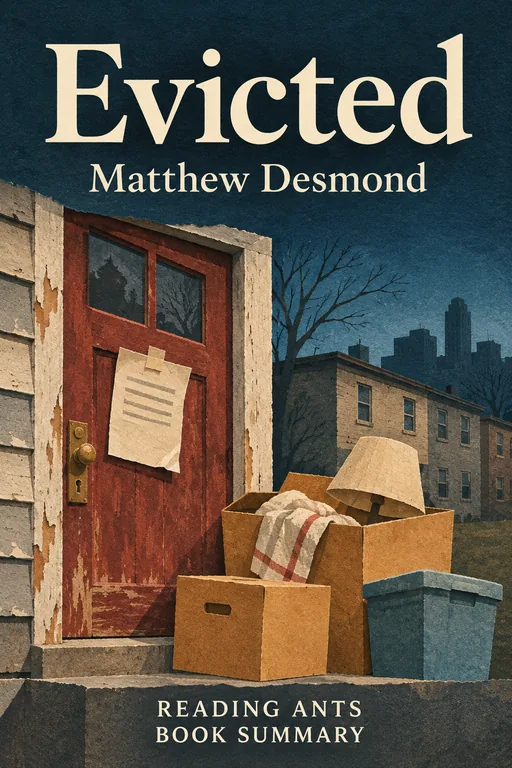
Evicted
Sociologist Matthew Desmond lived among poor tenants and landlords in Milwaukee and shows that eviction is not just a result of poverty but a major cause of it, trapping families in a cycle of lost homes, jobs and hope.
Overview
Evicted: Poverty and Profit in the American City was published in 2016 by Matthew Desmond, a sociologist who had himself lived in a trailer park and a rooming house in Milwaukee in 2008 and 2009 as part of his research. He followed eight families, as well as two landlords, and combined their stories with data on evictions. The book won the Pulitzer Prize for general nonfiction. It describes the daily struggle of families who spend most of their income on rent, and the business of landlords, and argues that housing should be seen as a basic need.
Full Summary
1. Rent that takes most of the income
The idea: Desmond begins by showing that for many poor families in American cities, rent consumes more than half of their income, and for about one in four, more than seventy percent. After paying it, very little is left for food, clothes and bills. A small shock, such as a lost shift or a car repair, can make it impossible to pay. He says that the cost of housing has risen faster than wages, while public help is available to only a minority of those who qualify.
In real life: If most of your money goes to one bill, even a small surprise can cause a crisis.
2. The tenants and their stories
The idea: The book introduces the people whom the author lived among, including a single mother whose rent took about 88 percent of her income, a nurse whose drug addiction cost him his career, and a man who had lost both legs. Desmond shows their efforts, mistakes and kindness, and avoids both blaming and romanticizing them. He says that they are doing what they can with few options, and that the system makes it hard to recover.
In real life: It is easy to judge someone’s choices without seeing the limited options they had.
3. Landlords and the business of poverty
The idea: The author also follows landlords, including one who owns a trailer park and another who owns inner-city apartments. He shows that landlords too are caught in difficult economics, but that some find it profitable to rent to the poor, with high rents and low upkeep, and use the threat of eviction as a tool. He explains that a landlord can often make more by evicting and re-renting than by waiting, and that the law mostly supports owners.
In real life: A rule that makes it easy to remove a tenant can create an incentive to do so.
4. The process of eviction
The idea: Desmond describes how an eviction takes place: a notice, a quick court hearing, where tenants often do not appear or do not have a lawyer, and then the removal of belongings by movers and sheriff’s deputies. Many cases are for small amounts. Families may lose their possessions, which are put in storage or on the street. He observes that in some neighborhoods eviction has become common, especially for Black women, and says that it is a routine part of life.
In real life: Without a lawyer, a person facing a legal process may not understand their rights.
5. The consequences
The idea: The book shows that eviction brings many harms. People lose their jobs because of the disruption, children change schools, and families may end up in worse housing, in more dangerous neighborhoods, or in shelters. A record of eviction makes it hard to rent again, and some landlords refuse such applicants. Eviction is also linked to depression. Desmond argues that eviction is thus a cause of poverty, not only a result.
In real life: Losing a home affects work, school, health and friendships all at once.
6. Solutions: a right to housing
The idea: In the last chapter, Desmond proposes solutions. He calls for expanding the housing voucher program so that every family below a certain income would receive one and pay about a third of its income on housing, as the most effective way to reduce evictions and homelessness. He argues that a decent home should be seen as a basic right, since without stable shelter everything else falls apart, and says that families would then be able to spend more on food, schooling and savings.
In real life: A safe home makes it easier to hold a job, to study and to stay healthy.
Why It Matters
Evicted drew national attention to a problem that had been little discussed, and changed the debate on poverty. Its method, in which the author lived among his subjects, gave it an unusual depth. It was named a best book of the year by many publications, and Desmond went on to lead the Eviction Lab, a project that collects data on evictions. The book also shows how a sociologist can combine personal stories with data. The Pulitzer Prize and the book’s popularity made eviction a part of the public conversation, and it remains a key text on housing and inequality.
Key Takeaways
- Rent burdens are heavy. Many families spend most of their income on housing.
- Eviction is a cause of poverty. It disrupts jobs, schools and health.
- The system favors owners. Tenants often lack legal help.
- Stories reveal what numbers cannot. Individual lives show the human cost.
- Housing is a basic need. Stable housing supports everything else.
What We Can Learn
The book invites you to think about the role of housing in a person’s life, and to notice the effects of insecurity. Learn about the housing laws and assistance programs in your area. Support efforts to give tenants access to legal advice. When you hear that someone is evicted, try to understand the conditions before judging. And recall that those who are poor are not a separate species: anyone could face a crisis. If you are a student, consider volunteering with a housing organization.
Criticism and Counterpoints
Some critics say that the study of a single city, Milwaukee, in one period, may not represent all of the United States, and that the small sample of families limits what can be concluded. Others note that the book gives less attention to the small landlords’ difficulties and to other factors, such as the supply of housing and zoning restrictions that raise prices. Some economists question whether vouchers alone would solve the problem without increasing rents. Some reviewers argued that eviction may worsen existing problems such as addiction, unemployment and domestic violence more than it creates them. Still, the main findings on the prevalence and impact of evictions have been supported by later research.
Who Should Read It
This book is for readers interested in poverty, housing, sociology and public policy. It reads like a narrative, with real characters, and is easy to follow. Those who are sensitive to descriptions of hardship should be prepared for sad scenes, and those who want to see all sides should also read about housing economics.
Want the whole book?
A summary is a taste, not the meal. Here is where to find the full book.
You reached the end 🎉
Nicely done. Mark this one as read, and we will suggest what to read next.
Read this next
Nickel and Dimed
Barbara Ehrenreich
Journalist Barbara Ehrenreich spent months working low-wage jobs in three American cities, to see whether a person could live on such pay, and found that even hard, full-time work often did not cover basic needs.
⚖️ Politics & Society
The New Jim Crow
Michelle Alexander
Civil rights lawyer Michelle Alexander argues that the American criminal justice system, especially the War on Drugs, has functioned as a system of racial control that labels many Black men as criminals and strips them of rights, much as Jim Crow laws once did.
⚖️ Politics & Society
Hillbilly Elegy
J. D. Vance
J. D. Vance recalls growing up in a struggling Ohio steel town in a family from Kentucky's Appalachian hills, marked by poverty and addiction, and uses his story to reflect on the troubles of white working-class America.
⚖️ Politics & Society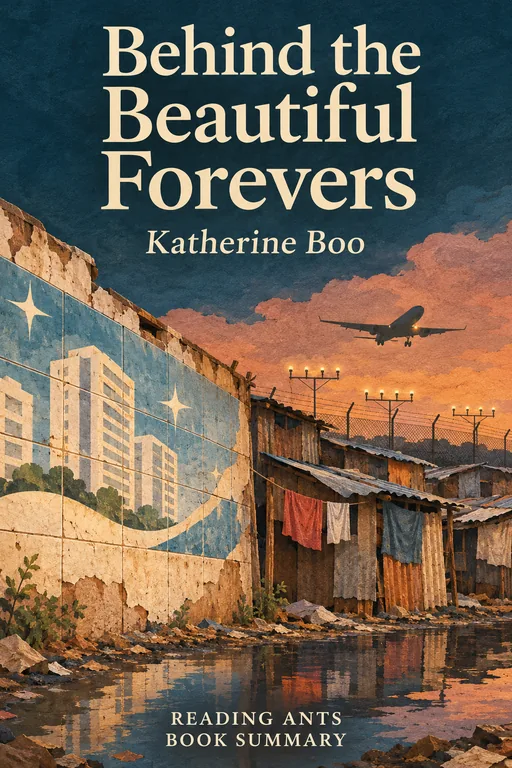
Behind the Beautiful Forevers
Katherine Boo
Journalist Katherine Boo spent years in a Mumbai slum beside the airport and tells, through the lives of its residents, how hope, ambition, corruption and injustice shape the struggle to escape poverty in a booming India.
⚖️ Politics & Society
The Warmth of Other Suns
Isabel Wilkerson
Isabel Wilkerson tells the story of the Great Migration, in which about six million Black Americans left the South for cities in the North and West, through the lives of three people who made the journey.
🏛️ History
The Prince
Niccolo Machiavelli
A Renaissance diplomat advises rulers to judge their actions by results rather than morality, arguing that a successful leader must sometimes be cunning and ruthless to win and keep power.
⚖️ Politics & SocietyWant something different?
Pick another topic and we will show you three books to start with.