 Reading Ants
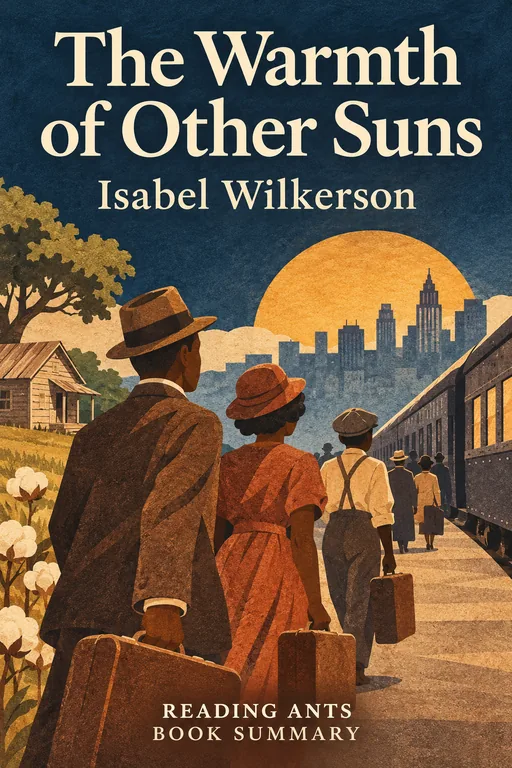
The Warmth of Other Suns
Isabel Wilkerson tells the story of the Great Migration, in which about six million Black Americans left the South for cities in the North and West, through the lives of three people who made the journey.
Overview
The Warmth of Other Suns: The Epic Story of America’s Great Migration was published in 2010 by Isabel Wilkerson, a journalist who had earlier won a Pulitzer Prize. Between about 1915 and 1970, millions of African Americans fled the Jim Crow South, where they faced segregation, violence and limited economic opportunity, and moved to cities such as Chicago, New York and Los Angeles. Wilkerson interviewed more than a thousand people over about fifteen years and chose to follow three in detail, who left for Chicago, New York and Los Angeles. She also describes the wider history that shaped their choices.
Full Summary
1. Why people left the South
The idea: Wilkerson explains that after the end of slavery, Black Southerners faced a system of laws and customs, known as Jim Crow, that kept them separate and unequal. Many worked as sharecroppers on land owned by others, and were kept in debt. Violence, including lynching, was a constant threat, and a Black person who challenged the rules could lose their life or land. These pressures pushed people to leave, while the promise of jobs and freedom in the North pulled them.
In real life: When a place offers you no fair chance, a move may be the only way to build a different life.
2. Ida Mae: from the cotton fields to Chicago
The idea: Ida Mae Brandon Gladney was a sharecropper’s wife in Mississippi. After her husband’s cousin was brutally mistreated by a plantation owner and the family saw little future in sharecropping, she and her husband decided to leave in 1937. They had first thought of following her sister to Milwaukee, but they took a train and settled in Chicago, where they found work, lived in cramped and costly housing, and raised their children. Wilkerson shows her as a person of quiet determination who carried her faith and her resourcefulness to a new place.
In real life: A family who moves to a strange place has to start from nothing, using only courage and what they can carry.
3. George: a young man and his escape
The idea: George Swanson Starling was a young citrus worker in Florida, who organized his fellow workers to ask for fair pay. When he learned that grove owners were angry and that his life might be in danger, he fled in the 1940s. He went to New York, where he found a job on the railroads, working on passenger trains, and bought a house in Harlem. Wilkerson shows how he built a life in the North, helped other migrants and supported the civil rights cause, but also regretted the education he never finished.
In real life: Standing up for a group can bring great risks, and sometimes the safe choice is to move on.
4. Robert: a doctor who drove west
The idea: Robert Joseph Pershing Foster was a talented surgeon from Monroe, Louisiana, who faced barriers because of his race. In 1953, after serving as an Army surgeon, he decided to make a new start in Los Angeles. He drove across the country, and on the way some hotels refused to give him a room because of his race. In California, he built a medical practice, treated many Southern migrants and well-known patients, such as the singer Ray Charles, and became a respected figure in the community. His story shows that even well-educated people were pushed by the system to leave.
In real life: Talent and effort do not always receive fair rewards, and sometimes people have to go elsewhere to use them.
5. The North was not paradise
The idea: Wilkerson shows that the migrants found better wages and more freedom, but also new kinds of discrimination. They were often limited to certain neighborhoods and kept out of some jobs and unions. Some white residents responded with hostility, and there were riots and conflicts. Black communities in cities grew and created new institutions, churches, businesses and music, and had a growing political voice.
In real life: A new place can bring both opportunity and unfairness, and newcomers often work to change the rules.
6. A changed nation
The idea: The Great Migration changed the United States. It moved Black Americans from rural areas to cities, increased their political influence and helped to give rise to the civil rights movement. It also shaped culture, from jazz and blues to literature. Wilkerson says that the migrants were like immigrants within their own country, who left in search of freedom and opportunity. She argues that this story deserves to be seen as one of the major movements in American history.
In real life: When many people change where they live, the country they move to changes too.
Why It Matters
The Warmth of Other Suns was a New York Times bestseller, won the National Book Critics Circle Award and many other prizes, and is widely regarded as a landmark work on a part of American history that was little known to many readers. By following three real people, Wilkerson turned statistics into a human story, and showed the courage involved in leaving home. The book also changed the way that people think about migration in the United States, and Wilkerson placed the story within the long American tradition of people moving in search of freedom. It later inspired a ballet production, and a television series based on it was announced. For many readers, it helped to explain how the nation’s cities and culture came to look the way they do.
Key Takeaways
- The migration was massive. Millions left the South over half a century.
- People moved for freedom and work. Violence and injustice pushed them, and opportunity pulled them.
- Individual stories matter. Personal accounts reveal what numbers cannot.
- New places brought new challenges. Discrimination did not end at the Mason-Dixon line.
- The effects were lasting. The migration shaped politics, culture and cities.
What We Can Learn
Reading this book can help us understand the roots of the places where we live. You can ask older relatives or neighbors how they or their families came to your community. It encourages empathy for people who leave their homes, whether they cross a border or a state line. It shows that ordinary people make history through their decisions. And it reminds us that justice and opportunity are not just matters of law, but of daily life, and that each generation can add to the story.
Criticism and Counterpoints
By design, the book follows three people who left, so it gives less attention to the many Black Southerners who stayed, and three life stories cannot show every kind of experience among millions of migrants. It is also long, more than six hundred pages, and it moves between personal narrative and general history, which some readers find slows the pace. Despite these points, it is widely praised for its research and its humane voice.
Who Should Read It
This book is for readers who like history told through people, and for anyone who wants to understand the origins of modern American cities and the civil rights era. It is long but readable. It contains accounts of racial violence that may be upsetting, so younger readers may wish to read it with a parent or teacher.
Want the whole book?
A summary is a taste, not the meal. Here is where to find the full book.
You reached the end 🎉
Nicely done. Mark this one as read, and we will suggest what to read next.
Read this next
Caste: The Origins of Our Discontents
Isabel Wilkerson
Isabel Wilkerson argues that the United States has long been organized by an unspoken caste system, in which a person's place is fixed at birth by race, and she compares it with the caste systems of India and Nazi Germany.
🏛️ History
Between the World and Me
Ta-Nehisi Coates
In a letter to his teenage son, Ta-Nehisi Coates describes what it means to live in a Black body in America, and reflects on fear, history and the struggle to be free.
⚖️ Politics & Society
Team of Rivals
Doris Kearns Goodwin
Historian Doris Kearns Goodwin shows how Abraham Lincoln won the Republican nomination in 1860 against more famous rivals, and then brought those same rivals into his cabinet and used their talents to lead the nation through the Civil War.
🏛️ History
Bury My Heart at Wounded Knee
Dee Brown
Dee Brown tells the history of the American West from 1860 to 1890 as seen by the Native peoples who lost their lands, showing the broken treaties, the wars and the massacres that ended their independence.
🏛️ History
The Color Purple
Alice Walker
Told in letters, the story follows Celie, a poor Black woman in rural Georgia who survives abuse and loss, and through the love of other women finds her voice, her independence and joy.
✨ Modern Fiction
Sapiens: A Brief History of Humankind
Yuval Noah Harari
Humans came to rule the planet not because we are the strongest animals but because we can believe in shared stories (gods, nations, money, companies) that let millions of strangers cooperate.
🏛️ HistoryWant something different?
Pick another topic and we will show you three books to start with.