 Reading Ants
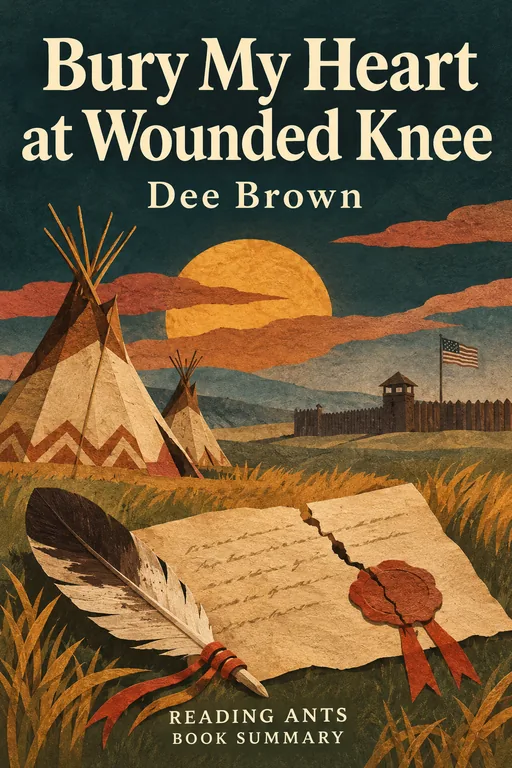
Bury My Heart at Wounded Knee
Dee Brown tells the history of the American West from 1860 to 1890 as seen by the Native peoples who lost their lands, showing the broken treaties, the wars and the massacres that ended their independence.
Overview
Bury My Heart at Wounded Knee: An Indian History of the American West was published in 1970 by Dee Brown, an American writer and librarian. Most earlier books on the West were written from the viewpoint of settlers, soldiers and the government. Brown set out to tell the story from the perspective of Native Americans, using the records of treaty councils and other meetings with officials, newspaper interviews, firsthand accounts and official documents, quoting Native speakers wherever he could. He covers about thirty years, in which the tribes of the Plains, the Southwest and the Northwest were pushed onto reservations. The title comes from a line in the 1927 poem “American Names” by Stephen Vincent Benet.
Full Summary
1. The Long Walk and war in the Southwest
The idea: After an introductory chapter, Brown’s main account begins with the Navajo, who in 1864 were rounded up by the army and forced to walk hundreds of miles to a reservation in New Mexico, in an event known as the Long Walk. Many died of hunger and cold. He also describes the wars with the Apache, who resisted for decades under leaders such as Cochise. He shows that the government often broke its promises and sent soldiers when settlers wanted the land.
In real life: When a powerful group decides that it wants what someone else has, it can find many excuses.
2. Sand Creek and the Plains
The idea: In November 1864, Colorado volunteer soldiers under Colonel Chivington attacked a camp of Cheyenne and Arapaho people at Sand Creek in Colorado, killing many, including women and children, although the Cheyenne leader Black Kettle had been given reason to believe that his people were safe there. Brown describes how this massacre led to more war on the Plains. Native leaders who had wanted peace found that their trust had been betrayed, and many Cheyennes, Arapahos and Lakotas called for revenge.
In real life: A broken promise can turn friends into enemies, and the harm can last for generations.
3. Red Cloud’s war and the treaties
The idea: The Lakota chief Red Cloud led a campaign against soldiers who were building forts along a trail to the gold fields of Montana. In 1866, warriors destroyed a force of soldiers led by Captain William Fetterman. A treaty in 1868 promised the Lakota a large reservation, but the promise did not last. Brown shows that the Native leaders often negotiated carefully, and that the treaties were frequently ignored when gold or settlers arrived.
In real life: An agreement is only worth as much as the willingness to keep it.
4. The Little Bighorn and its consequences
The idea: When gold was found in the Black Hills, thousands of miners entered land that had been promised to the Lakota. In 1876, a combined force of Lakota, Cheyenne and others defeated the cavalry of Lieutenant Colonel George Armstrong Custer at the Little Bighorn. It was a great victory, but it brought a harsh response: the army pursued the tribes relentlessly, and the leaders were forced to surrender. Sitting Bull went to Canada for a time, and Crazy Horse was killed after he surrendered.
In real life: A single victory does not always help if the other side is much stronger and does not stop.
5. The flight of the Nez Perce and other struggles
The idea: Brown tells of the Nez Perce, whose leaders, including Chief Joseph, tried to lead their people to Canada in 1877 rather than live on a reservation, and who were pursued for hundreds of miles. They fought skillfully, but were stopped close to the border. Brown also describes the fate of other groups, such as the Modoc, the Ute and the Apache, to show that the same pattern was repeated across the West.
In real life: A long and brave journey can still end in disappointment when the odds are overwhelming.
6. The reservations and Wounded Knee
The idea: By the late 1880s, most Native peoples were confined to reservations, with their way of life shattered and their buffalo nearly gone. A religious movement called the Ghost Dance, which promised renewal, spread, and the authorities became alarmed. In December 1890, soldiers took a group of Lakota under the chief Big Foot to a camp at Wounded Knee Creek in South Dakota. The next morning, when a shot was fired as the Lakota were being disarmed, the soldiers opened fire and killed many men, women and children, in what is rightly called a massacre. Brown’s story ends here, with a catastrophic loss of land and freedom, though Native peoples survived and continued to resist.
In real life: Fear and misunderstanding can lead to terrible violence, especially when one side has all the weapons.
Why It Matters
Bury My Heart at Wounded Knee stayed on bestseller lists for over a year and had a deep effect on how many Americans think about the West. It appeared during the civil rights era and a time of rising Native American activism, and it helped to challenge the myths of the frontier. Brown’s use of Native voices and records gave readers a view that they had not seen. The book has never gone out of print and has been translated into at least 17 languages. Whatever its limits, it remains an important and widely read work.
Key Takeaways
- There are two sides to history. The story of the West looks different from the perspective of Native peoples.
- Treaties were often broken. Promises to Native nations were disregarded when land was wanted.
- Violence was widespread. Massacres and forced removals caused great suffering.
- Resistance was real. Native leaders fought, negotiated and adapted in many ways.
- Memory matters. Telling hidden stories corrects the record.
What We Can Learn
When you read about history, ask whose voices are heard and whose are missing. Think about the value of keeping promises, in personal life and in public affairs. Learn about the Native peoples of your own region, and consider listening to Native writers and historians today. Be careful about words that make one group seem less human. And consider how past injustices still affect communities, and what fair responses might look like. This history is painful, but facing it honestly is part of respecting everyone.
Criticism and Counterpoints
Some scholars, such as the historian Francis Paul Prucha, have said that the book gives few sources for much of its material apart from direct quotations, that it selects its material to present one point of view, and that it does not place the story within the wider events of the country at the time. Brown himself notes that Native words were usually recorded through white interpreters and officials. Others, such as the historian Ari Kelman, argue that the book reduces Native history to loss and disappearance, which does not show how Native peoples continued to live and to change. The Ojibwe writer David Treuer wrote The Heartbeat of Wounded Knee as a counternarrative about Native life rather than Native death. The book is best read as a pioneering and influential work, to be supplemented by newer studies.
Who Should Read It
This book is for mature readers who want to understand the history of the American West from the Native point of view. It is moving but often painful, with many descriptions of killing. Teachers and students may find it a useful beginning, and readers who want more up-to-date scholarship can follow with newer works by historians of Native peoples.
Want the whole book?
A summary is a taste, not the meal. Here is where to find the full book.
You reached the end 🎉
Nicely done. Mark this one as read, and we will suggest what to read next.
Read this next
1491: New Revelations of the Americas Before Columbus
Charles C. Mann
Charles Mann gathers recent research to argue that the Americas before Columbus held more people, older cities and more skillful land managers than most of us were taught, and that the picture of a pristine, empty wilderness is wrong.
🏛️ History
The Warmth of Other Suns
Isabel Wilkerson
Isabel Wilkerson tells the story of the Great Migration, in which about six million Black Americans left the South for cities in the North and West, through the lives of three people who made the journey.
🏛️ History
King Leopold's Ghost
Adam Hochschild
Adam Hochschild tells how King Leopold II of Belgium took over the Congo as his personal possession, enriched himself through forced labor and terror, and was finally exposed by a global campaign of ordinary people.
🏛️ History
A People's History of the United States
Howard Zinn
Howard Zinn retells American history from the point of view of the people usually left out of textbooks, such as Native Americans, enslaved people, workers, women and protesters, instead of presidents and generals.
🏛️ History
Long Walk to Freedom
Nelson Mandela
Nelson Mandela tells his own story, from a village childhood to twenty-seven years in prison to becoming South Africa's first democratically elected president, and shows how patience, courage and forgiveness helped end apartheid.
👤 Real Lives
Sapiens: A Brief History of Humankind
Yuval Noah Harari
Humans came to rule the planet not because we are the strongest animals but because we can believe in shared stories (gods, nations, money, companies) that let millions of strangers cooperate.
🏛️ HistoryWant something different?
Pick another topic and we will show you three books to start with.