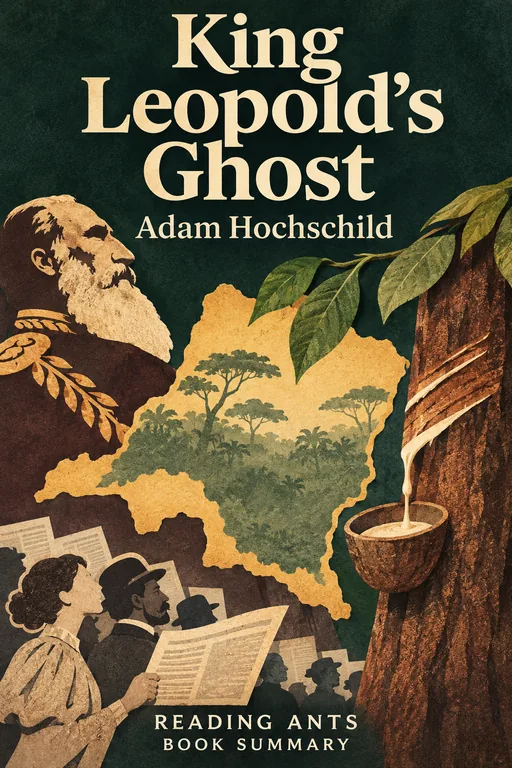
King Leopold's Ghost
Adam Hochschild tells how King Leopold II of Belgium took over the Congo as his personal possession, enriched himself through forced labor and terror, and was finally exposed by a global campaign of ordinary people.
Overview
King Leopold’s Ghost: A Story of Greed, Terror, and Heroism in Colonial Africa was published in 1998 by Adam Hochschild, an American journalist and author. It tells the story of the Congo Free State, which existed from the 1880s to 1908, when Leopold II, king of a small European country, ran a vast area of central Africa as a private business. The book is about the cruelty of that regime, and about the first great international human rights movement that challenged it. Hochschild also shows how the memory of these events was later suppressed.
Full Summary
1. A king who wants a colony
The idea: Leopold was the king of Belgium, a small country with little power, and he longed for an overseas empire. Because the Belgian government was not interested, he used his own money and his skill at public relations. He presented his project as a humanitarian effort to end the slave trade and bring civilization to Africa. At a conference in Berlin in 1884 and 1885, and through separate agreements, the major powers recognized his claim to a huge area of the Congo basin. No African people had agreed to this, and the territory was under Leopold’s personal control, not Belgium’s.
In real life: A noble-sounding purpose can be used to hide a selfish plan.
2. Explorers and the scramble for Africa
The idea: The explorer Henry Morton Stanley, famous for his journey to find the missing missionary David Livingstone, worked for Leopold and signed treaties with local chiefs, who often did not understand what they were giving up. Meanwhile, European countries rushed to claim lands in Africa. Hochschild describes how the African peoples were not consulted, and how new borders were drawn on maps in Europe.
In real life: Decisions made by outsiders about someone else’s land rarely take the people living there into account.
3. Rubber and terror
The idea: At first, ivory was the main source of income. When the world’s demand for rubber grew, with the spread of bicycles and cars, Leopold’s agents forced villagers to collect wild rubber from vines. Quotas were set, and those who did not meet them were punished. The Force Publique, an army of African soldiers led by European officers, took hostages, burned villages and used whips. Hochschild says that the cutting off of hands was used as proof that bullets had been used and not wasted.
In real life: When a system rewards people for numbers and ignores how they are met, cruelty can spread.
4. The first to speak out
The idea: Several people exposed the abuses. An African American minister and journalist, George Washington Williams, traveled in the Congo in 1890 and wrote an open letter to Leopold, protesting. Missionaries, including some from Britain and the United States, wrote about what they saw. Another African American, the missionary William Henry Sheppard, also witnessed and reported on atrocities. A British shipping clerk in Antwerp, Edmund Morel, noticed that ships brought rubber and ivory out of the Congo but went back with weapons and soldiers rather than trade goods, and he became a leading critic.
In real life: Careful observation of ordinary records, such as shipping lists, can reveal that something is wrong.
5. A movement grows
The idea: Morel, with an Irish diplomat, Roger Casement, who wrote an official report in 1904, and others, founded a campaign called the Congo Reform Association in 1904. The movement used photographs, public lectures, pamphlets and newspapers, and gained support from well-known writers, including Mark Twain, who wrote a satire about Leopold. Public pressure in Britain and the United States rose. Hochschild presents this as an early example of an international human rights campaign.
In real life: A group of ordinary people who share facts and keep asking questions can put pressure on a powerful ruler.
6. The end of Leopold’s rule and a forgotten crime
The idea: In 1908, the Belgian government took control of the Congo from Leopold, and some reforms followed, though the colony remained exploitative until independence in 1960. Estimates of how many people died as a result of the regime vary. Hochschild argues, from uncertain demographic evidence, that the population may have fallen by as many as ten million, through killings, forced labor, disease, hunger and fewer births, and not only through direct executions. Hochschild describes how Leopold’s officials burned incriminating papers before the handover, and how Belgian authorities for many years played down the story and limited access to what records remained. He asks why this history is so little known.
In real life: A society may prefer to forget the wrongs in its past, which makes it harder to put them right.
Why It Matters
King Leopold’s Ghost was a bestseller that made many readers aware of a horrifying chapter in colonial history that had been largely ignored outside of specialist circles. It stimulated discussion in Belgium and elsewhere about colonial memory, and encouraged further research and debate. The book also highlights the role of ordinary people in changing public opinion, and so offers a model for later campaigns. It remains a key introduction to the history of the Congo and of colonial exploitation in Africa, and it ties past events to present problems of inequality and conflict in the region.
Key Takeaways
- Colonial rule could be brutal. The Congo Free State relied on forced labor and terror.
- Public relations masked greed. Leopold used humanitarian language to hide his aims.
- Truth-tellers matter. Missionaries, journalists and activists exposed the abuses.
- Public pressure can work. A mass campaign forced a change of rule.
- Memory is political. Nations may try to forget uncomfortable chapters.
What We Can Learn
This history shows why it is important to look at who benefits from a system, and to listen to those who suffer under it. It teaches us to examine claims of good intentions with care, and to value independent reporting. It also encourages us to take part in campaigns for fairness, because history shows that they can succeed. And it reminds us to learn about places and peoples whose stories are rarely told, and to treat the history of other countries with respect, remembering that the effects of colonial rule are still felt today.
Criticism and Counterpoints
Some historians dispute the estimate of the number of deaths, pointing out that there were no reliable censuses, and that disease and other causes also contributed to the fall in population. Others say that Hochschild tells the story mostly through European voices and gives less space to the Congolese experience and resistance. Some critics find the book overly moralistic, and some Belgian historians objected to its comparison of Leopold with twentieth-century dictators. The historian Jean Stengers, for one, said Hochschild exaggerates. The book is still valued as a powerful introduction.
Who Should Read It
This book is for mature readers who are interested in colonial history, human rights and Africa. It is well written but describes cruelty, and it can be upsetting. Those who want a fuller picture should read Congolese authors and recent histories as well.
Want the whole book?
A summary is a taste, not the meal. Here is where to find the full book.
You reached the end 🎉
Nicely done. Mark this one as read, and we will suggest what to read next.
Read this next
Heart of Darkness
Joseph Conrad
A sailor named Marlow tells his friends of a journey up the Congo River to find a mysterious ivory trader named Kurtz, and of the horror and moral darkness he finds at the end of it.
📜 Classics
Bury My Heart at Wounded Knee
Dee Brown
Dee Brown tells the history of the American West from 1860 to 1890 as seen by the Native peoples who lost their lands, showing the broken treaties, the wars and the massacres that ended their independence.
🏛️ History
We Wish to Inform You That Tomorrow We Will Be Killed with Our Families
Philip Gourevitch
Journalist Philip Gourevitch investigates the 1994 genocide in Rwanda, in which hundreds of thousands of Tutsi and moderate Hutu were murdered in about a hundred days, and asks how it happened and why the world did not stop it.
🏛️ History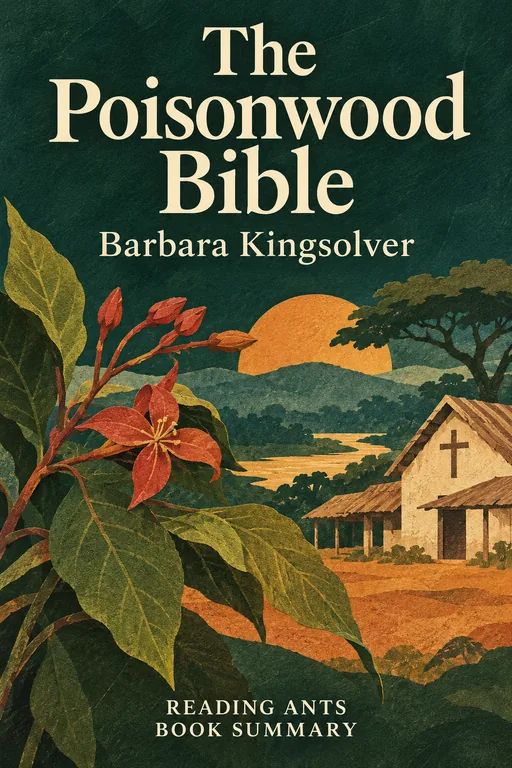
The Poisonwood Bible
Barbara Kingsolver
In 1959, an American Baptist missionary named Nathan Price drags his wife and four daughters to the Belgian Congo, where his rigid zeal and the country's turmoil change all of their lives, as told by the women of the family.
✨ Modern Fiction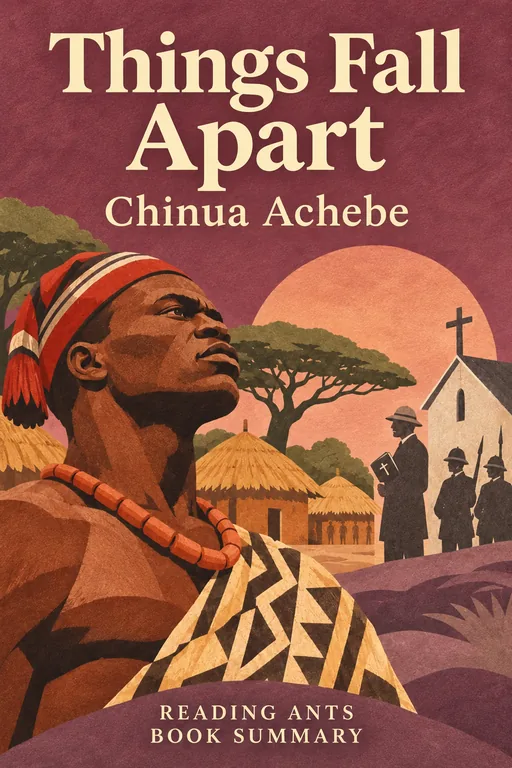
Things Fall Apart
Chinua Achebe
Okonkwo, a proud and fearsome leader in an Igbo village in Nigeria, struggles against his own fears and against the arrival of British missionaries and colonial rulers, who change his world forever.
🌍 World Literature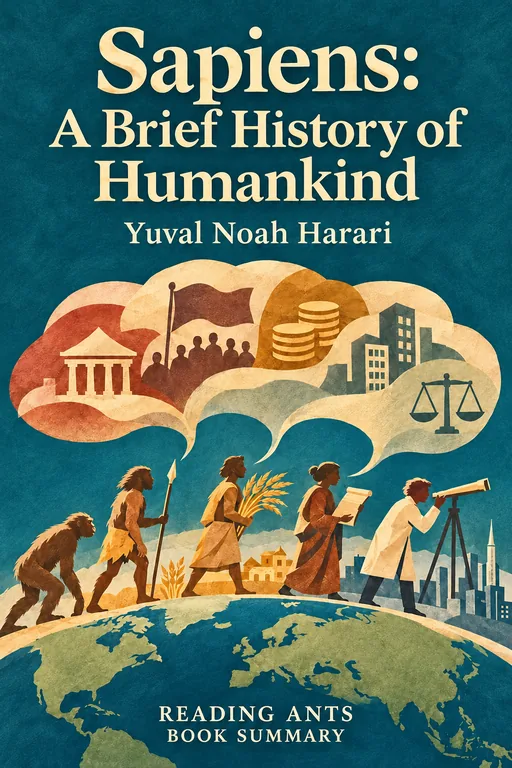
Sapiens: A Brief History of Humankind
Yuval Noah Harari
Humans came to rule the planet not because we are the strongest animals but because we can believe in shared stories (gods, nations, money, companies) that let millions of strangers cooperate.
🏛️ HistoryWant something different?
Pick another topic and we will show you three books to start with.