 Reading Ants
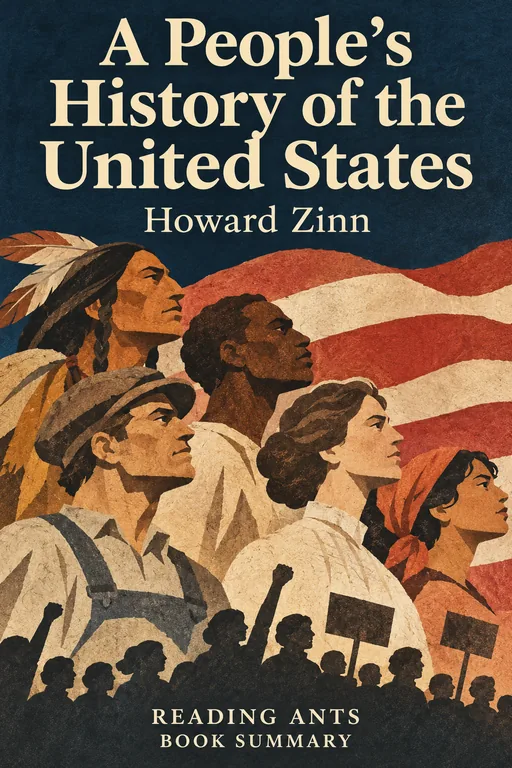
A People's History of the United States
Howard Zinn retells American history from the point of view of the people usually left out of textbooks, such as Native Americans, enslaved people, workers, women and protesters, instead of presidents and generals.
Overview
A People’s History of the United States was written by Howard Zinn, a historian and political activist who taught at Spelman College and Boston University and took part in the civil rights and antiwar movements. First published in 1980, the book covers American history from Columbus’s arrival in 1492 to the present, with later editions extending it into more recent decades. Zinn rejects the idea that history should be told only from the viewpoint of those in power. Instead he focuses on conflict, inequality and resistance, and he admits openly that he is taking a side. The book sold millions of copies, mostly by word of mouth, and has been widely read and widely disputed.
Full Summary
1. Columbus and the Native peoples
The idea: Zinn begins with Christopher Columbus, whom many textbooks present as a heroic explorer. He draws on accounts from Columbus and others to show how the Spanish enslaved and killed the Arawak people of the Caribbean in search of gold. He argues that the arrival of Europeans brought conquest and disease to Native peoples and that the story of American “discovery” should be told with their losses in mind. This opening sets the book’s tone: it asks whose story is being told and who gets left out.
In real life: Learning that the same event can look very different from different sides helps us read any history more carefully.
2. Slavery, class and the colonies
The idea: Zinn describes how the early colonies were built on harsh labor by indentured servants and enslaved Africans. He argues that colonial elites used racial divisions to keep poor white and Black people from uniting against them, as in the case of Bacon’s Rebellion in Virginia in 1676. He also writes about rebellions and resistance by enslaved people, showing that they were active participants in history and not only victims.
In real life: When groups are taught to see each other as rivals, they may overlook what they have in common.
3. The Revolution and the Constitution
The idea: Zinn challenges the view that the American Revolution was simply a united fight for liberty. He argues that many colonial leaders, who were wealthy, wanted independence in part to protect their own interests, and that ordinary soldiers, women, Native Americans and the enslaved had different experiences and hopes. He treats the Constitution as a document that protected property and the power of the elite, while setting up a government that limited more radical change.
In real life: Founding stories often simplify events, and looking at who gained and who lost helps us see what they leave out.
4. Expansion, war and reform
The idea: In the nineteenth century, Zinn covers the removal of Native peoples, including the Trail of Tears, the war with Mexico, the growth of the factory system and the early labor and women’s movements. He describes the abolitionist movement and the Civil War, arguing that the war’s aims were mixed and that freedom for the enslaved was won in part by the actions of Black people themselves. He also describes the failure of Reconstruction to provide lasting equality.
In real life: Rights are often won by organized people pushing for them, not simply granted by leaders.
5. Labor, empire and world wars
The idea: The next sections describe the Gilded Age, with its great fortunes, and the harsh conditions for workers, which led to strikes and union movements and sometimes violent clashes. Zinn discusses American overseas expansion, such as the Spanish-American War, and describes opposition to World War I, including the jailing of some who spoke out against it. He argues that wars often serve economic and political interests more than the high-minded goals proclaimed by leaders.
In real life: Reading the words of a worker on strike next to those of a factory owner shows how the same event can be understood in different ways.
6. The twentieth century and protest
The idea: Zinn gives much attention to the Great Depression, the New Deal, World War II, the Cold War and the movements of the 1950s to the 1970s: civil rights, opposition to the Vietnam War, women’s liberation and Native American activism. He argues that major change came from movements of ordinary citizens and not mainly from the government. The later chapters criticize both major political parties for protecting corporate power, and the book ends by encouraging readers to see themselves as people who can make history.
In real life: The civil rights movement is a clear example of citizens, through protest and organizing, changing laws and attitudes.
Why It Matters
Zinn’s book changed how many people thought about teaching history. It encouraged a view that includes those whom older textbooks ignored, and it influenced many teachers, writers and activists. It is often assigned in high school and college classes, and it has been cited by public figures and in popular culture, including in the film Good Will Hunting.
It also became a symbol in debates over how American history should be taught, with supporters praising it for including excluded voices and opponents criticizing it for bias. Whatever one’s view, the book made many readers more aware that history is a matter of choosing whose story to tell.
Key Takeaways
- History has more than one side. The same events look different from below.
- Ordinary people make change. Movements, not just leaders, shape history.
- Class and race have driven conflict. Zinn highlights inequality.
- Heroes are worth questioning. Look at what textbooks leave out.
- Take a stand openly. Zinn argues that neutrality can hide a viewpoint.
What We Can Learn
The book shows the value of asking, “Who is telling this story, and who is missing?” This is a useful question for any news article or textbook, and it helps us read more critically.
It also reminds us that people with little power have often shaped events, through strikes, protests, resistance and everyday acts of courage. Many rights we now take for granted were won by such efforts.
Finally, the book shows that it is fine to have a point of view, as long as one is honest about it. Zinn’s openness invites readers to compare his account with others and to form their own conclusions.
Criticism and Counterpoints
Many historians say that the book is selective and one-sided, leaving out achievements and complexities that do not fit its thesis, and that it sometimes relies on secondary sources or on weak evidence for specific claims. Critics note that it tends to portray leaders as motivated mainly by economic interests, and that it pays less attention to ideas, religion and the positive role of institutions.
Some conservative critics argue it is unpatriotic, while some on the left say it underplays other factors. Zinn responded that his aim was to balance a history that had mainly told the other side. Teachers often suggest reading it alongside other histories to see multiple views.
Who Should Read It
This book suits teenagers and adults who want a different view of American history. It is long, so it can be read by section. Readers should keep in mind that it argues a point of view, and it is most useful when read alongside other accounts.
Want the whole book?
A summary is a taste, not the meal. Here is where to find the full book.
You reached the end 🎉
Nicely done. Mark this one as read, and we will suggest what to read next.
Read this next
Sapiens: A Brief History of Humankind
Yuval Noah Harari
Humans came to rule the planet not because we are the strongest animals but because we can believe in shared stories (gods, nations, money, companies) that let millions of strangers cooperate.
🏛️ History
The Warmth of Other Suns
Isabel Wilkerson
Isabel Wilkerson tells the story of the Great Migration, in which about six million Black Americans left the South for cities in the North and West, through the lives of three people who made the journey.
🏛️ History
Guns, Germs, and Steel
Jared Diamond
Some societies came to conquer others not because their people were smarter or better, but because geography gave them a head start in farming, animals, germs and technology.
🏛️ History
The Histories
Herodotus
Herodotus, often called the father of history, tells how the Greeks and the Persians came into conflict and fought the great wars of the early fifth century BCE, with long, colorful detours into the lands, customs and legends of the known world.
🏛️ History
History of the Peloponnesian War
Thucydides
Thucydides, an Athenian general turned historian, records the long war between Athens and Sparta in the fifth century BCE and uses it to study power, fear, politics and how human nature behaves in crisis.
🏛️ History
The Muqaddimah
Ibn Khaldun
Ibn Khaldun, a North African scholar of the fourteenth century, sets out a pioneering theory of how societies are organized, how states rise and fall, and how economies work, as an introduction to a larger history of the world.
🏛️ HistoryWant something different?
Pick another topic and we will show you three books to start with.