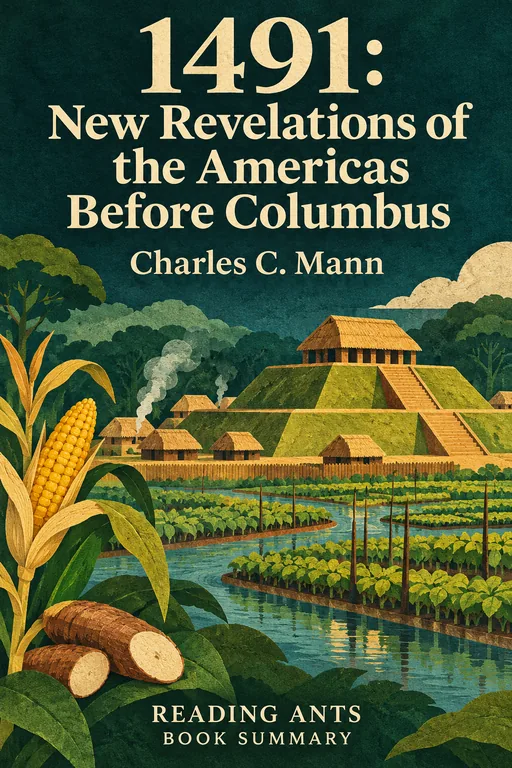
1491: New Revelations of the Americas Before Columbus
Charles Mann gathers recent research to argue that the Americas before Columbus held more people, older cities and more skillful land managers than most of us were taught, and that the picture of a pristine, empty wilderness is wrong.
Overview
1491: New Revelations of the Americas Before Columbus was published in 2005 by Charles C. Mann, a science journalist. He wrote it after reading the work of archaeologists, anthropologists, geographers and historians who had begun to question what had been believed for a long time about Native societies. The book has three parts, around three main questions: how many people lived in the Americas, how old and how sophisticated their cultures were, and how they changed their environments. Mann is careful to say where scholars disagree, and he does not claim that every claim is settled.
Full Summary
1. How many people were there?
The idea: Mann says that for much of the twentieth century, textbooks held that only a small number of people lived in the Americas in 1491. Later researchers argued that the number was far greater, perhaps tens of millions, with some estimates reaching about a hundred million, though the exact figures are strongly debated. The reason that the lands seemed empty to European settlers, in this view, is that the people had already been devastated by diseases that spread ahead of the settlers.
In real life: An empty house does not always mean that nobody ever lived there, and it is worth asking what happened.
2. Plague and the vanished peoples
The idea: European sailors and explorers brought infectious diseases, such as smallpox, to which Native communities had never been exposed and so had little protection. Mann describes how epidemics spread quickly, sometimes ahead of the Europeans themselves, as smallpox seems to have done in the Inca empire, and killed huge numbers. He tells the story of Tisquantum, known as Squanto, a Native man who was kidnapped by an English captain and taken across the ocean, and who returned to find that his own people, the Patuxet, had been wiped out. The Pilgrims later settled on that empty site. This changes how we see the early colonial period.
In real life: A sudden loss of many people can change a place so much that later visitors misread what it was before.
3. Old cities and the oldest societies
The idea: Mann reports that archaeologists have found evidence of complex societies in the Americas that are much older than once thought. In Peru, for example, the Norte Chico or Caral region had large ceremonial centers thousands of years ago, at roughly the time when the great pyramids of Egypt were being built. He discusses the Maya, whose cities declined abruptly, the Aztec capital Tenochtitlan, which amazed the Spanish with its size and order, and the fall of the vast Inca empire.
In real life: A school history that begins its story only with the arrival of Europeans misses thousands of years.
4. Maize and the making of food
The idea: The book discusses how Native farmers developed maize, which is also called corn, from a wild grass called teosinte, which was almost inedible, by selecting and breeding it over a very long time. Mann treats this as a triumph with global consequences, since maize became a staple crop in many parts of the world and helped feed growing populations. He argues that the skill of Native plant breeding shows that these peoples were innovators.
In real life: Every ear of corn you eat is the result of generations of patient work.
5. Gardens in the Amazon and managed land
The idea: Mann reports on research suggesting that parts of the Amazon rainforest were shaped by humans. Some soils there are dark and fertile, called terra preta, and many researchers think that people made them, partly with charcoal and other waste. Elsewhere in North America, Native people used fire to manage forests and grasslands, to clear land and to encourage game and useful plants, and he describes them as a kind of keystone species in the environment. The idea that the Americas were an untouched wilderness, Mann says, is a myth.
In real life: A park that looks natural may have been shaped by careful human care over a long time.
6. Why it matters for the future
The idea: In the last chapters, Mann explains why this research matters. If Native peoples managed their environments for thousands of years, we may learn from their methods, and he suggests that restoring the landscape to its state in 1491 would mean tending it like an enormous garden. He also suggests that how we picture the past affects our attitude toward nature and toward Native peoples today. He is careful to note the uncertainties, and says that the debate about population and about the nature of ancient societies will continue.
In real life: What we believe about the past can change how we treat people and places in the present.
Why It Matters
1491 was a New York Times bestseller, won a National Academies Communication Award, and contributed to a shift in how general readers and teachers think about the history of the Americas. It brought together research that was scattered in specialist journals and presented it in an engaging way, and it prompted a wider discussion of Native achievements. Mann followed it in 2011 with a related book about the Columbian exchange, 1493. Whether or not every estimate holds up, the book has encouraged a more respectful and curious view of Native civilizations, and has made many people question the idea of an untouched wilderness.
Key Takeaways
- The Americas were not empty. Many people lived there, in advanced societies.
- Disease reshaped history. Epidemics killed vast numbers, often before settlers arrived.
- Civilizations were old. Some monumental building began thousands of years ago.
- Native people managed the land. They shaped forests, fields and grasslands.
- Science is evolving. Many details are debated, and new evidence keeps coming.
What We Can Learn
You can start by asking whose history you were taught, and what might be missing. When you visit a landscape, think about who lived there before and how they used it. Respect the knowledge of Indigenous communities about plants, animals and land management. And notice how scientists change their minds when there is new evidence, which is a sign of healthy inquiry. Be open to the idea that our assumptions about the past may be wrong, and enjoy the discovery of new facts.
Criticism and Counterpoints
Some scholars say that Mann leans toward the high population estimates, which are disputed by the “low counters”, and one reviewer complains that he does not walk readers through the calculations behind the competing numbers or give an estimate of his own. Others argue that the extent to which the Amazon was reshaped by people is still contested. Reviewers also note that his stories about researchers are sometimes quite critical of the scientific community. New research since 2005 has continued to revise some of the details. These debates show how active the field is.
Who Should Read It
This book is for readers interested in history, archaeology and the environment, and for those who want to learn about Native societies in the Americas. It is long, but written in an easy style. Those who want a short summary or the most recent findings should use it with newer articles and with works by Indigenous scholars.
Want the whole book?
A summary is a taste, not the meal. Here is where to find the full book.
You reached the end 🎉
Nicely done. Mark this one as read, and we will suggest what to read next.
Read this next
Guns, Germs, and Steel
Jared Diamond
Some societies came to conquer others not because their people were smarter or better, but because geography gave them a head start in farming, animals, germs and technology.
🏛️ History
Bury My Heart at Wounded Knee
Dee Brown
Dee Brown tells the history of the American West from 1860 to 1890 as seen by the Native peoples who lost their lands, showing the broken treaties, the wars and the massacres that ended their independence.
🏛️ History
Sapiens: A Brief History of Humankind
Yuval Noah Harari
Humans came to rule the planet not because we are the strongest animals but because we can believe in shared stories (gods, nations, money, companies) that let millions of strangers cooperate.
🏛️ History
The Dawn of Everything
David Graeber and David Wengrow
Anthropologist David Graeber and archaeologist David Wengrow argue that the standard story of human history, in which small equal bands slowly turned into large unequal states, is wrong, and that early societies experimented with many ways of living.
🏛️ History
Collapse: How Societies Choose to Fail or Succeed
Jared Diamond
Jared Diamond studies societies that collapsed and societies that survived, and argues that environmental damage, climate change, enemies, trade and the way a society responds to problems decide whether it fails or succeeds.
🏛️ HistoryThe Histories
Herodotus
Herodotus, often called the father of history, tells how the Greeks and the Persians came into conflict and fought the great wars of the early fifth century BCE, with long, colorful detours into the lands, customs and legends of the known world.
🏛️ HistoryWant something different?
Pick another topic and we will show you three books to start with.