 Reading Ants
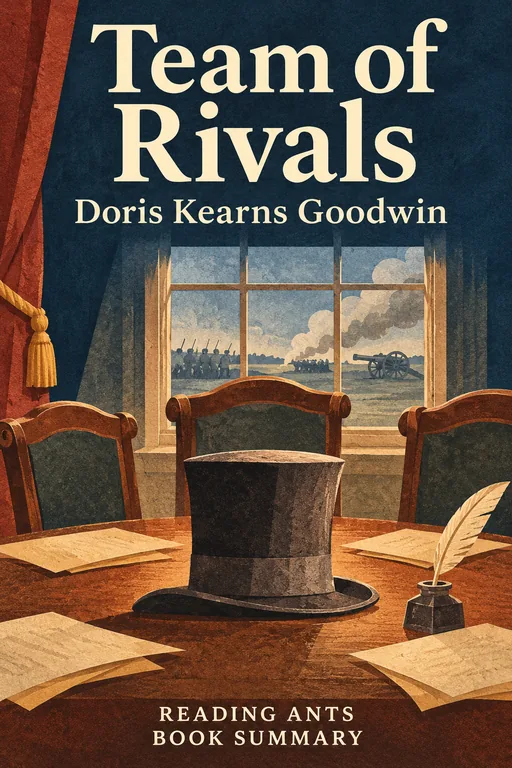
Team of Rivals
Historian Doris Kearns Goodwin shows how Abraham Lincoln won the Republican nomination in 1860 against more famous rivals, and then brought those same rivals into his cabinet and used their talents to lead the nation through the Civil War.
Overview
Team of Rivals: The Political Genius of Abraham Lincoln was published in 2005 by Doris Kearns Goodwin, an American historian. It follows four men, Lincoln and three of his main competitors for the Republican nomination in 1860: William Seward, Salmon Chase and Edward Bates. All three were better known and more experienced than the former congressman from Illinois. After winning the election, Lincoln invited them to join his government. The book looks at their ambitions, their rivalries and how Lincoln handled them, and it inspired the 2012 film Lincoln.
Full Summary
1. Four ambitious men
The idea: Goodwin begins by introducing the four men before the contest. Seward was a famous senator and former governor from New York, widely seen as the front-runner. Chase, the governor of Ohio, was an early anti-slavery leader who hoped for the presidency. Bates was a distinguished elder statesman and former attorney general of Missouri. Lincoln, from a poor frontier family, had little formal schooling and was a former congressman from Illinois who had risen through his debates with Stephen Douglas, and Goodwin presents his gift for coalition-building as one of his great strengths. Each had hopes of reaching the White House.
In real life: Four classmates may all want the same role in the school play, and the one who seems least likely may be the one who works hardest.
2. The convention of 1860
The idea: At the Republican convention in Chicago, Seward was the front-runner, but he had a record of strong statements that scared some delegates, and the others were also seen as risky. Lincoln’s team worked to make him the acceptable second choice of every faction, and he won the nomination on the third ballot. Goodwin shows that his skill at building friendships and his moderate reputation helped him. The other three took the loss badly, and Seward was especially disappointed.
In real life: Being the second choice of many people can be a stronger position than being the first choice of a few.
3. Bringing rivals into the cabinet
The idea: After the election, as the Southern states began to leave the Union, Lincoln chose to put his chief rivals in key positions: Seward became secretary of state, Chase secretary of the treasury, and Bates attorney general. Simon Cameron was the first secretary of war, and Edwin Stanton, who had once snubbed Lincoln when they worked on the same legal case, replaced him in January 1862. Many people were surprised. Lincoln said that the country needed the best men, whether or not they had been critical of him.
In real life: A leader who picks only friends may miss important ideas, while one who includes critics can make better decisions.
4. Winning the loyalty of strong people
The idea: At first, Seward and others thought that they could manage the inexperienced president. But Lincoln was firm, patient and fair. He listened to advice, used humor to ease tension, and refused to hold grudges. When Seward sent a memo in April 1861 that raised the possibility of war with European powers and said that either Lincoln or a cabinet member must set vigorous policy, Lincoln made clear that he would be the one to decide, and in time Seward came to respect him and became one of his closest allies. Chase remained ambitious and sometimes disloyal, but Lincoln valued his skill as a financial leader.
In real life: Strong people respect a leader who is calm, honest and sure of what he wants.
5. War, emancipation and difficult choices
The idea: As the Civil War progressed, Lincoln faced heavy losses, quarrels with generals and a peace movement that wanted the war to end. Goodwin describes his careful route to the Emancipation Proclamation, which declared enslaved people in the areas still in rebellion to be free as of January 1863, after a preliminary announcement in September 1862, though it did not free everyone and did not end slavery nationwide. He read a draft to his cabinet in July 1862, took Seward’s advice to wait for a Union victory, and issued the preliminary version after the Battle of Antietam. She shows how his cabinet members’ differing views helped him to weigh the options.
In real life: Important decisions are often better when people with different views have had a say.
6. Reelection and a sudden end
The idea: In 1864, the war was not going well, and Lincoln feared that he would lose the election. Chase had resigned from the cabinet in June 1864, and later Lincoln named him Chief Justice. Victories in the fall helped Lincoln to win a second term. In April 1865, soon after the surrender of the main Confederate army, he was shot at a theater in Washington and died the next day. Seward was attacked on the same night but survived. Goodwin ends with the assassination and an epilogue on the later lives of Seward, Stanton, Bates, Chase and others.
In real life: Even a great leader’s work can be cut short, so it matters to have built relationships and institutions that endure.
Why It Matters
Team of Rivals was well received by critics and won the 2006 Lincoln Prize. It offers a close look at Lincoln’s leadership, showing his humility, empathy and ability to turn opponents into allies. The book has been read widely in business and politics, as a model of how to build a strong team, and its title has become a common phrase. It also gives a rich picture of the Civil War era and of the people who shaped it. By examining personal relationships, it humanizes events that can seem distant, and helps readers to appreciate how a leader’s character can affect the course of a nation. A 2012 film was based in part on it, and it prompted many discussions about leadership.
Key Takeaways
- Include strong voices. A team with different views can make better decisions.
- Do not hold grudges. Lincoln used the talents of people who had opposed him.
- Humility helps leaders. He listened, learned and shared credit.
- Emotional intelligence matters. Understanding people was one of Lincoln’s great strengths.
- Timing counts. Big decisions depend on readiness as well as principle.
What We Can Learn
When you lead a group, think about whether you are listening to people who disagree with you. Try to separate personal feelings from the question of who can do the job. Practice patience, humor and fairness when things get tense. If you lose a contest, consider whether you can still contribute to the team that wins. And when you face a hard choice, gather different views before deciding, but be ready to take responsibility for the final decision. Lincoln’s patience in waiting for the right moment to announce emancipation is a habit that students can borrow too.
Criticism and Counterpoints
Some reviewers say that Goodwin’s affection for Lincoln shapes the book, that it somewhat idealizes him, and that it gives less attention to his flaws or to controversial actions such as the suspension of certain civil liberties during the war. Others have noted that the film based on it drew on only a few pages of the book, and that the focus on the cabinet gives only a partial view of Lincoln’s government. Goodwin was also involved in debates about her use of sources in other works. Nonetheless, it is a vivid and popular study.
Who Should Read It
This book is for readers of American history, leadership and biography, and it is a good choice for anyone who wants to understand how Lincoln worked. It is long but engaging. Those who prefer a short introduction to Lincoln or a purely military history of the war may want another book to start with.
Want the whole book?
A summary is a taste, not the meal. Here is where to find the full book.
You reached the end 🎉
Nicely done. Mark this one as read, and we will suggest what to read next.
Read this next
1776
David McCullough
David McCullough tells the story of the pivotal year of the American Revolution, when George Washington's poorly equipped army nearly lost everything and then, in a few winter weeks, won two surprising victories.
🏛️ History
The Warmth of Other Suns
Isabel Wilkerson
Isabel Wilkerson tells the story of the Great Migration, in which about six million Black Americans left the South for cities in the North and West, through the lives of three people who made the journey.
🏛️ History
Narrative of the Life of Frederick Douglass
Frederick Douglass
Frederick Douglass tells how he was born into slavery, taught himself to read, resisted a brutal master and escaped to freedom, showing that literacy and courage are weapons against injustice.
👤 Real Lives
The Autobiography of Benjamin Franklin
Benjamin Franklin
Benjamin Franklin tells the story of his rise from a poor Boston boy to a successful printer, inventor and public leader in Philadelphia, and shares his methods of self-improvement.
👤 Real Lives
Long Walk to Freedom
Nelson Mandela
Nelson Mandela tells his own story, from a village childhood to twenty-seven years in prison to becoming South Africa's first democratically elected president, and shows how patience, courage and forgiveness helped end apartheid.
👤 Real Lives
Sapiens: A Brief History of Humankind
Yuval Noah Harari
Humans came to rule the planet not because we are the strongest animals but because we can believe in shared stories (gods, nations, money, companies) that let millions of strangers cooperate.
🏛️ HistoryWant something different?
Pick another topic and we will show you three books to start with.