 Reading Ants
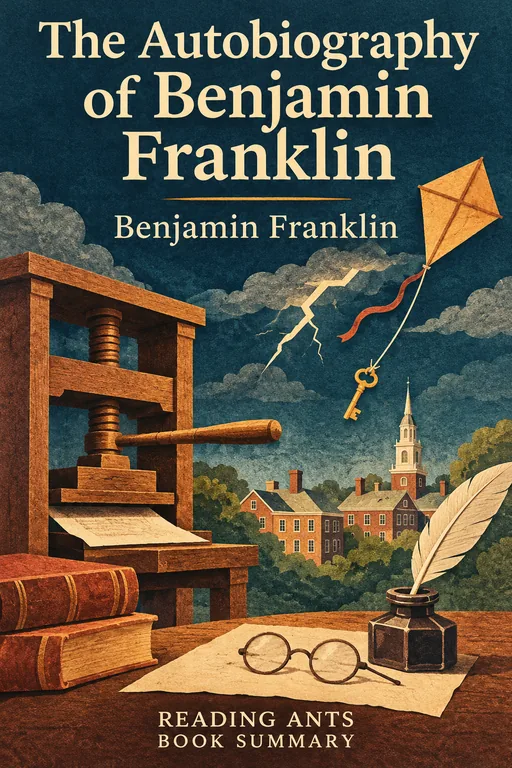
The Autobiography of Benjamin Franklin
Benjamin Franklin tells the story of his rise from a poor Boston boy to a successful printer, inventor and public leader in Philadelphia, and shares his methods of self-improvement.
Overview
The Autobiography of Benjamin Franklin was written in several parts between 1771 and 1790, and first appeared in print in 1791, after Franklin’s death in 1790, in a partial French version. The textual history of the English editions is complicated. It begins as a letter to his son, and tells the story of his family and his early life. The book is unfinished, and ends around 1757, long before he became famous as a diplomat. It is told in a friendly, witty style, and Franklin does not hide his mistakes, which he calls “errata,” a printer’s word for errors. It is one of the great classics of American literature.
Full Summary
A Boy in Boston
Franklin begins with his family background in England and with his boyhood in Boston, as the youngest son of a candle and soap maker with many children. He loves to read, and spends his small savings on books. His father puts him to work in the family trade, but he is unhappy, and is apprenticed to his older brother James, a printer. Young Benjamin teaches himself to write by imitating the style of the essays in The Spectator, and by rewriting essays from memory to see if he can improve on them.
Leaving for Philadelphia
Franklin and his brother quarrel, and James treats him harshly. At age seventeen, Benjamin leaves Boston secretly, and goes by boat and on foot to Philadelphia. He arrives tired, hungry and almost penniless, and walks the streets with a loaf of bread under each arm. He finds work as a printer, and soon attracts the attention of the governor, who encourages him to go to London to buy a press. The promise turns out to be empty, and Franklin finds himself stranded far from home.
London and a Return
In London, Franklin works in printing shops and learns more about his trade, and about the temptations of a big city. He writes frankly about his youthful errors, including neglecting Deborah Read, his future wife, and spending money that belonged to a friend. After about eighteen months, he returns to Philadelphia to work for a merchant, Mr. Denham, resolves to behave better, and later sets up his own printing business with a partner. Hard work and a reputation for honesty help him to build credit.
Habits, Clubs and Public Works
Franklin founds a club for mutual improvement, called the Junto, where friends discuss ideas, and he starts a newspaper and a popular yearly almanac. He also helps to found a lending library, a fire company and a volunteer group to organize the defense of the colony, and later an academy that grew into a university. He explains how he persuades people by asking questions and by avoiding the appearance of pushing his own interests. He says that he often accomplished more by letting others take credit.
The Plan for Moral Perfection
One of the best-known passages describes Franklin’s project to achieve what he calls moral perfection. He makes a list of thirteen virtues, such as temperance, order, industry, sincerity and humility, and keeps a little book in which he marks each failing. He works on one virtue each week, hoping to build good habits. He admits that he never reached perfection, and that he found humility especially hard, since he was proud of how humble he was. He says that the effort made him a better and happier man.
Science and Public Service
In the later part of the autobiography, Franklin tells of his rise in public life, including his work as a clerk of the colonial assembly and as postmaster. In 1754 he drafts a plan to unite the colonies for their defense at a congress in Albany, and in the next war he helps General Braddock’s army obtain wagons. He mentions his interest in electricity, and his experiments, though in less detail than in other writings. The story breaks off, unfinished, in England, where he is representing Pennsylvania in its dispute with the colony’s proprietors over taxes. The book closes without describing his role in the American Revolution.
Why It Matters
Franklin’s autobiography is one of the most popular and influential books in American history. It gave a model of the self-made man, who rises by industry, thrift and public spirit, and it helped to shape the American idea of success. The book’s practical wisdom, about habits, honesty and learning, has been admired in many countries. It is also a rich source of information about colonial America, and about the life of a printer and civic leader. Many readers value its charm and humor, and its willingness to admit faults. It continues to be read in schools and by people interested in personal growth.
Key Takeaways
- Self-education works. Franklin taught himself by reading and imitating good writing.
- Habits shape character. His list of virtues and daily practice made improvement a project.
- Honesty and industry build trust. A good reputation was his best credit.
- Work with others. Clubs and public projects multiplied his effort.
- Admit mistakes. His errata are part of what makes the story human.
What We Can Learn
You can try a small version of Franklin’s experiment. Choose one habit that you want to improve, such as being on time or being kind in speech, and keep a simple daily record. Read a good writer and try to rewrite a passage in your own words, to learn style. Gather a few friends to discuss ideas, as he did in the Junto. And remember that his method was gentle with himself: he did not give up when he failed, but began again.
Criticism and Counterpoints
Some critics say that the book presents an idealized and self-promoting picture, and that Franklin shapes his story to give lessons. Writers such as D. H. Lawrence mocked his focus on practical virtue as narrow. Historians note that the autobiography leaves out important parts of his life, including his years as a diplomat, his role in the Revolution and some of his scientific work, and that it says little about his complicated family and about his relationship to slavery, which changed over his life. Franklin’s humor suggests that he meant it to be lighthearted, not a rule book.
Who Should Read It
This book is for readers of all ages who like stories of self-improvement and early American life. The older language may take some patience, but the chapters are short, and the tone is friendly. Those who want a full biography, with all of Franklin’s achievements and controversies, should read a modern life of him as well.
Want the whole book?
A summary is a taste, not the meal. Here is where to find the full book.
You reached the end 🎉
Nicely done. Mark this one as read, and we will suggest what to read next.
Read this next
Up from Slavery
Booker T. Washington
Booker T. Washington tells how he rose from an enslaved childhood in Virginia to found the Tuskegee Institute in Alabama, and explains his belief that education, hard work and practical skills offered the best path to progress for Black Americans.
👤 Real Lives
1776
David McCullough
David McCullough tells the story of the pivotal year of the American Revolution, when George Washington's poorly equipped army nearly lost everything and then, in a few winter weeks, won two surprising victories.
🏛️ History
Team of Rivals
Doris Kearns Goodwin
Historian Doris Kearns Goodwin shows how Abraham Lincoln won the Republican nomination in 1860 against more famous rivals, and then brought those same rivals into his cabinet and used their talents to lead the nation through the Civil War.
🏛️ History
Walden
Henry David Thoreau
Henry David Thoreau describes the two years he spent living simply in a small cabin by Walden Pond in Massachusetts, and argues that people should simplify their lives, spend time in nature and think for themselves.
🕊️ Philosophy & Religion
The 7 Habits of Highly Effective People
Stephen R. Covey
Lasting success in life and work comes not from quick tricks or a charming personality but from good character, built through seven habits that move us from depending on others, to standing on our own, to working well with others.
🌱 Self-Improvement
Man's Search for Meaning
Viktor E. Frankl
A psychiatrist who survived the Nazi concentration camps explains that even in the worst suffering, people can choose their attitude, and that finding a reason to live is what gives us the strength to endure.
👤 Real LivesWant something different?
Pick another topic and we will show you three books to start with.