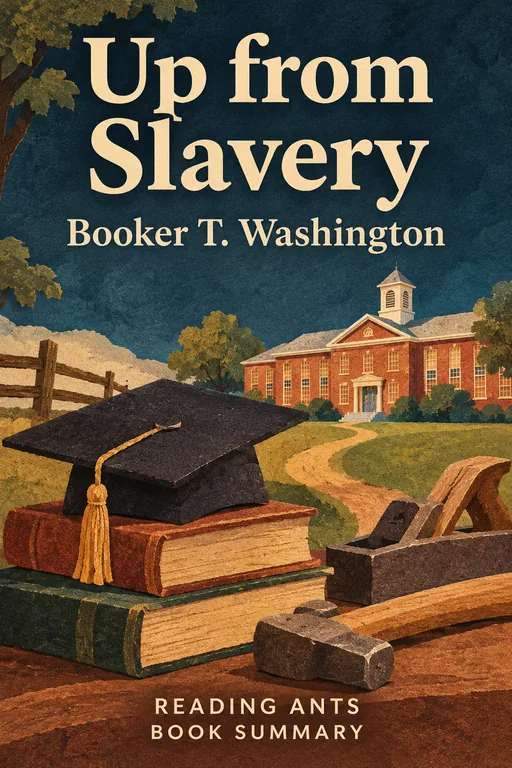
Up from Slavery
Booker T. Washington tells how he rose from an enslaved childhood in Virginia to found the Tuskegee Institute in Alabama, and explains his belief that education, hard work and practical skills offered the best path to progress for Black Americans.
Overview
Up from Slavery is the autobiography of Booker T. Washington, published in 1901. Washington was born into slavery in Virginia in the late 1850s (the exact date is uncertain), and became one of the most prominent Black leaders in the United States at the turn of the twentieth century. The book is written in a simple, modest style and tells of his struggle to get an education, his years as a teacher and the building of a school from almost nothing. It also expresses his views about how Black Americans should advance in a country that was becoming more segregated. The book was a best-seller and added to his fame.
Full Summary
A Childhood in Slavery
Washington begins with his earliest memories as an enslaved child on a plantation in Virginia, where he lives in a dirt-floored cabin with his mother, who works as the plantation cook, and with his brother and sister. He remembers poverty, a scratchy flax shirt and a longing to learn, which grew when he carried a young mistress’s books to the schoolhouse door and saw children studying inside. He recalls the day when freedom came at the end of the Civil War, when the family heard the announcement of emancipation. He says that the joy was mixed with uncertainty about how to live as free people.
Work and the Hunger to Learn
After the war, the family moves to West Virginia, where his stepfather works in the salt furnaces. Young Booker is put to work in the salt furnaces and later in a coal mine, but he is determined to learn to read. He teaches himself the alphabet, and later attends a small school at night and in his spare time. He takes the name Washington when the teacher asks for a surname. At a young age, he also works as a servant in the house of a woman who values neatness and discipline, which teaches him lessons that he uses later.
The Journey to Hampton
Washington hears about a school in Virginia, called Hampton Institute, where Black students can work to pay for their education. Without much money, he sets out, traveling partly on foot and sleeping outdoors, to cover about five hundred miles. When he arrives, tired and dirty, the teacher in charge gives him an entrance test: to sweep and dust a room. He cleans it so thoroughly that he is accepted. At Hampton, he is influenced by the school’s leader, General Samuel Armstrong, whose ideas of practical education and self-help shape his later career.
Teaching and a Call to Alabama
After finishing at Hampton, Washington teaches in West Virginia and later returns to Hampton as a teacher. In 1881, he is recommended to start a new school in Tuskegee, Alabama. He arrives to find no buildings and no land, only a small state grant that can pay teachers’ salaries and nothing else. He begins in a rundown church and a shanty with thirty students, and soon sets about finding land and funds. The school’s early days are hard, but Washington insists that the students will learn to do things for themselves.
Building Tuskegee
The students at Tuskegee help to build the school, making bricks, constructing buildings and raising food. Washington believes that learning a trade, together with academic study, gives dignity and independence, and prepares students to earn a living. He spends much of his time traveling to raise money from wealthy donors, many of them white Northerners, and wins the support of important people. The school grows into a large institution, with many buildings and hundreds of students.
A Leader and a Controversy
In 1895, Washington gives a speech in Atlanta in which he urges Black and white Southerners to cooperate in business and progress, and says that Black Americans should focus first on building economic strength and skills. It brings him national fame, though later critics, including W. E. B. Du Bois, argued that it gave up the demand for political rights and equality. Later chapters cover his travels in Europe, an honorary degree from Harvard in 1896 and the growth of Tuskegee. He ends the book on a hopeful note, speaking to both races in Richmond, Virginia, the city where he had once slept under a sidewalk.
Why It Matters
Up from Slavery was one of the best-selling autobiographies of its time and is a major source on the life of Black Americans after emancipation. It shows the importance of education to people who were once forbidden to learn, and the determination of those who pursued it. Washington’s Tuskegee Institute trained many teachers and tradespeople, and became a center of Black education. The book also is a document in the debate about the best strategy for racial progress, a debate that continues to be studied. Its inspiring story and clear voice made it popular with readers of many backgrounds, and it remains a staple in American literature and history classes.
Key Takeaways
- Education is power. Washington traveled some five hundred miles, partly on foot, for the chance to learn.
- Dignity in work. He valued practical skills and honest labor.
- Self-help matters. The students at Tuskegee built their own school.
- Build with allies. He sought support from people of different backgrounds.
- Strategies can be debated. His approach to civil rights was controversial.
What We Can Learn
Washington’s story reminds us not to take education for granted, and to value the people who make it possible. His habit of doing small tasks very well, as he did with the sweeping of the room, shows how excellent work can open doors. At the same time, we can learn from the debates: we can admire his courage and results, and still ask whether his emphasis on patience and accommodation was the best response to injustice. A thoughtful reader considers both his achievements and the criticism of his approach.
Criticism and Counterpoints
Washington’s approach has been criticized by many. W. E. B. Du Bois and others said that by accepting segregation and downplaying the demand for the vote and for higher education, he gave comfort to white supremacy. Some historians note that his public tone of patience was a strategy for working in a dangerous environment, and that he quietly funded legal challenges to discrimination, which he did not reveal in the book. Others say that the autobiography presents a smoothed, optimistic picture and leaves out much of the violence of the time. Modern readers often view him as a complicated figure.
Who Should Read It
This book is for readers of American history and for anyone interested in education and perseverance. It is clear and accessible, with short chapters, and suitable for teenagers. Readers who want a full picture of the debates about civil rights in this period should read it together with works by Du Bois and others.
Want the whole book?
A summary is a taste, not the meal. Here is where to find the full book.
You reached the end 🎉
Nicely done. Mark this one as read, and we will suggest what to read next.
Read this next
Narrative of the Life of Frederick Douglass
Frederick Douglass
Frederick Douglass tells how he was born into slavery, taught himself to read, resisted a brutal master and escaped to freedom, showing that literacy and courage are weapons against injustice.
👤 Real Lives
Twelve Years a Slave
Solomon Northup
Solomon Northup, a free Black man from New York, tells how he was kidnapped in 1841, sold into slavery in Louisiana and kept there for twelve years until he was rescued and returned to his family.
👤 Real Lives
The Souls of Black Folk
W. E. B. Du Bois
In fourteen eloquent essays, W. E. B. Du Bois examines the lives, struggles and hopes of Black Americans at the start of the twentieth century, and argues that the great problem of the age is the color line.
⚖️ Politics & Society
Long Walk to Freedom
Nelson Mandela
Nelson Mandela tells his own story, from a village childhood to twenty-seven years in prison to becoming South Africa's first democratically elected president, and shows how patience, courage and forgiveness helped end apartheid.
👤 Real Lives
The Autobiography of Benjamin Franklin
Benjamin Franklin
Benjamin Franklin tells the story of his rise from a poor Boston boy to a successful printer, inventor and public leader in Philadelphia, and shares his methods of self-improvement.
👤 Real Lives
Man's Search for Meaning
Viktor E. Frankl
A psychiatrist who survived the Nazi concentration camps explains that even in the worst suffering, people can choose their attitude, and that finding a reason to live is what gives us the strength to endure.
👤 Real LivesWant something different?
Pick another topic and we will show you three books to start with.