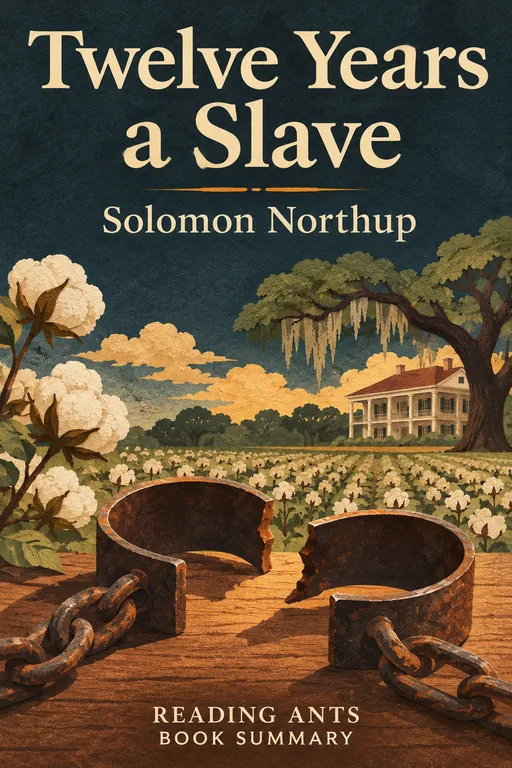
Twelve Years a Slave
Solomon Northup, a free Black man from New York, tells how he was kidnapped in 1841, sold into slavery in Louisiana and kept there for twelve years until he was rescued and returned to his family.
Overview
Twelve Years a Slave is a memoir published in 1853 by Solomon Northup, who was born free in New York State and worked as a farmer and a violinist. He was lured to Washington, D.C., drugged and sold into slavery. The book was written, with the help of a white lawyer and editor, soon after his release, and it became a bestseller in the years just before the American Civil War. It describes the cruelty of the slave system from the viewpoint of a man who knew freedom, and provides details of work on cotton and sugar plantations in the Deep South.
Full Summary
A Free Man’s Life
Northup describes his life in upstate New York, where he lives with his wife, Anne, and their three children. His father had been enslaved but was freed, and Solomon grew up as a free man, working on farms, rafts and canals, and playing the violin. In 1841, two men who say they are circus performers offer him a short job as a musician and persuade him to travel with them to Washington. He expects to be gone only briefly.
The Trap
In Washington, Northup falls ill after a meal, and wakes up in chains, in a cellar of a slave pen. He tells his captors that he is a free man, and is beaten severely for it. He is shipped by sea, with other captives, to New Orleans. During the voyage, smallpox appears and kills one of the captives. In New Orleans, Northup himself falls ill with it and is taken to a hospital. In the slave pen, he is given a false name, Platt, and sold under it, and his past is erased.
A Kind and a Cruel Master
His first owner, William Ford, a Baptist preacher, treats him better than most, and Northup is able to use his skills, for instance by devising a way to float lumber on rafts down a narrow creek to its destination. But a debt forces Ford to sell him, and he falls into the hands of a violent carpenter, John Tibeats. When Tibeats tries to whip him, Northup fights back and beats him. Tibeats returns with two overseers from neighboring plantations and they try to hang him, but Ford’s overseer, Chapin, stops them with pistols in his hands. Northup is left bound, with the rope still round his neck, in the heat all day, until Ford returns toward sunset and frees him. Later, after Tibeats attacks him with a hatchet, Northup flees through a swamp, escapes the hounds and makes his way to Ford’s. In the end Tibeats sells him to Edwin Epps.
Years under Epps
Northup spends the longest part of his captivity on the plantation of Edwin Epps, a harsh and unpredictable man who drinks and beats his workers. Northup labors at picking cotton, and learns to work under a daily quota that must be met on pain of the whip. He describes the exhaustion, the hunger and the humiliation, as well as the songs and small moments of fellowship among the enslaved. He tells of Patsey, a young enslaved woman who is the best cotton picker, and who is abused by Epps and his wife.
The Letter and the Wait
For years, Northup is unable to send word to his family, since he is kept far from towns and has no means of writing. He hides his real name and past from everyone. After years of trying, he gets a sheet of paper and writes a letter, but the man he trusts to mail it proves treacherous, and Northup has to burn it. Later, a Canadian carpenter named Samuel Bass, who works for Epps and speaks against slavery, hears his story and agrees to help. Bass writes letters to Northup’s friends in New York, at risk to himself.
Rescue
The letter reaches Northup’s friends and his wife, Anne, who appeal to the governor of New York, and a lawyer from Northup’s home area, Henry B. Northup, is sent to Louisiana with legal papers. After a tense search, he finds Northup in the cotton field, and Epps gives him up at a legal meeting in Marksville in January 1853. Northup returns to his family, to find that his children are grown and that his daughter has a child of her own. He tries to bring his kidnappers to justice, but the case fails, and he turns to telling his story.
Why It Matters
Twelve Years a Slave is one of the most important slave narratives, and a key text for understanding the reality of slavery in the United States. It was widely read in its time, and helped to turn public opinion against slavery. The book was forgotten for a time, then rediscovered by historians, and its detailed account of plantation life has been used as a source. A major film adaptation in 2013 brought it to a new audience, and the film won an Academy Award. Northup’s account has been verified in many respects by historians. It is a testimony to human dignity and endurance, and a reminder of how fragile freedom was for free Black people in that period.
Key Takeaways
- Slavery was brutal. The book shows the daily violence and degradation.
- Freedom was precarious. Free Black people could be kidnapped and enslaved.
- Dignity persisted. Northup kept his sense of self even under another name.
- Allies mattered. A few brave people helped to secure his release.
- Testimony is powerful. Firsthand accounts are crucial to history.
What We Can Learn
Reading this book helps us to grasp, through a single life, what slavery meant, and how it damaged the lives of millions. It encourages us to listen to the voices of those who experienced injustice. It also shows that individuals can make a difference by taking a risk, as Samuel Bass did. We can think about how to protect the rights of everyone today, and about the importance of records, letters and legal rights in defending freedom. Because the book is painful, it is helpful to read it with a teacher or a trusted adult, and to discuss it.
Criticism and Counterpoints
Historians have confirmed many of the details in Northup’s story, and few doubt its truth. Some point out that the account was written with the help of a white editor, David Wilson, and that some of its language may reflect the style of the time and of the anti-slavery movement. Others note that, like most slave narratives, it is directed to a white Northern audience and aims to persuade, which shapes how events are told. Some scholars have discussed the limits of what Northup could say about certain topics, such as sexual abuse. Despite this, it is widely seen as reliable and powerful.
Who Should Read It
This book is for mature readers who want a first-hand account of slavery in the United States. It is clear and gripping, but contains descriptions of violence and cruelty. It is suitable for older teenagers and adults, and best read with context from teachers and other sources.
Want the whole book?
A summary is a taste, not the meal. Here is where to find the full book.
You reached the end 🎉
Nicely done. Mark this one as read, and we will suggest what to read next.
Read this next
Up from Slavery
Booker T. Washington
Booker T. Washington tells how he rose from an enslaved childhood in Virginia to found the Tuskegee Institute in Alabama, and explains his belief that education, hard work and practical skills offered the best path to progress for Black Americans.
👤 Real Lives
Narrative of the Life of Frederick Douglass
Frederick Douglass
Frederick Douglass tells how he was born into slavery, taught himself to read, resisted a brutal master and escaped to freedom, showing that literacy and courage are weapons against injustice.
👤 Real Lives
Uncle Tom's Cabin
Harriet Beecher Stowe
A devout, gentle enslaved man named Tom is sold from owner to owner and finally dies at the hands of a brutal master, while other enslaved people try to escape, in a novel that shocked America into facing the cruelty of slavery.
📜 Classics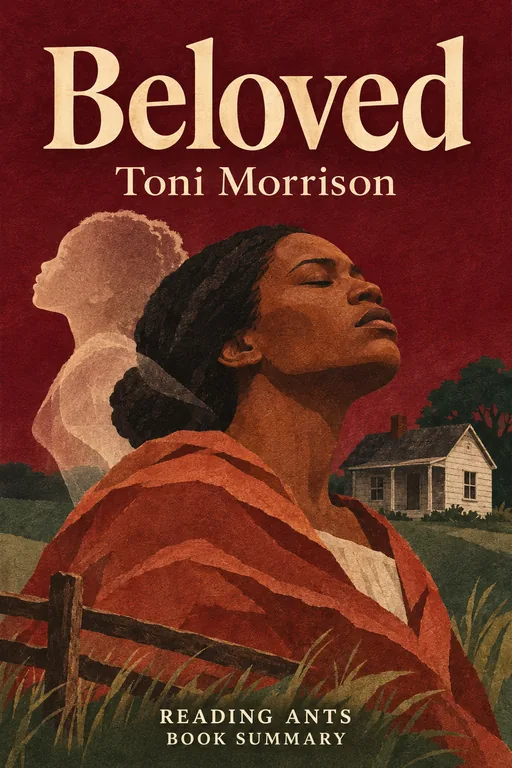
Beloved
Toni Morrison
A formerly enslaved woman living in Ohio after the Civil War is haunted by the ghost of the daughter she killed to save her from slavery, and by the painful memories she has tried to bury.
✨ Modern Fiction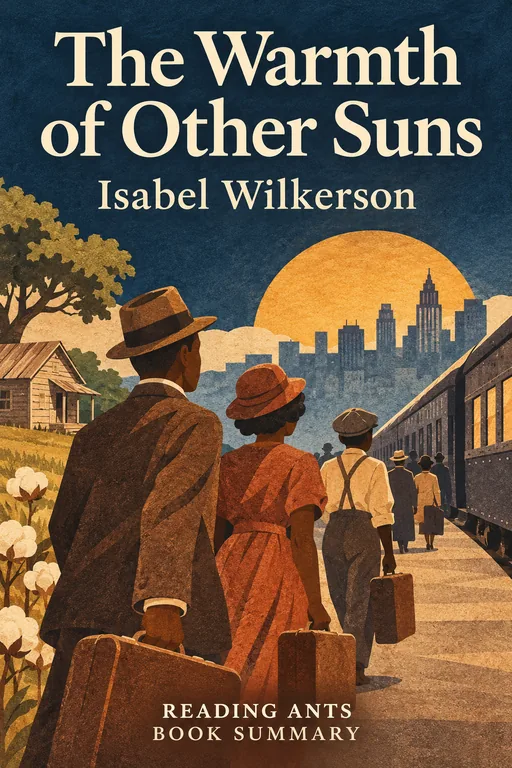
The Warmth of Other Suns
Isabel Wilkerson
Isabel Wilkerson tells the story of the Great Migration, in which about six million Black Americans left the South for cities in the North and West, through the lives of three people who made the journey.
🏛️ History
Man's Search for Meaning
Viktor E. Frankl
A psychiatrist who survived the Nazi concentration camps explains that even in the worst suffering, people can choose their attitude, and that finding a reason to live is what gives us the strength to endure.
👤 Real LivesWant something different?
Pick another topic and we will show you three books to start with.