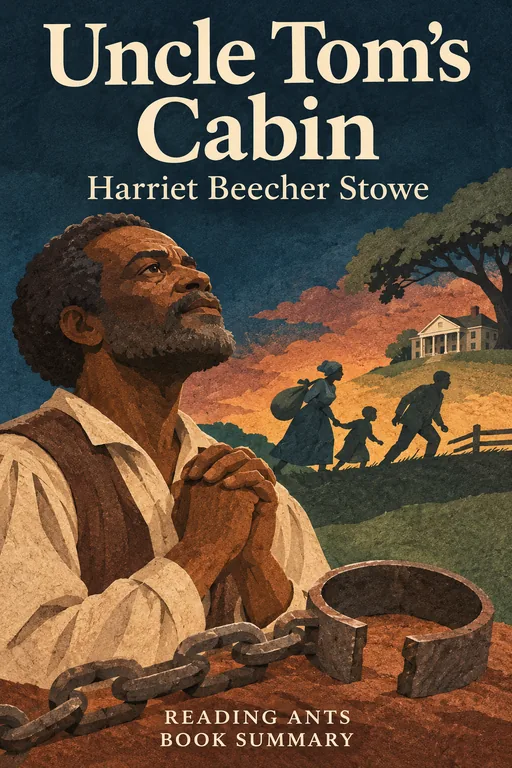
Uncle Tom's Cabin
A devout, gentle enslaved man named Tom is sold from owner to owner and finally dies at the hands of a brutal master, while other enslaved people try to escape, in a novel that shocked America into facing the cruelty of slavery.
Overview
Uncle Tom’s Cabin; or, Life Among the Lowly is a novel by Harriet Beecher Stowe, published in 1852, after it first appeared in installments in an abolitionist newspaper. Stowe, a New England writer and daughter of a minister, wrote it in response to the Fugitive Slave Act of 1850, which forced Northerners to help return people who had escaped from slavery. The novel was an extraordinary success, selling hundreds of thousands of copies in its first year and reaching readers around the world. It makes a passionate moral argument that slavery destroys families and corrupts souls. It is also controversial today for its stereotypes and its portrayal of Tom.
Main Characters
- Uncle Tom: a loyal, deeply Christian enslaved man who believes in forgiveness and endurance.
- Eliza Harris: a young enslaved mother who escapes with her son to save him from being sold.
- George Harris: Eliza’s husband, who also escapes to freedom.
- Mr. Shelby: the Kentucky planter who sells Tom and Eliza’s child to pay debts.
- Little Eva: the angelic daughter of a New Orleans slaveholder, who loves Tom.
- Augustine St. Clare: Eva’s father, who is kind but indecisive.
- Simon Legree: the cruel plantation owner who buys Tom.
- Topsy: a mischievous young enslaved girl.
- Cassy: an enslaved woman on Legree’s plantation who plans an escape.
Full Summary
The Sale
On a Kentucky farm, Mr. Shelby, who is in debt, decides to sell two enslaved people to a slave trader: Tom, a trusted and religious man, and Eliza’s young son, Harry. Eliza overhears the plan, and in the night she flees with her child, crossing the icy Ohio River by leaping from floe to floe. She reaches the free state and is helped by Quakers and others on the Underground Railroad. Tom, however, accepts his fate, refusing to run away because he does not want to harm Mr. Shelby’s family. He is taken south on a riverboat. Tom’s farewell to his wife Chloe and his children is heartbreaking, and he tries to comfort them by telling them that God will look after them. The trader, Haley, who has no feelings for the families he separates, chains him in the boat.
Little Eva
On the boat, Tom saves a little white girl, Eva St. Clare, who falls overboard. Her father, Augustine St. Clare, buys Tom out of gratitude, and takes him to New Orleans. Tom becomes a trusted servant in a household that is unusually kind, and he forms a deep bond with Eva, who is gentle and sees the humanity in everyone. Eva also befriends Topsy, a rough girl who has been abused. But Eva grows ill, and as she dies, she urges her father to free the enslaved people.
St. Clare’s Death
After Eva dies, St. Clare decides to free Tom, but before he can sign the papers, he is accidentally stabbed and killed while trying to stop a brawl. His wife sells Tom and the others at auction. This shows how enslaved people have no security, even in apparently kind households. Tom is taken from the home, and bought by a new owner.
Simon Legree
Tom is sold to Simon Legree, a brutal plantation owner in the Red River region of Louisiana. Legree wants to break Tom’s spirit and make him a driver of other enslaved people, but Tom refuses to whip a fellow worker. Legree beats him, and tries to humiliate him. Tom’s faith gives him strength, and he comforts others who are suffering. He also meets Cassy, a defiant enslaved woman who is Legree’s mistress, and Emmeline, a young woman whom Legree has bought.
Escape and Death
Cassy and Emmeline hide in the garret, using a haunting deception to frighten Legree, and then escape in disguise; Tom knows of the plan but does not leave. Legree demands that Tom tell where they have gone, and Tom refuses to betray them. Legree has his overseers, Sambo and Quimbo, beat him savagely and leave him dying. Tom forgives them, and they are moved to repent. At this moment, George Shelby, the son of Tom’s first master, arrives to buy him back, but he is too late. Tom dies, and George vows to fight against slavery, freeing the enslaved people on his family’s farm.
Freedom
Meanwhile, Cassy and Emmeline make their way north in disguise, and on a riverboat they meet George Harris’s sister, and travel with her to Canada. There Cassy discovers that Eliza is her long-lost daughter, and the family is reunited. They later travel to France and then to Liberia. Stowe closes by urging readers to examine their own consciences and to work for the end of slavery, and by suggesting that the nation must repent.
Why It Matters
Uncle Tom’s Cabin was the best-selling novel of the nineteenth century and is often described as the second-best-selling book of that century overall, after the Bible. It energized the antislavery movement and turned many Northerners against slavery by presenting enslaved people as human beings with feelings, families and faith. When Abraham Lincoln reportedly met Stowe, he supposedly called her the little woman who started the great war, though the story may be apocryphal.
It was adapted into stage plays that were hugely popular, and its characters have entered American culture, even as its influence has become problematic, because later versions used and exaggerated racial stereotypes.
Key Takeaways
- Slavery tears families apart. Many of the central events involve separation.
- Moral courage can be quiet. Tom’s faith and refusal to obey wrongdoing are a form of resistance.
- Complicity matters. Even kind people take part in an unjust system.
- Stories can change minds. The novel influenced public opinion.
- Freedom is worth great risk. Eliza and George risk everything.
What We Can Learn
The novel shows the power of literature to build empathy. By showing enslaved people as individuals with love for their children, Stowe challenged readers to see them as fellow humans.
It also reminds us that kindness alone is not enough. St. Clare’s good intentions, without action, leave the people he enslaves vulnerable.
Finally, it raises questions about how best to represent injustice, and how the intentions of an author can differ from the effects of her work. Reading it today, alongside the narratives written by formerly enslaved people themselves, gives a fuller picture of both the history and the way it was told.
Criticism and Counterpoints
Modern readers and scholars have criticized the novel for its racial stereotypes, such as the loyal servant, the comic child Topsy and the idealized Black Christian, as well as its use of racist language. Black writers such as James Baldwin and Ralph Ellison criticized it as sentimental and as failing to show Black people as complex. The term “Uncle Tom” is now used as an insult for someone seen as too submissive to white authority, although Stowe’s Tom is a figure of resistance.
Some also object to the idea of colonization, as Stowe’s solution for the free Black characters is to send them to Liberia. Still, the book remains historically important.
Who Should Read It
This book suits teenagers and adults. It is long and sentimental in style, and contains scenes of violence and offensive language and stereotypes. It is best read with context and discussion, and alongside writings by formerly enslaved authors.
Want the whole book?
A summary is a taste, not the meal. Here is where to find the full book.
You reached the end 🎉
Nicely done. Mark this one as read, and we will suggest what to read next.
Read this next
Narrative of the Life of Frederick Douglass
Frederick Douglass
Frederick Douglass tells how he was born into slavery, taught himself to read, resisted a brutal master and escaped to freedom, showing that literacy and courage are weapons against injustice.
👤 Real Lives
Beloved
Toni Morrison
A formerly enslaved woman living in Ohio after the Civil War is haunted by the ghost of the daughter she killed to save her from slavery, and by the painful memories she has tried to bury.
✨ Modern Fiction
Twelve Years a Slave
Solomon Northup
Solomon Northup, a free Black man from New York, tells how he was kidnapped in 1841, sold into slavery in Louisiana and kept there for twelve years until he was rescued and returned to his family.
👤 Real Lives
Pride and Prejudice
Jane Austen
Quick-witted Elizabeth Bennet and the proud, wealthy Mr. Darcy badly misjudge each other, and only by facing their own faults do they find their way to love.
📜 Classics
Nineteen Eighty-Four
George Orwell
In a future Britain ruled by an all-seeing Party, one man secretly rebels by keeping a diary and falling in love, and discovers just how completely a totalitarian state can crush the human mind.
📜 Classics
To Kill a Mockingbird
Harper Lee
In a small Alabama town in the 1930s, young Scout Finch watches her father, a lawyer, defend a Black man falsely accused of a crime, and learns hard lessons about prejudice, courage and seeing the world through other people's eyes.
📜 ClassicsWant something different?
Pick another topic and we will show you three books to start with.