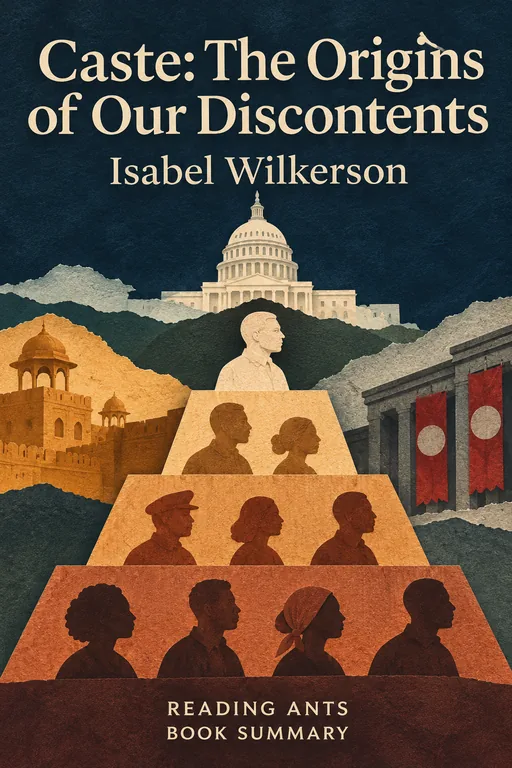
Caste: The Origins of Our Discontents
Isabel Wilkerson argues that the United States has long been organized by an unspoken caste system, in which a person's place is fixed at birth by race, and she compares it with the caste systems of India and Nazi Germany.
Overview
Caste: The Origins of Our Discontents was published in 2020 by Isabel Wilkerson, the author of The Warmth of Other Suns. She says that “race” is only the way caste has been shown in America, and that the real structure beneath it is a hierarchy that ranks groups of people and assigns them different status and rights. The book offers a way of seeing the country, using comparisons with India and Germany. Wilkerson tells stories of individuals, and also lays out eight common features of caste systems, which she calls pillars.
Full Summary
1. Caste is the bones, race is the skin
The idea: Wilkerson uses a picture of the human body. Race, she says, is the visible surface, such as skin color, which we use to sort people. Caste is the deep structure that gives the sorting its force: a ranking of human value, which is enforced by custom and law. She argues that thinking only in terms of race can make us miss how the system works, and how it is passed down.
In real life: In a school, the visible groups of students are shaped by something deeper, such as unwritten rules about who sits where.
2. The pillars of caste
The idea: The author describes eight features that she finds in caste systems. They include the belief that the order comes from nature or God’s will, the idea that status is inherited, strict control of who may marry whom, the notion that the lower caste is impure, a hierarchy of work, the stigma and dehumanization of the lowest group, terror and cruelty to enforce the order, and the belief in the inherent superiority of the top group and the inferiority of the bottom. She shows these in the history of American slavery and Jim Crow, and also in India and in Nazi Germany.
In real life: A rule that “this is how it has always been” is often a sign that a system is being protected from questions.
3. India and Germany
The idea: Wilkerson compares the American system with the caste system of India, where people at the lowest level were treated as “untouchable,” and with Nazi Germany, which classified Jews and persecuted them. She notes that leaders of India’s lowest castes and American Black leaders were aware of each other: the Dalit leader Bhimrao Ambedkar wrote to W.E.B. Du Bois in 1946 about the similarity of their peoples’ positions, and when Martin Luther King Jr. visited India in 1959 a school principal introduced him as a fellow untouchable from America. Relying on the legal historian James Whitman, she describes how Nazi lawyers meeting in 1934 studied American race laws on marriage and immigration as they prepared what became the Nuremberg Laws, though they found parts of the American system, such as the one-drop rule, too harsh to copy. She is careful to say that the systems differ in how they are built and run, and that the comparison is about shared patterns, not about equating them.
In real life: Seeing the same pattern in different places can help us to recognize it at home.
4. How caste shows up in daily life
The idea: The book tells many personal stories of people who were treated differently because of their position in the hierarchy, in settings that range from restaurants to encounters with the police. Wilkerson says that these everyday events, large and small, tell people where they are expected to stay, and that policing roles and boundaries is what marks caste at work. She also looks at how those in the dominant caste benefit and how they can take their standing for granted.
In real life: A person who is never questioned when entering a shop may not realize that others are followed.
5. The costs to everyone
The idea: Wilkerson argues that caste harms not only those at the bottom, but the whole society. It wastes talent, breeds rivalry, distrust and a lack of empathy, and she argues that it leaves the United States behind other wealthy nations on measures such as health and well-being. She points to the baseball pitcher Satchel Paige as an example of a gifted person held back by the system, and she discusses research linking everyday discrimination to health problems and early aging, and showing that prejudice itself can harm the body of the person who holds it. She suggests that a society that wastes the potential of some of its people is poorer for it. She also reads the backlash after Barack Obama’s election, and the 2016 election, as a reaction by many in the dominant caste to a perceived threat to their standing.
In real life: A school team that excludes some players because of their background may lose the one who could have helped it to win.
6. Toward a world without caste
The idea: In the final part, the author turns to hopes of change. She says that the first step is to see the structure and to name it, and that ending caste will take effort from everyone, above all from members of the dominant caste, who would have to give up the belief that they are inherently superior. She calls for what she describes as radical empathy: humbly listening to and learning from another person’s experience, rather than imagining how you would feel in their place. She says that each person has a part to play in resisting the demands of the hierarchy.
In real life: Sitting with someone who is usually left out at lunch is a small kindness, but a caste system is enforced by law, custom and violence, so it takes more than personal friendliness to change.
Why It Matters
Caste was an immediate bestseller, reaching the top of the New York Times nonfiction list in 2020, and one of the most discussed books of that year, at a time when the United States was debating race and justice. It gave readers a new vocabulary and a different framework for talking about inequality, one that links American history with other societies. The book was recommended by many readers and public figures, including Oprah Winfrey and Barack Obama, and it has been used in discussion groups, schools and workplaces. It has also been criticized and debated. Its main contribution is to invite readers to look at the hidden structure of status, and to ask how it affects everyone. It continues to shape conversations about history and fairness.
Key Takeaways
- Caste is a hidden ranking. It organizes who is treated as higher or lower.
- Race is its American form. Skin color is the visible sign of a deeper system.
- The system has recognizable features. It includes inherited status, control of marriage and enforced cruelty.
- Everyone is affected. A hierarchy costs society talent and trust.
- Empathy is a start. Seeing and understanding can lead to change.
What We Can Learn
You can start by noticing the unspoken rankings in your own life, in schools, workplaces and neighborhoods, and ask whether they are fair. Listen to people who have a different experience, and try to understand it without becoming defensive. Think about small ways in which you can include those who are left out, and speak up when someone is demeaned. Learn history, including the parts that are hard. And remember that systems made by people can be changed by people, which gives each of us a role.
Criticism and Counterpoints
Some scholars say that the comparison of American racism with India’s caste system and with Nazi Germany is too loose, and that it blurs important differences in history and structure. Sociologists and historians have disputed whether “caste” is the best term for American racial inequality, which, they say, is already explained by existing concepts such as racism. One reviewer in the Wall Street Journal argued that Wilkerson never convincingly shows why caste is a better lens than race, and that she underplays the progress the country has made. Some of the claims about the Nazi interest in American law are also debated. Supporters answer that the metaphor is meant to open a conversation, and that it succeeds.
Who Should Read It
This book is for readers who want to think about inequality in a broad and humane way, and who are comfortable with painful history. It is clearly written, with stories that stay in the mind. Those who want a strictly academic analysis may prefer specialist works, and some of the examples of violence may be hard for younger readers.
Want the whole book?
A summary is a taste, not the meal. Here is where to find the full book.
You reached the end 🎉
Nicely done. Mark this one as read, and we will suggest what to read next.
Read this next
The Warmth of Other Suns
Isabel Wilkerson
Isabel Wilkerson tells the story of the Great Migration, in which about six million Black Americans left the South for cities in the North and West, through the lives of three people who made the journey.
🏛️ History
Between the World and Me
Ta-Nehisi Coates
In a letter to his teenage son, Ta-Nehisi Coates describes what it means to live in a Black body in America, and reflects on fear, history and the struggle to be free.
⚖️ Politics & Society
The Origins of Totalitarianism
Hannah Arendt
Hannah Arendt examines how antisemitism, imperialism and the breakdown of society in Europe prepared the ground for the totalitarian regimes of Nazi Germany and Stalin's Soviet Union, and what made these regimes new and uniquely terrible.
🏛️ History
The Rise and Fall of the Third Reich
William L. Shirer
Journalist William Shirer tells the story of how Adolf Hitler came to power in Germany, built a dictatorship, started the Second World War and carried out genocide, until the regime's defeat in 1945.
🏛️ History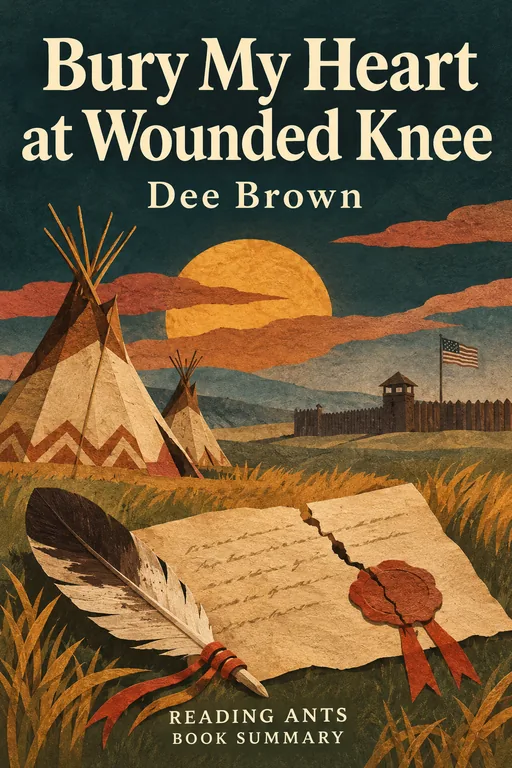
Bury My Heart at Wounded Knee
Dee Brown
Dee Brown tells the history of the American West from 1860 to 1890 as seen by the Native peoples who lost their lands, showing the broken treaties, the wars and the massacres that ended their independence.
🏛️ History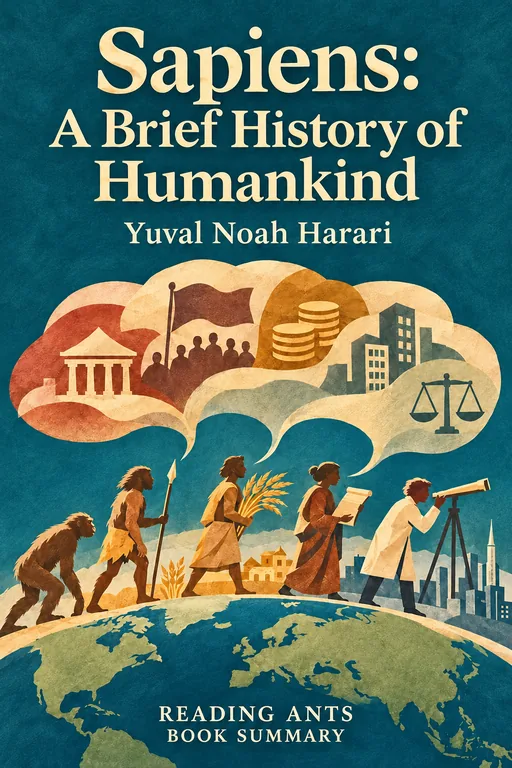
Sapiens: A Brief History of Humankind
Yuval Noah Harari
Humans came to rule the planet not because we are the strongest animals but because we can believe in shared stories (gods, nations, money, companies) that let millions of strangers cooperate.
🏛️ HistoryWant something different?
Pick another topic and we will show you three books to start with.