 Reading Ants
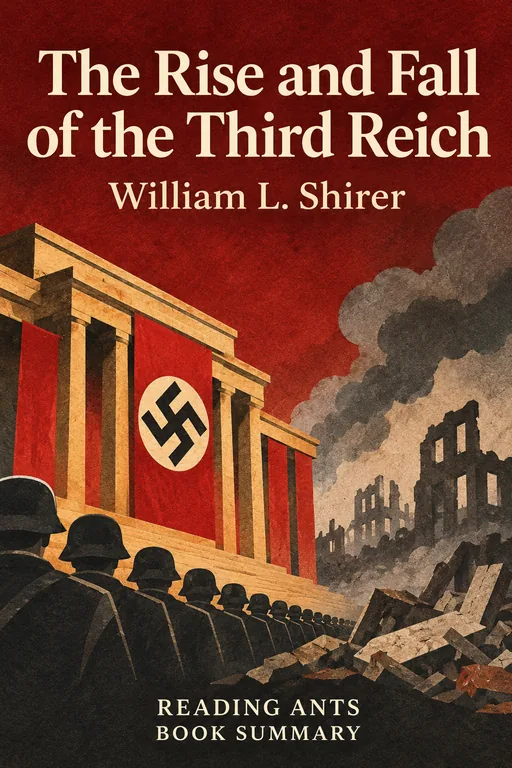
The Rise and Fall of the Third Reich
Journalist William Shirer tells the story of how Adolf Hitler came to power in Germany, built a dictatorship, started the Second World War and carried out genocide, until the regime's defeat in 1945.
Overview
The Rise and Fall of the Third Reich: A History of Nazi Germany was published in 1960 by William L. Shirer, an American journalist who had reported from Nazi Germany in the 1930s, partly for CBS radio, and had seen the regime at close range. After the war, he drew on captured German documents, the diaries of figures such as Joseph Goebbels, and evidence and testimony from the war crimes trials at Nuremberg. The book is more than a thousand pages long. It was one of the first major histories of the period for a general public, and it became a bestseller that sold in huge numbers.
Full Summary
1. The roots and the seizure of power
The idea: Shirer covers Hitler’s life from his birth and the Germany that he emerged from: a country that had lost the First World War, humiliated by the peace treaty, shaken by inflation and in turmoil. Hitler, who was a failed artist and a soldier, joined a small political party, tried to seize power in a failed uprising in Munich in 1923, and wrote a book in prison setting out his hatreds and plans. In 1933, after a period of economic crisis, he was appointed chancellor by the president, and conservative politicians thought that they could control him.
In real life: A group can seem to be a small fringe movement until a crisis gives it a chance, and others misjudge the danger.
2. Building a dictatorship
The idea: Within months, Hitler used a fire at the parliament building as a pretext to take away civil rights, then pushed through a law that let him make laws without parliament. Opposition parties and trade unions were banned, the press was controlled and the state used propaganda and terror. In 1934, Hitler had a number of rivals and critics killed in a purge known as the Night of the Long Knives, and after the death of the president that year the army swore an oath of loyalty to him personally. Jews were stripped of rights through laws that made them second-class.
In real life: Freedoms are often lost step by step, with each step explained as a temporary measure.
3. Preparing for war
The idea: The Nazi regime rebuilt Germany’s armed forces in violation of the peace treaty, and took the Rhineland. In 1938, it took Austria and then, after pressure and a conference with Britain, France and Italy, took the Sudeten region of Czechoslovakia. The leaders of Britain and France hoped that giving way would keep the peace, which Shirer describes as appeasement. Hitler later seized the rest of Czechoslovakia, and signed a pact with the Soviet Union that cleared the way for war.
In real life: Giving in to a bully to avoid a fight can sometimes encourage more demands.
4. War across Europe
The idea: Germany invaded Poland in September 1939, which led Britain and France to declare war. In the following months and years, German forces quickly conquered Denmark, Norway, the Low Countries and France. The British resisted in the air, and Hitler turned east, attacking the Soviet Union in 1941. Shirer describes the military campaigns, the brutal occupation of conquered lands and the first great setbacks, such as the defeat at Stalingrad.
In real life: A sudden run of victories can lead leaders to take more and more risks, until one goes wrong.
5. Genocide
The idea: Shirer devotes part of the book to the persecution and murder of the Jews of Europe, which the Nazis called the “Final Solution.” He describes how policies grew from discrimination to forced ghettos, to mass shootings and then to extermination camps, where millions of people, most of them Jews, were killed. Other groups were also persecuted and killed. He bases his account on German documents and witness testimony.
In real life: Studying these events is painful, but it shows why we must protect the rights of everyone and speak up against hatred.
6. Defeat and the end
The idea: In the last years of the war, Germany was attacked from east and west. A group of officers tried to kill Hitler in 1944 and failed, and the regime took savage revenge, with thousands executed. Hitler stayed in a bunker in Berlin as Soviet forces approached, and took his own life at the end of April 1945. Germany surrendered in May. Shirer links the catastrophe to the course of German history, an argument that later drew much criticism.
In real life: The end of a regime does not undo the harm it caused, but it opens the possibility of a different future.
Why It Matters
Shirer’s book was among the first to put the history of Nazi Germany in front of a general readership across the English-speaking world, and it sold in huge numbers. It won the National Book Award for nonfiction in 1961 and shaped how a generation understood the war and the Holocaust. Its use of captured German documents and trial evidence gave an authority and detail that few popular histories had. The book also serves as a warning about how democracies can be undermined and about the cost of ignoring danger. Historians have since added much new research, but the book remains a landmark and an introduction to the subject for readers who want a full narrative.
Key Takeaways
- Democracy can be fragile. A dictator can rise through legal-looking steps during a crisis.
- Propaganda and terror work together. The regime controlled minds and silenced opponents.
- Appeasement failed. Concessions encouraged further aggression.
- Genocide was deliberate. It was planned and carried out by a state.
- Memory matters. Remembering history helps us to guard against repeating it.
What We Can Learn
The history teaches us to value freedom of speech, independent courts and a free press, and to notice when they are under threat. It encourages us to speak up when we see injustice, and to be careful about hate speech and scapegoating. It shows how ordinary people can become part of terrible events, and so asks each of us to think about our responsibility. Studying such history should be done with care and support, particularly for younger readers, and in conversation with teachers or family.
Criticism and Counterpoints
Since 1960, historians have criticized aspects of the book. The sharpest criticism targets Shirer’s view that German history led in a straight line from Martin Luther to Hitler, which many scholars find too simple. The historian Klaus Epstein also faulted the book for neglecting current scholarship and for lacking a real understanding of totalitarianism, and Richard J. Evans called it readable but outside the academic mainstream. Others note that Shirer wrote largely from captured German documents and before much later research, so new archives and studies have corrected details. Nearly all journalists praised the book, while scholars were more divided. The work should be read as a pioneering narrative, supplemented by newer studies.
Who Should Read It
This book is for mature readers who want a complete narrative of Nazi Germany and of the Second World War in Europe. It is extremely long and often disturbing. Many people find it easier to read selected parts, or a shorter modern history, first, and teenagers should read with guidance.
Want the whole book?
A summary is a taste, not the meal. Here is where to find the full book.
You reached the end 🎉
Nicely done. Mark this one as read, and we will suggest what to read next.
Read this next
The Origins of Totalitarianism
Hannah Arendt
Hannah Arendt examines how antisemitism, imperialism and the breakdown of society in Europe prepared the ground for the totalitarian regimes of Nazi Germany and Stalin's Soviet Union, and what made these regimes new and uniquely terrible.
🏛️ History
Eichmann in Jerusalem
Hannah Arendt
Hannah Arendt reports on the trial of the Nazi official Adolf Eichmann in Jerusalem and argues that he was not a monster but a thoughtless bureaucrat, which led her to the idea of the banality of evil.
🏛️ History
Night
Elie Wiesel
Elie Wiesel tells, in short and searing pages, how as a teenager he was taken from his hometown of Sighet to Auschwitz and Buchenwald, lost his family and watched his faith and childhood break apart.
👤 Real Lives
On Tyranny
Timothy Snyder
Historian Timothy Snyder draws twenty practical lessons from the history of fascism, communism and other dictatorships of the twentieth century, to help ordinary citizens defend freedom in democratic societies today.
🏛️ History
The Diary of a Young Girl
Anne Frank
A Jewish teenage girl hiding from the Nazis in a secret apartment in Amsterdam records two years of fear, family quarrels, first love and big dreams in a diary that became one of the most famous books in the world.
👤 Real Lives
Sapiens: A Brief History of Humankind
Yuval Noah Harari
Humans came to rule the planet not because we are the strongest animals but because we can believe in shared stories (gods, nations, money, companies) that let millions of strangers cooperate.
🏛️ HistoryWant something different?
Pick another topic and we will show you three books to start with.