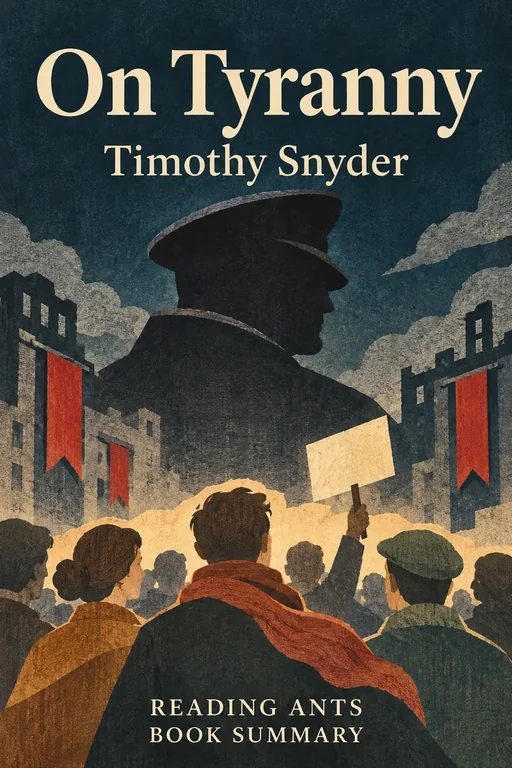
On Tyranny
Historian Timothy Snyder draws twenty practical lessons from the history of fascism, communism and other dictatorships of the twentieth century, to help ordinary citizens defend freedom in democratic societies today.
Overview
On Tyranny: Twenty Lessons from the Twentieth Century is a very short book published in 2017 by Timothy Snyder, a professor of history at Yale University who has written extensively about Europe in the era of Nazism and Stalinism. He wrote it as a small guide, after the American presidential election of 2016, in the belief that the experience of the last century is relevant to the present. Each lesson is a short chapter with a title that is a call to action, and is based on historical examples. Snyder says that history does not repeat itself, but it can teach us, and it can help us to see patterns.
Full Summary
1. Don’t obey in advance
The idea: Snyder says that in many cases, authoritarian regimes were helped by people who adjusted their behavior before they were forced to, by guessing what the rulers wanted. Such early compliance tells a new regime that resistance is weak, and makes it easier to go further. He urges people not to give up their freedoms before anyone demands it, and to remember that rules and norms can be defended.
In real life: If a class gives in to a new rule that nobody has asked for, the teacher may think that it is acceptable.
2. Defend institutions
The idea: Courts, newspapers, laws, unions and other institutions help to protect liberty by creating places where people can stand up to power. Snyder says that they do not defend themselves, and need people who support them. If we let them decline, we lose the shield that they give us. He draws on the rise of the Nazi Party before World War II to show how institutions that were left undefended could be weakened. He suggests choosing an institution that you value, and actively supporting it.
In real life: A school’s student council works only if students use it and care about it.
3. Beware the one-party state, and be wary of paramilitaries
The idea: Snyder warns that regimes that rose in the twentieth century often changed the rules of elections to favor one party, or took over the political system. He also describes how groups of armed supporters outside the formal police or army, such as party militias, were used to intimidate opponents. He advises citizens to be alert to attempts to remove fair competition, and to be careful about armed groups that are loyal to a leader instead of to the law.
In real life: If a game changes its rules so that only one team can win, it is no longer a fair game.
4. Believe in truth, and be kind to our language
The idea: Snyder says that if facts can be dismissed, no one can hold power accountable, and that people who give up on facts give up on freedom. He urges readers to check information themselves, to read books and long articles, to support serious journalism and to defend the idea that truth exists. He also asks us to think about the words we use, and to avoid repeating slogans, since manipulated language can narrow our thinking.
In real life: Before you share a post, you can ask who made it and whether the claim can be checked.
5. Stand out, and take responsibility
The idea: Many lessons are about personal courage. Snyder says that when someone dares to say “no,” it can break the spell for others, and that one person who refuses to go along can encourage many. He also stresses professional ethics: lawyers, judges and civil servants are needed for abuses of power to work, so their professional standards matter most when leaders behave badly.
In real life: One student who politely refuses to join in teasing someone can make it easier for others to stop.
6. Build a life of connection and calm
The idea: Snyder suggests small, human habits: making eye contact and speaking to people, practicing “corporeal politics,” which means showing up in person, and keeping a private life so that those in power have little leverage over you. He encourages support for good causes, learning from peers in other countries and listening for dangerous words, such as “emergency” or “exception,” when they are used to justify limiting rights. His final lessons are to be calm when the unthinkable arrives, to be a patriot in the best sense and to be as courageous as you can.
In real life: Getting to know the people in your neighborhood is a way of making your community stronger.
Why It Matters
On Tyranny became a bestseller in the United States, reaching the top of the New York Times paperback nonfiction list in 2017 and selling well over a million copies. It was read as a warning by people who were alarmed by political developments, and was also criticized by those who thought that its comparisons were exaggerated. The book’s popularity shows how many readers wanted to understand how democracies can fail, and what individuals can do. It helped to bring the work of historians of dictatorship to a wider audience. Its form, short lessons with clear action points, made it easy to share and use in discussion groups. Snyder later wrote longer works that expand on the ideas.
Key Takeaways
- Act early. Do not give up your freedoms before you are made to.
- Institutions need defenders. Courts, press and civic groups depend on our support.
- Truth matters. A society that loses facts loses the ability to resist.
- Courage is contagious. One person’s refusal can inspire others.
- Everyday connection helps. Trust and community are protection against fear.
What We Can Learn
You can try the lessons at a small scale. Check facts before you pass them on, read something longer than a post every week, and talk with people who see things differently. Join a group in your school or town that helps others. If something seems unfair, think about how you can say so politely and clearly. And remember to take care of yourself and of those close to you, because a calm and connected life is a good base for taking part in public life, whatever your views.
Criticism and Counterpoints
Critics say that the book draws comparisons between the twentieth-century dictatorships and present-day events that are sometimes too loose or alarmist; one reviewer called it overwrought, and another said it seemed to have been written in a hurry. Others say that the lessons are broad enough to be used by people of any political view, and that democracy and authoritarianism do not follow the same path in each country. Others find the book’s tone political and partisan, and the publication in response to a specific election made it a target of debate. Supporters answer that the lessons about courage, truth and institutions apply broadly, and that the purpose is to encourage citizens to pay attention.
Who Should Read It
This book is for readers who want a short, direct guide to thinking about democracy and its dangers, and for teachers and students. It can be read in an hour, and it gives readers plenty to discuss. Those who want a deep, balanced account of any one regime will find it only a starting point, and readers should weigh its arguments for themselves.
Want the whole book?
A summary is a taste, not the meal. Here is where to find the full book.
You reached the end 🎉
Nicely done. Mark this one as read, and we will suggest what to read next.
Read this next
The Origins of Totalitarianism
Hannah Arendt
Hannah Arendt examines how antisemitism, imperialism and the breakdown of society in Europe prepared the ground for the totalitarian regimes of Nazi Germany and Stalin's Soviet Union, and what made these regimes new and uniquely terrible.
🏛️ History
The Rise and Fall of the Third Reich
William L. Shirer
Journalist William Shirer tells the story of how Adolf Hitler came to power in Germany, built a dictatorship, started the Second World War and carried out genocide, until the regime's defeat in 1945.
🏛️ History
Nineteen Eighty-Four
George Orwell
In a future Britain ruled by an all-seeing Party, one man secretly rebels by keeping a diary and falling in love, and discovers just how completely a totalitarian state can crush the human mind.
📜 Classics
Animal Farm
George Orwell
The animals of an English farm overthrow their cruel human owner to create a fair society, but the clever pigs who lead them slowly become just as tyrannical as the humans they replaced.
📜 Classics
Eichmann in Jerusalem
Hannah Arendt
Hannah Arendt reports on the trial of the Nazi official Adolf Eichmann in Jerusalem and argues that he was not a monster but a thoughtless bureaucrat, which led her to the idea of the banality of evil.
🏛️ History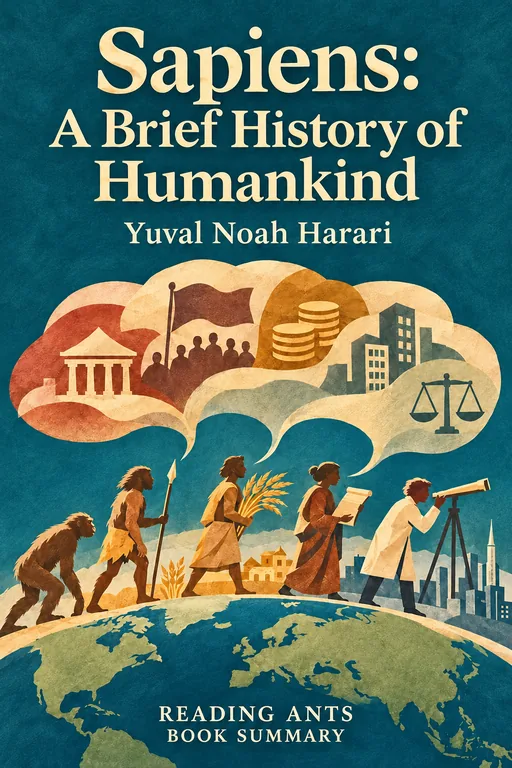
Sapiens: A Brief History of Humankind
Yuval Noah Harari
Humans came to rule the planet not because we are the strongest animals but because we can believe in shared stories (gods, nations, money, companies) that let millions of strangers cooperate.
🏛️ HistoryWant something different?
Pick another topic and we will show you three books to start with.