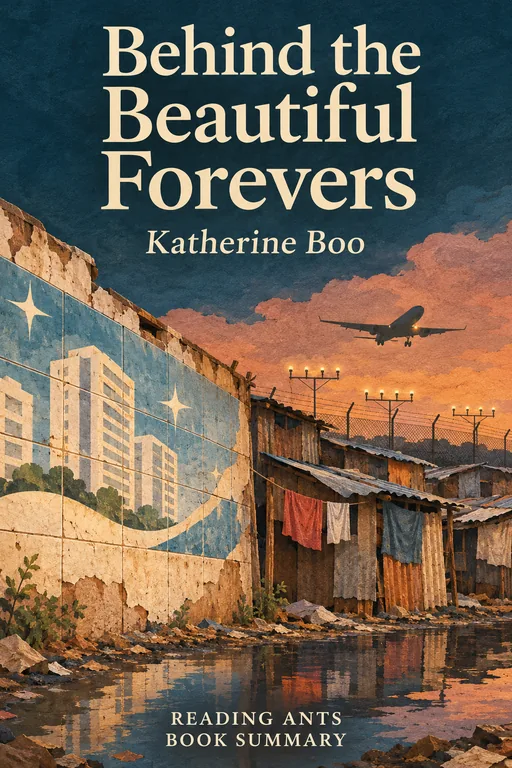
Behind the Beautiful Forevers
Journalist Katherine Boo spent years in a Mumbai slum beside the airport and tells, through the lives of its residents, how hope, ambition, corruption and injustice shape the struggle to escape poverty in a booming India.
Overview
Behind the Beautiful Forevers: Life, Death, and Hope in a Mumbai Undercity was published in 2012 by Katherine Boo, an American journalist who had won a Pulitzer Prize and a MacArthur fellowship. Over more than three years, she spent time in Annawadi, a slum of about three thousand people built on land near Mumbai’s airport, behind a wall that advertised floor tiles with the slogan “Beautiful Forever.” She interviewed the residents and used documents to reconstruct events. The book reads like a novel, though it is nonfiction, and won the National Book Award.
Full Summary
1. Annawadi and its people
The idea: Boo introduces the slum and several of its people. Abdul, a teenage boy, sorts and sells garbage, recycled from the city, to support his large family. Asha is a woman who wants to become the slum’s leader and gain wealth by dealing with politicians and officials. Her daughter, Manju, is seen as the slum’s most capable girl and may become its first woman college graduate. Around them are scavengers, thieves, children and others who live by their wits.
In real life: Everyone in a community has a role and dreams, even if outsiders see only poverty.
2. The economy of garbage and ambition
The idea: The author describes the workings of the slum economy: the sorting, trading and selling of trash and scrap, which provide a living, and the competition among those who rely on it. As India’s economy grows, with luxury hotels near the airport, the people of Annawadi feel both hope and exclusion. Some hope to benefit from the boom; others are crushed by it. Boo shows how small advantages can be decisive.
In real life: A neighbor who has a slightly better route for selling scrap may do much better.
3. Corruption and petty power
The idea: A theme of the book is corruption at every level. Officials demand bribes, police extort money, and charities and schools are used as sources of profit. Asha uses her connections to get funds and favors, by becoming a middleman. Boo presents corruption not as an exception, but as the way things work in the world of the poor. Residents need to bargain, bribe and flatter in order to survive.
In real life: If you must pay someone to get what you are owed, the system is unfair.
4. The fire and the accusation
The idea: The central event of the book is a conflict between Abdul’s family and a neighbor, a one-legged woman called Fatima, who sets herself on fire after a bitter quarrel, and later dies in the hospital. She blames the Husain family for what happened. Abdul, his father Karam and his sister Kehkashan are arrested, though they are innocent, and the charge is that they drove her to it. Police see an opportunity to demand bribes. The case turns a family’s life upside down.
In real life: A false accusation can destroy a family, especially when they have no power to defend themselves.
5. The legal system and justice for sale
The idea: Boo follows the family through the legal system, where everyone seems to expect money. Abdul and his father are beaten and held by the police, and Abdul, who is a minor, is later sent to a juvenile facility, while his father remains in detention. The family struggles to raise money for bribes and a lawyer, and lawyers and officials expect their share. The author shows how a poor person’s access to justice depends on money and connections, and how those with the least resources suffer the most.
In real life: Without money for a good lawyer, a person may not get a fair hearing.
6. Hope and the ending
The idea: The book ends without an easy resolution. After a long time, Abdul’s father and sister are acquitted, though Abdul’s own case drags on and the family has lost much. Others in the slum continue to struggle. Asha becomes a kind of slumlord and profits from the misfortunes of others, including money meant for schools, and Manju’s dreams are uncertain. In the last scene, Abdul is still waiting for a verdict in his juvenile case. Boo ends on a note of resilient hope, while making clear the structural obstacles that the poor face.
In real life: People often keep trying, even when the odds are against them.
Why It Matters
Behind the Beautiful Forevers was widely praised as an outstanding work of narrative reportage. It won the National Book Award, and made readers around the world aware of the details of life in a slum, not as an abstraction, but through individuals. Boo’s method, with years of immersion and no authorial commentary, gave the story authority. It was a finalist for the Pulitzer Prize and was adapted for the stage. It shows how stories can illuminate the effects of inequality and the failure of institutions, and how, in a booming economy, many are left behind.
Key Takeaways
- Poverty is shaped by systems. Corruption and weak institutions trap people.
- The poor have ambition and creativity. They are not passive victims.
- Growth does not reach everyone. Prosperity may bypass or harm the poor.
- Justice depends on resources. Money affects access to fair treatment.
- Hope persists. People continue to strive in difficult conditions.
What We Can Learn
You can use the book to challenge stereotypes about the poor, and to appreciate their resourcefulness. Think about how institutions, such as police, courts and schools, treat people differently depending on their wealth and connections. Learn about the places that are behind the products and services you use. Support efforts that improve access to justice and education. And read stories from other countries, to broaden your understanding. Remember that behind every statistic about poverty are real families with names and hopes.
Criticism and Counterpoints
Some readers feel that Boo’s portrayal, with its focus on corruption and cruelty, gives a bleak picture of life in the slum, and gives less space to solidarity and kindness. Others note that, as an outsider writing about people in a different culture, she could not fully capture their inner thoughts, and that the book’s reconstruction of the characters’ thoughts, drawn from interviews, requires trust. Boo explains her methods in an author’s note, and most readers find the book convincing.
Who Should Read It
This book is for readers interested in poverty, India, journalism and human stories. It is gripping and moving, though it contains scenes of suffering and injustice. Those who want economic or policy analysis should also read more technical works on development.
Want the whole book?
A summary is a taste, not the meal. Here is where to find the full book.
You reached the end 🎉
Nicely done. Mark this one as read, and we will suggest what to read next.
Read this next
Evicted
Matthew Desmond
Sociologist Matthew Desmond lived among poor tenants and landlords in Milwaukee and shows that eviction is not just a result of poverty but a major cause of it, trapping families in a cycle of lost homes, jobs and hope.
⚖️ Politics & Society
Nickel and Dimed
Barbara Ehrenreich
Journalist Barbara Ehrenreich spent months working low-wage jobs in three American cities, to see whether a person could live on such pay, and found that even hard, full-time work often did not cover basic needs.
⚖️ Politics & Society
Banker to the Poor
Muhammad Yunus
Muhammad Yunus tells how he began lending tiny sums to poor villagers in Bangladesh, built the Grameen Bank on the idea that the poor are creditworthy, and argues that credit is a basic human right.
💰 Money & Economics
Poor Economics
Abhijit V. Banerjee and Esther Duflo
Two economists who test anti-poverty ideas with field experiments argue that we should stop looking for one grand solution and instead study how poor families really live and decide, so that we can find what works.
💰 Money & Economics
The White Tiger
Aravind Adiga
Balram Halwai, the son of a poor rickshaw puller, escapes his fate as a servant by murdering his master and becoming a successful entrepreneur, and tells his story in one long letter, written over seven nights, to the Chinese premier.
✨ Modern Fiction
The Prince
Niccolo Machiavelli
A Renaissance diplomat advises rulers to judge their actions by results rather than morality, arguing that a successful leader must sometimes be cunning and ruthless to win and keep power.
⚖️ Politics & SocietyWant something different?
Pick another topic and we will show you three books to start with.