 Reading Ants
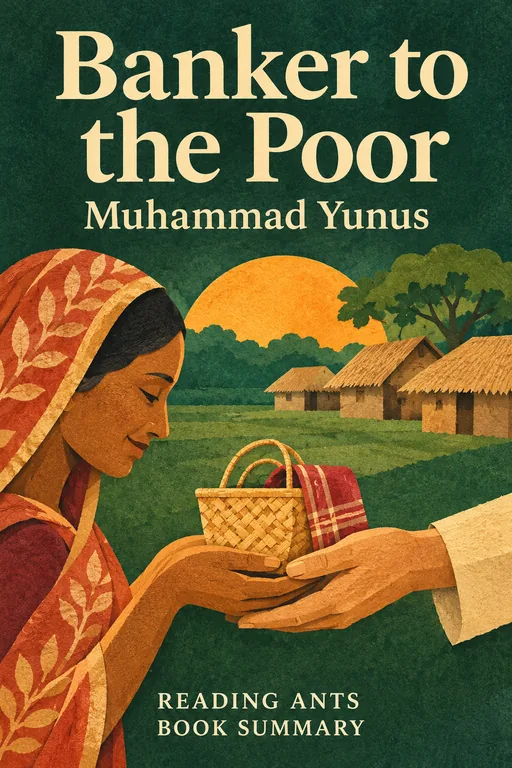
Banker to the Poor
Muhammad Yunus tells how he began lending tiny sums to poor villagers in Bangladesh, built the Grameen Bank on the idea that the poor are creditworthy, and argues that credit is a basic human right.
Overview
Banker to the Poor: Micro-Lending and the Battle Against World Poverty is a memoir by Muhammad Yunus, published in the United States in 1999 (a British edition appeared earlier) and written with the help of the writer Alan Jolis. Yunus was a professor of economics in Bangladesh who started helping poor villagers in the 1970s. His experiment grew into the Grameen Bank, which gives small loans, often to women, without requiring property as security. In 2006, Yunus and the bank received the Nobel Peace Prize. The book follows his journey, from an academic with theories to a banker with a mission, and describes the bank’s methods and the obstacles it faced.
Full Summary
1. A professor meets real poverty
The idea: Yunus returned to Bangladesh in 1972 after studying in the United States, and went on to teach economics at Chittagong University. The country had just won independence, and in 1974 it suffered a severe famine. Yunus found that his textbooks did not help him to understand what was happening outside his classroom. He decided to visit the nearby village of Jobra, to learn from the people there.
In real life: Sometimes the best way to understand a problem is to go and see it for yourself.
2. The first loans
The idea: In the village, Yunus met Sufia Begum, a young woman who made bamboo stools and who had to borrow from a moneylender at very high rates, so that she kept almost nothing from her work. He found that many villagers were trapped in the same way. He lent about twenty-seven dollars, out of his own pocket, to forty-two villagers, and saw that they used it well and repaid it. This showed him that the lack of small capital, not a lack of ability, kept many people poor.
From the book: Yunus often describes how small the amounts were, about twenty-seven dollars shared among forty-two villagers, well under a dollar each, and how big the effect could be.
In real life: A small loan to buy materials can help a craftsperson to make a living, instead of being a worker for someone else.
3. Banks refuse, so he builds his own
The idea: Yunus tried to persuade the regular banks to lend to the poor, but they said that the poor were not creditworthy, since they had no property to offer as security. After many refusals, he secured a loan from a state-owned bank to lend on to villagers. The project grew, and in 1983 it became the Grameen Bank, a name that comes from the word for village. It was built around the belief that trust, and not collateral, can be the base of lending.
In real life: A friend who lends you a book on trust, because you have always returned things, is using the same idea.
4. Group lending and women borrowers
The idea: In the early model, the bank lends to groups of five borrowers, with loans going out in stages, so that group members support each other and encourage each other to repay. It focuses on women, who in Bangladesh had little access to ordinary bank credit. Loans are made for small activities, such as making bamboo goods or weaving, and are repaid in small weekly installments. The bank reports very high repayment rates.
In real life: A study group that helps each member to finish homework can be more effective than studying alone.
5. Beyond loans: social goals
The idea: Yunus describes how the bank encourages its members to make commitments to improve their lives, such as sending their children to school, and the bank measures progress by things like clean drinking water and a sanitary toilet. The aim is not just profit, but to help people to move out of poverty. He says that credit should be seen as a human right, which allows people to build their own lives and not to depend on charity.
In real life: Teaching someone to fish is often better than giving a fish, but they also need a rod.
6. Growth, critics and the wider vision
The idea: The book follows the growth of the bank across Bangladesh and the spread of microcredit around the world. Yunus responds to criticism, such as the argument that charging interest to the poor is wrong, and he explains why the bank needs to cover its costs in order to survive. He also speaks about his dream of a world where poverty is seen as something that belongs in a museum.
In real life: A club that charges small fees can continue for many years, while one that depends on gifts may stop when they end.
Why It Matters
Banker to the Poor tells the story of a movement that spread microfinance to many countries and inspired millions of people. Yunus’s work showed that poor people can be reliable borrowers and that small loans can open up opportunities, especially for women. The award of the Nobel Peace Prize in 2006 gave global recognition to the idea. The book also contributed to the broader notion of social business, in which a company is created to solve a social problem. It is a lively account of a determined individual who took an idea from a village to the world. It remains a key text in discussions about poverty and finance.
Key Takeaways
- The poor are creditworthy. Many repay small loans reliably.
- Trust can replace collateral. Group support helps lending to work without property as a guarantee.
- Credit is a tool for dignity. Access to capital lets people build their own livelihoods.
- Focus on women. Loans to women often benefit whole families.
- Solve problems from the ground. Learning from the people affected leads to better ideas.
What We Can Learn
Yunus’s story shows how a single, practical step can grow into something large. When you see a problem, go and talk to the people who face it, and try a small experiment instead of waiting for a perfect plan. Question rules that everyone assumes, such as the idea that some people cannot be trusted with money. Remember the power of support groups, and of treating people with respect. It also encourages you to think about how a business can serve a social purpose, while being honest about its costs.
Criticism and Counterpoints
In later years, microcredit has been criticized. Studies have found that it often helps families to manage, but does not always lift them out of poverty as hoped, and some borrowers have fallen into debt, particularly when many lenders compete and the interest rates are high. Critics also say that Yunus’s account is idealistic and that repayment figures may hide pressure on borrowers. In Bangladesh, Yunus also faced political conflict and legal disputes with the government. Supporters say that the movement’s flaws should not erase its achievements. The book was written at an early stage and presents an optimistic view.
Who Should Read It
This book is for readers who are interested in economics, social change and the story of a determined person. It is easy to read, and it is an inspiring introduction to microfinance. Readers who want a critical assessment or the latest research on microcredit should read it together with more recent studies.
Want the whole book?
A summary is a taste, not the meal. Here is where to find the full book.
You reached the end 🎉
Nicely done. Mark this one as read, and we will suggest what to read next.
Read this next
Poor Economics
Abhijit V. Banerjee and Esther Duflo
Two economists who test anti-poverty ideas with field experiments argue that we should stop looking for one grand solution and instead study how poor families really live and decide, so that we can find what works.
💰 Money & Economics
Development as Freedom
Amartya Sen
Amartya Sen argues that development should be judged not by national income alone, but by the real freedoms people have to live lives they value, such as being healthy, educated and able to take part in public life.
💰 Money & Economics
Why Nations Fail
Daron Acemoglu and James A. Robinson
Nations become rich or stay poor mainly because of their institutions: countries that share power and reward ordinary people's effort prosper, while those run by narrow elites for their own benefit stay poor.
💰 Money & Economics
Mountains Beyond Mountains
Tracy Kidder
Tracy Kidder follows the American doctor Paul Farmer, who devoted his life to bringing high-quality medical care to the poorest people in Haiti and elsewhere, and who challenged the world to treat poor patients as worthy of the best.
🍎 Health
The Wealth of Nations
Adam Smith
A nation's true wealth is not its stock of gold but the goods and services its people produce, and that wealth grows fastest when people specialize, trade freely and compete, with government providing justice, defense and public goods.
💰 Money & Economics
Rich Dad Poor Dad
Robert T. Kiyosaki
Schools teach people to work for money, but the rich learn to make money work for them by understanding the difference between assets and liabilities and by building businesses and investments.
💰 Money & EconomicsWant something different?
Pick another topic and we will show you three books to start with.