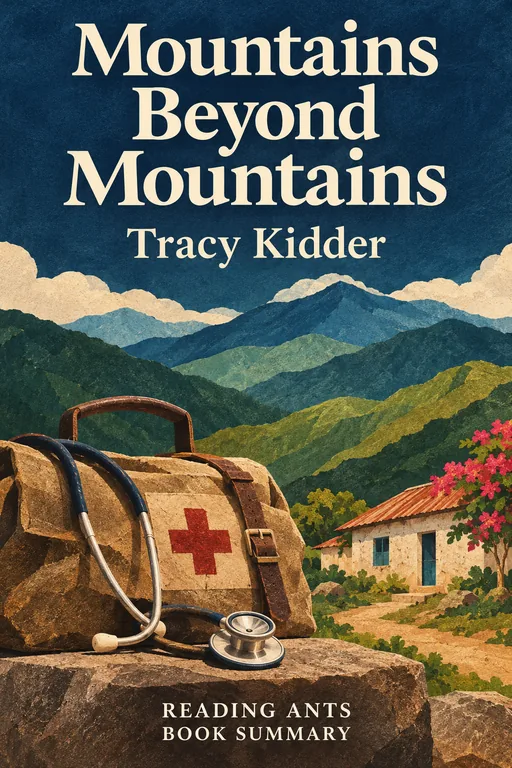
Mountains Beyond Mountains
Tracy Kidder follows the American doctor Paul Farmer, who devoted his life to bringing high-quality medical care to the poorest people in Haiti and elsewhere, and who challenged the world to treat poor patients as worthy of the best.
Overview
Mountains Beyond Mountains: The Quest of Dr. Paul Farmer, a Man Who Would Cure the World was published in 2003 by Tracy Kidder, an American author known for narrative nonfiction. Kidder spent a long time with Farmer, traveling with him to Haiti, Peru and Russia, and meeting his colleagues and patients. The two first met in Haiti in 1994. The title comes from a Haitian proverb that says that behind the mountains there are more mountains, meaning that each problem solved reveals another. Farmer was a physician and anthropologist who co-founded the organization Partners In Health. He died in 2022, long after the book was published.
Full Summary
1. A doctor who never stops
The idea: Kidder introduces Farmer as a man of enormous energy, who split his time between working at a Boston hospital and running health programs in poor places. He slept very little, traveled constantly and gave his attention to individual patients and to big problems. Kidder says that he was drawn to Farmer himself, a man who seemed to practice more than he preached. Farmer was inspiring, and for the people around him, a challenge and sometimes exhausting.
In real life: Some people seem to work without limits, and it is worth asking what fuels them and what it costs them and their families.
2. Haiti and a clinic in the hills
The idea: In the early 1980s, Farmer began working at a hospital in Cange, a poor village in the central plateau of Haiti, where many people had little access to doctors or medicine. He and his friends built up a clinic and, over time, a hospital, known as Zanmi Lasante, a Creole name meaning Partners in Health. It treated nearly everyone, regardless of their ability to pay. Farmer believed that the poor had the same right to care as the rich, and insisted on using modern treatments and not second-rate solutions. Kidder describes how much of this began with a few people, helped by donors in Boston.
In real life: A small group that cares and refuses to give up can start something that grows far beyond their first plan.
3. Treating the diseases of poverty
The idea: Farmer and his colleagues treated diseases such as tuberculosis and HIV/AIDS in places where others said that it was too expensive or too complicated. Many health experts said that treating AIDS in poor countries was too costly, and favored prevention, but Farmer and Partners In Health treated patients regardless of the cost. The organization also relied on local community health workers, who helped patients to follow their treatment. Kidder also names colleagues such as Ophelia Dahl, Jim Yong Kim and Tom White, and the work at Cange.
In real life: A neighbor who checks that a sick friend has taken their medicine can make the difference between getting better or not.
4. Drug-resistant tuberculosis and the fight with the system
The idea: Kidder tells of Farmer’s work in Peru, where the organization went to fight a form of tuberculosis that resists common drugs, after a priest who was a friend of Farmer and Kim, and who had urged them to work in Lima, died of the disease. The drugs needed were extremely expensive, and Jim Yong Kim negotiated with drug companies to bring the price down sharply. Farmer and his colleagues also argued against the rigid standard approach to tuberculosis promoted by the World Health Organization, and their work helped to produce a modified approach called DOTS-Plus. In 2000 the Gates Foundation gave Partners In Health and other organizations a large grant, $45 million, to fight the disease in Lima. The struggle involved long arguments with powerful organizations over whether such expensive treatment was worth the cost.
In real life: When someone tells you something is too expensive to try, asking who decided, and on what basis, can open new possibilities.
5. A moral view of health
The idea: The book explores Farmer’s thinking, which was shaped by his studies and by liberation theology, a religious movement that stresses a preferential option for the poor, which the people of his organization shorten to “O for the P.” Farmer argued that history and politics, including the policies of the United States toward Haiti, helped to keep poor countries poor and sick. He argued that health care should go first to those who need it most. Kidder also looks at tensions, such as triage and whether it is realistic to give the best care to everyone.
In real life: A school where some students lack books because of where they live is facing the same kind of unfairness.
6. Costs, critics and the sense of mission
The idea: The final part shows the personal cost of Farmer’s devotion: little time with his wife, Didi Bertrand, and their daughter, and an earlier marriage proposal to Ophelia Dahl that she turned down, partly because of his work. Kidder repeatedly asks whether the money spent on individual patients might do more good elsewhere. A Haitian boy with a rare cancer is flown to Boston for expensive care, but he dies, and Farmer answers that saving individual lives matters whatever the cost. Kidder concludes that Farmer is not a saint but a man who is sincerely devoted to the poor.
In real life: You do not have to give up everything to help; but it is worth asking what you can give.
Why It Matters
Mountains Beyond Mountains became a New York Times bestseller and won awards, and an edition for young readers was later published. It presented the story of global health inequality through the life of a single person, which made the subject vivid, and it showed the power of persistence and compassion. The book has been praised as inspiring, including by Bill Gates, and it helped to draw attention to Partners In Health and to the wider movement for access to treatment in poor countries. It also asks difficult questions about fairness, resources and personal sacrifice, which remain relevant. Farmer died in Rwanda in February 2022, at the age of 62.
Key Takeaways
- Health is a right. The poor deserve the same quality of care as the rich.
- Show that it can be done. Practical examples can change minds and policies.
- Local people are essential. Community health workers can help patients to stay with their treatment.
- Social conditions affect health. Poverty and inequality cause disease.
- There are always more mountains. Solving one problem reveals others, so persistence is required.
What We Can Learn
You can start with attention to the people near you. Learn about health in your community and ask who is left out. Volunteer, donate or study something that helps others. Remember that big change often starts with small, steady work and the refusal to accept that a problem cannot be solved. At the same time, take care of yourself and the people you love: Farmer’s example is inspiring, and also shows the costs of giving everything. Find a way to serve that you can keep up over many years.
Criticism and Counterpoints
Because the book is an admiring portrait of one remarkable man, readers may find that it gives an idealized picture, and that the focus on a single heroic person can hide the work of many colleagues and local people. Kidder himself raises the question of whether spending large sums on individual patients does the most good, and the debates over cost-effectiveness and whether such an approach can be scaled up remain open and are more complex than a single story can show. The book was written in 2003, and later events changed the field. Still, it remains a moving portrait.
Who Should Read It
This book is for readers who are interested in medicine, global health, poverty and the lives of people who try to change the world. It is warmly written and easy to follow. Those looking for a technical study of health policy should look elsewhere, and readers who are distressed by stories of illness and poverty may find some chapters difficult.
Want the whole book?
A summary is a taste, not the meal. Here is where to find the full book.
You reached the end 🎉
Nicely done. Mark this one as read, and we will suggest what to read next.
Read this next
Banker to the Poor
Muhammad Yunus
Muhammad Yunus tells how he began lending tiny sums to poor villagers in Bangladesh, built the Grameen Bank on the idea that the poor are creditworthy, and argues that credit is a basic human right.
💰 Money & Economics
Poor Economics
Abhijit V. Banerjee and Esther Duflo
Two economists who test anti-poverty ideas with field experiments argue that we should stop looking for one grand solution and instead study how poor families really live and decide, so that we can find what works.
💰 Money & Economics
The Checklist Manifesto
Atul Gawande
Surgeon Atul Gawande shows that in a world too complex for any expert to remember everything, a simple checklist can prevent mistakes in hospitals, airplanes and building sites.
🍎 Health
Being Mortal
Atul Gawande
Surgeon and writer Atul Gawande argues that modern medicine is good at fighting death but poor at helping people live well as they age and approach the end, and that doctors and families should focus on what matters most to the person.
👤 Real Lives
Development as Freedom
Amartya Sen
Amartya Sen argues that development should be judged not by national income alone, but by the real freedoms people have to live lives they value, such as being healthy, educated and able to take part in public life.
💰 Money & Economics
Outlive
Peter Attia with Bill Gifford
To live longer and better, we should work early to prevent the chronic diseases that kill most people, by training the body with exercise, paying attention to nutrition and sleep, and caring for our mental health.
🍎 HealthWant something different?
Pick another topic and we will show you three books to start with.