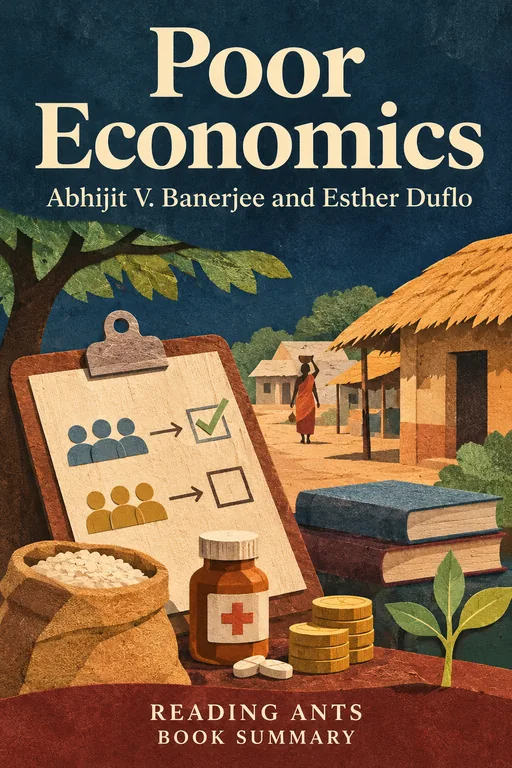
Poor Economics
Two economists who test anti-poverty ideas with field experiments argue that we should stop looking for one grand solution and instead study how poor families really live and decide, so that we can find what works.
Overview
Poor Economics: A Radical Rethinking of the Way to Fight Global Poverty was published in 2011 by Abhijit Banerjee and Esther Duflo, who both work at the Massachusetts Institute of Technology. They helped to pioneer the use of randomized controlled trials, which are experiments like those used to test medicines, to see which programs actually reduce poverty. In 2019, they shared the Nobel Prize in economics with Michael Kremer, in recognition of this experimental approach. The book draws on years of study in many countries, and it is built around ordinary people and their choices on food, health, schooling, savings and work.
Full Summary
1. Skip the grand debates, ask small questions
The idea: The authors begin by describing two camps in the debate about foreign aid. One says that more aid will end poverty, and the other says that aid does more harm than good. They reject both as too broad. Instead, they ask smaller, specific questions, such as whether a certain program helps children to learn, or whether a certain type of loan helps a business to grow, and they test the answers with evidence.
In real life: To know whether a new study method helps, you compare two similar groups of students, and do not just argue about it.
2. Do the poor eat enough?
The idea: Many people assume that poor families spend any extra money on food. The authors find that this is often not the case. People who live on very little may buy a television or tasty food rather than the most nutritious meals. They explain that this is not foolish. Life is hard and often monotonous, and small pleasures matter. At the same time, they argue that the problem is often a lack of nutritious food, and not only a lack of calories.
In real life: A tired student may buy a treat instead of saving, because a small joy makes the day easier.
3. Health care and the problem of small steps
The idea: The authors observe that poor families often do not use cheap preventive health measures, such as vaccinations or bed nets, although they will spend on expensive treatments when someone is sick. They show that small nudges, such as a gift for coming to a vaccination camp, can increase use. They also note that care from unqualified providers is common, and that public clinics are often unreliable, with staff who are frequently absent.
From the book: One well-known study in rural Rajasthan, India, offered a small gift of lentils to families who completed their children’s immunizations at a camp, and the immunization rate rose.
In real life: A small reward or a reminder can help someone to keep a good habit that they would otherwise delay.
4. Education and what children really learn
The idea: Many poor children attend school, but learn little. The authors say that part of the problem is that schools are built around the few children who are expected to do well, so that those who fall behind are left behind, and that teachers are often absent. They describe experiments in which extra help for the weakest children, such as remedial tutoring in small groups, had a strong effect.
In real life: If a class moves on before you understand fractions, you may fall further behind each week.
5. Savings, loans and small businesses
The idea: The poor are often entrepreneurs by necessity, running small shops or stalls with little capital. The authors discuss microcredit, which means small loans for the poor, and find that it can help many families to manage, but that it is not a miracle that lifts most people out of poverty. They also find that saving is hard for poor families, since stress and unexpected expenses get in the way.
In real life: A street vendor who can safely keep a little money at a bank may avoid spending it on emergencies.
6. Institutions, policy and hope
The idea: In the final chapters, the authors discuss how policy and institutions affect poverty. They argue that poor people face many obstacles, including bad information and weak public services, and that small changes in how programs are designed can have large effects. They resist offering a single cure. Their conclusion is hopeful, if modest: small changes can have big effects, and the right help at the right time can change lives.
In real life: Making a form simpler or a clinic more reliable can help many people, even if it does not look like a grand plan.
Why It Matters
Poor Economics helped to shift the debate about global poverty from big ideological arguments to evidence about what works. The authors’ use of randomized trials has influenced governments, charities and international organizations, and it led to a wave of experiments around the world. The book also humanizes the poor, showing them as people who make thoughtful choices under difficult conditions, though not always perfectly, since information, habit and self-control matter for the poor as for the rich, and not as passive victims or as people who need to be told what to do. It won the 2011 Financial Times and Goldman Sachs Business Book of the Year award and was praised by many reviewers. Its Nobel recognition in 2019 confirmed the importance of the approach. It is a standard reference for students and policymakers.
Key Takeaways
- Ask specific questions. Small, testable questions are more useful than grand theories.
- Poor people’s choices make sense in context. Constraints, beliefs and limited information shape them.
- Small nudges matter. Simple changes in the design of programs can have big effects.
- Test what works. Evidence from experiments helps us to avoid wasteful programs.
- No single cure. Poverty has many causes and needs many tools.
What We Can Learn
If you want to help with a problem, whether at school, in your town or in the world, ask what the evidence says, and be willing to learn that your first idea was wrong. Listen to the people who face the problem and pay attention to their reasons. Try small experiments, like a trial period for a new class routine, and see what changes. Be careful about big claims and simple answers. And remember that dignity matters: people want choices, security and respect, and good programs make room for these.
Criticism and Counterpoints
Some critics say that randomized trials answer narrow questions and may not tell us how to deal with large structural problems such as corruption, weak states or unfair trade rules. Experiments in one place may not apply in another, and the focus on small interventions can distract from bigger political change. Others argue that the book underplays the role of economic growth and institutions in reducing poverty, which other economists such as those who study national policies emphasize. Some have also questioned the ethics of experimenting on poor communities. Supporters respond that careful evidence helps to avoid waste and harm.
Who Should Read It
This book is for readers who want to understand poverty and development without slogans, including students, volunteers and policymakers. It is clear and warmly written. People who are looking for a single big solution to poverty will not find it here, and those who prefer a historical or political approach may want to read other authors as well.
Want the whole book?
A summary is a taste, not the meal. Here is where to find the full book.
You reached the end 🎉
Nicely done. Mark this one as read, and we will suggest what to read next.
Read this next
Development as Freedom
Amartya Sen
Amartya Sen argues that development should be judged not by national income alone, but by the real freedoms people have to live lives they value, such as being healthy, educated and able to take part in public life.
💰 Money & Economics
Banker to the Poor
Muhammad Yunus
Muhammad Yunus tells how he began lending tiny sums to poor villagers in Bangladesh, built the Grameen Bank on the idea that the poor are creditworthy, and argues that credit is a basic human right.
💰 Money & Economics
The Undercover Economist
Tim Harford
Tim Harford shows how economic ideas explain everyday puzzles, from why coffee costs what it does to why used cars are risky and why poor countries struggle, in a lively and friendly style.
💰 Money & Economics
Why Nations Fail
Daron Acemoglu and James A. Robinson
Nations become rich or stay poor mainly because of their institutions: countries that share power and reward ordinary people's effort prosper, while those run by narrow elites for their own benefit stay poor.
💰 Money & Economics
The Wealth of Nations
Adam Smith
A nation's true wealth is not its stock of gold but the goods and services its people produce, and that wealth grows fastest when people specialize, trade freely and compete, with government providing justice, defense and public goods.
💰 Money & Economics
Rich Dad Poor Dad
Robert T. Kiyosaki
Schools teach people to work for money, but the rich learn to make money work for them by understanding the difference between assets and liabilities and by building businesses and investments.
💰 Money & EconomicsWant something different?
Pick another topic and we will show you three books to start with.