 Reading Ants
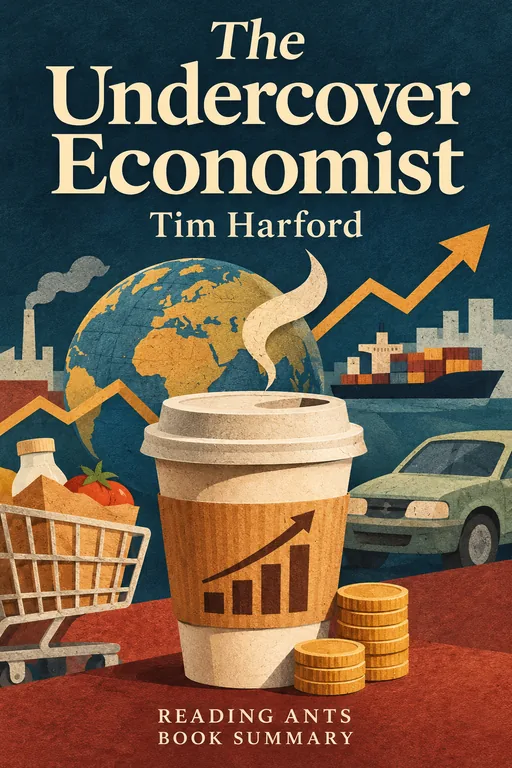
Tim Harford shows how economic ideas explain everyday puzzles, from why coffee costs what it does to why used cars are risky and why poor countries struggle, in a lively and friendly style.
Overview
The Undercover Economist was published in 2005 by Tim Harford, an economist and journalist who wrote a column for the Financial Times. The title refers to the idea that an economist can go “undercover” in ordinary life, spotting the hidden logic behind prices, shops and markets. Harford begins with a trip to a coffee shop and then moves outward, through supermarkets, traffic, information, game theory and auctions, to the questions of why poor countries are poor, what globalization does, and how China grew rich. The book is meant for general readers and uses stories and plain language instead of formulas.
Full Summary
1. Scarcity, rent and why some places cost more
The idea: Harford starts with a puzzle: why is a cup of coffee in some places much more expensive than in others? He explains that the price depends on what economists call scarcity. Good locations, such as a spot in a busy station, are limited, and the owners of these places can charge more rent. The extra price of coffee in a prime spot reflects the value of the location: customers there are in a hurry and will pay more, and the owner of the scarce spot captures much of that through rent, so the premium is not mainly about the beans.
In real life: A food stall near a stadium pays a high rent for its spot, because the crowd there is willing to pay more.
2. Price discrimination and how shops read minds
The idea: Harford says that sellers are often trying to find out how much each customer is willing to pay, so that they can charge more to those who are keen and less to those who are careful. This is why a coffee shop may offer a basic drink and a fancier version at a higher price, even though the extra cost of making the fancy one is small. He suggests that firms do this to capture the extra money from customers who are willing to pay more, while still selling to those who are not.
In real life: A movie theater sells cheaper tickets in the afternoon to those who can go then, and charges more in the evening.
3. Who knows what: information and the problem of used cars
The idea: In many markets, one side knows more than the other. A seller of a used car knows its history, but the buyer does not. Harford explains that this can make buyers wary and push down the prices of good cars, since they cannot be told from the bad. He links this idea to health insurance, where people who know that they are high-risk are more likely to buy it. Sellers can signal quality through costly commitments, such as a showroom on a long lease, and buyers can gather information of their own, for example from reviews.
In real life: When you buy a secondhand phone, you may trust a seller who offers a return policy more than one who does not.
4. Strategy, auctions and design
The idea: Harford discusses game theory, the study of how people make choices when the results depend on what others do. He tells stories of how economists have helped design auctions, including auctions of telecom licenses, so that the rules produce better outcomes. He shows that the design of the rules can make a big difference to the outcome.
In real life: In a school raffle, the way tickets are sold and drawn can change how many people take part and how much is raised.
5. Traffic, pollution and the cost to others
The idea: Some choices affect others who are not part of the deal, which economists call externalities. A driver in a traffic jam adds to everyone else’s delay, and a car trip through a city adds noise and pollution for others. Harford says that charging people for the harm they cause, as in a congestion charge for driving in a busy city center, can reduce the problem by giving people a reason to change. He admits that such charges are controversial, since they are not an exact science and their effects on different groups differ from place to place.
In real life: If using a loud speaker in the library were free, many people would do it, but a small fee, or a rule, makes people think twice.
6. Why some countries are poor
The idea: In the final chapters, Harford looks at the question of why some countries are rich and others are poor, and then at globalization and the rise of China. On why poor countries are poor, he points to problems of government and to the dangers of corruption. He explains comparative advantage, the idea that two sides gain from specializing and trading even when one of them is better at making everything, and he argues that trade barriers such as tariffs protect industries that compete with imports but hurt exporters, because foreign buyers need to earn money from exports to pay for imports. He also asks how China has grown rich in recent decades.
In real life: A farmer who can sell crops at a fair price, and who is safe from having the land taken away, has a reason to invest in better seeds.
Why It Matters
The Undercover Economist was part of a wave of popular economics books in the 2000s, along with Freakonomics. It reached a large audience and helped to make economics more approachable. Its main virtue is that it teaches ideas by telling stories about things that readers know, such as coffee shops and used cars, instead of abstract models. Harford later became known for his radio and television work about economics and statistics. The book also shows that economists are interested in practical and social problems, such as pollution and poverty. For many readers, it has been a way to discover that economic thinking is a useful tool for understanding daily life and public policy.
Key Takeaways
- Scarcity shapes prices. Limited good locations and resources set costs.
- Sellers read customers. Price differences often reflect willingness to pay.
- Information gaps matter. When one side knows more, markets can fail.
- Rules affect outcomes. Good design of auctions and policies can improve results.
- Pay for harm. Prices that reflect the cost to others can reduce waste and pollution.
What We Can Learn
You can become your own undercover economist. The next time you shop, ask why prices differ and who is paying for what. Notice how companies try to guess how much you will pay. When you buy something where the seller knows more than you, look for ways to reduce the risk, such as reviews, guarantees or an expert. Think of the effects of your choices on other people, and support fair ways to deal with shared problems. And remember that behind the news about prices and trade, there are often simple logic and incentives at work.
Criticism and Counterpoints
Some critics say that the book gives too rosy a picture of what markets and economists can do, and that its examples are chosen to fit the theory. Others point out that it focuses on a mainstream, market-friendly kind of economics and gives less space to other views, such as those about inequality or the role of power. The discussion of why countries are poor is brief, and experts disagree about the causes. Some of the market solutions, such as congestion charges, are debated on grounds of fairness. The book is best seen as an engaging introduction, not the last word.
Who Should Read It
This book is for readers who are new to economics, and for anyone who enjoys looking for the logic behind everyday things. It is witty and easy to follow. Those who want a deeper or more technical treatment, or who are looking for a critical view of mainstream economics, will want to read further.
Want the whole book?
A summary is a taste, not the meal. Here is where to find the full book.
You reached the end 🎉
Nicely done. Mark this one as read, and we will suggest what to read next.
Read this next
Freakonomics
Steven D. Levitt and Stephen J. Dubner
Economics is really the study of incentives, and by asking odd questions and following the data, we can discover surprising truths about cheating, crime, parenting and everyday life.
💰 Money & Economics
Basic Economics
Thomas Sowell
Thomas Sowell explains how economies work in plain language, with no graphs or jargon, by showing how prices, incentives and trade-offs shape everything from rents and wages to trade between nations.
💰 Money & Economics
Economics in One Lesson
Henry Hazlitt
Henry Hazlitt argues that most economic mistakes come from looking only at the immediate effect of a policy on one group, and that good economics means tracing the long-term effects on everyone.
💰 Money & Economics
Poor Economics
Abhijit V. Banerjee and Esther Duflo
Two economists who test anti-poverty ideas with field experiments argue that we should stop looking for one grand solution and instead study how poor families really live and decide, so that we can find what works.
💰 Money & Economics
Thinking, Fast and Slow
Daniel Kahneman
Our minds run on two systems, a fast, intuitive one and a slow, careful one, and understanding how the fast system fools us can help us make better decisions about money, risk, work and happiness.
🧩 Mind & Psychology
The Wealth of Nations
Adam Smith
A nation's true wealth is not its stock of gold but the goods and services its people produce, and that wealth grows fastest when people specialize, trade freely and compete, with government providing justice, defense and public goods.
💰 Money & EconomicsWant something different?
Pick another topic and we will show you three books to start with.