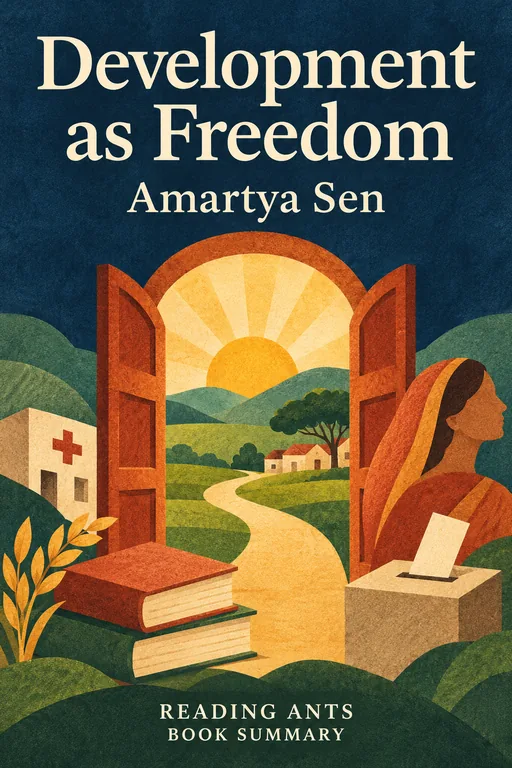
Development as Freedom
Amartya Sen argues that development should be judged not by national income alone, but by the real freedoms people have to live lives they value, such as being healthy, educated and able to take part in public life.
Overview
Development as Freedom was published in 1999 by Amartya Sen, an Indian economist and philosopher who had won the Nobel Prize in economics the year before. The book is based on lectures given to the World Bank. Sen proposes a different way to think about progress in poor and rich countries alike. Instead of asking only how fast an economy is growing, he asks what people can do and be. He ties together themes in economics, ethics and politics, and gives special attention to famine, health, education, the rights of women and democracy.
Full Summary
1. What development is for
The idea: Sen says that the point of development is to expand human freedom. Income and wealth are useful, but only as means to something else: the ability to live a long, healthy and fulfilling life, to learn, to take part in the community and to make choices. A country can have a high average income and still leave many people without basic opportunities. Freedom is both the goal of development and a means of reaching it.
In real life: Two people can earn the same amount, but the one who lives in a safe place with a good school and clinic has more real freedom than the one who does not.
2. Capabilities, not just goods
The idea: Sen introduces the idea of capabilities, which means the real opportunities a person has to do things they have reason to value. What a person actually manages to do or be, such as being well fed, he calls functionings. The same amount of money gives different freedoms to different people. A disabled person, a pregnant woman or someone who lives in a place with disease needs more resources to achieve the same level of functioning. He argues that we should compare people by what they are able to do.
In real life: A wheelchair user needs ramps and lifts to enter a building that others can walk into without thinking.
3. Five freedoms that support each other
The idea: Sen lists five kinds of freedoms that help development: political freedoms, such as the right to vote and speak; economic facilities, such as the chance to trade and get credit; social opportunities, such as education and health care; transparency, which means openness and trust; and protective security, such as a safety net for the very poor. He says that these support each other, so that progress in one area helps the others.
In real life: A girl who can attend school may later find work, take part in her community and help her family stay healthy.
4. Famines and democracy
The idea: One of Sen’s best-known arguments is that famines do not happen in functioning democracies with a free press. Governments that must face elections and criticism have a strong reason to prevent starvation, and they are informed when it threatens. He does not claim that democracy ends all chronic hunger or malnutrition. He also says that famines are often caused less by a lack of food than by people losing their ability to get food, because their incomes or jobs have failed. Sen himself was a child in Bengal during the famine of 1943.
In real life: If a town has a local newspaper that reports a shortage, officials have a harder time ignoring it.
5. Markets, but not only markets
The idea: Sen defends the role of markets, saying that the freedom to exchange and trade is a part of human liberty and a source of growth. But he says that markets alone are not enough. They must work along with public provision of education, health care and a social safety net, and they need rules. He argues against both blind faith in markets and blanket distrust of them.
In real life: A farmers’ market works well, but it also relies on roads, police and a legal system that someone has to provide.
6. Women’s role and the missing women
The idea: Sen gives special attention to the role of women. He says that when women have education, jobs and rights, families and societies gain, and that women’s well-being is a key part of development. He points to evidence of “missing women,” meaning that in some regions there are fewer women than would be expected, which suggests that girls and women have received less care and food. He argues that this is a deep injustice.
In real life: A village that sends all its boys but few of its girls to school loses talents that it cannot see.
7. Culture, values and public discussion
The idea: In the later chapters, Sen discusses how public debate and the ability to take part in shaping social values are central to development. He rejects the claim that democracy and human rights are only Western ideas, and shows that traditions of tolerance and argument exist in many cultures, including in Asia. He closes by stressing the importance of social choice, reasoned debate and a sense of responsibility.
In real life: A school that asks students to help decide rules is teaching them skills for public life.
Why It Matters
Development as Freedom helped to reshape how the world thinks about progress. Sen’s earlier work on capabilities contributed to the creation of the Human Development Index, launched in 1990, nine years before this book, which ranks countries not only by income but also by health and education. His ideas influenced international organizations, governments and charities, and encouraged a broader view of poverty as a lack of freedom, not simply a lack of money. The book is also an important defense of democracy and of the role of public discussion in solving problems. Its blend of economic analysis and moral reasoning makes it a significant text for anyone studying development or justice. It also inspired many later writers and policy makers.
Key Takeaways
- Development is freedom. Progress means widening the choices people truly have.
- Income is a means. Money matters because of what it lets people do.
- Freedoms reinforce each other. Political, economic and social freedoms support one another.
- Democracy protects against disaster. Free press and elections give leaders a reason to prevent famine.
- Women’s agency is central. Education and rights for women benefit everyone.
What We Can Learn
When you judge how well a place is doing, you can ask about more than money: do people have good schools, health care, safety and a voice? When you help others, listen to what they want to be able to do, and not only what you think they need. Think about the hidden barriers that people face, such as discrimination or disability, and try to remove them. Value the freedoms you have, such as free speech and education, and use them. And remember that a society becomes stronger when everyone can take part.
Criticism and Counterpoints
Some critics say that the capability approach is hard to measure and to turn into practical policy, since it is not clear which capabilities should count or how to compare them. Economists who emphasize growth argue that income is more important than Sen suggests, and that rapid growth in some countries, with less democracy, has also reduced poverty. His argument about famine and democracy has been debated, with some pointing to exceptions. Others find Sen’s prose wordy, and the more philosophical passages, especially in the early chapters, hard going.
Who Should Read It
This book is for readers who are interested in development, ethics and public policy, as well as students of economics and politics. It is thoughtful and humane, though it assumes some patience with abstract ideas. Those who want a short, practical guide to development projects may find it more philosophical than expected.
Want the whole book?
A summary is a taste, not the meal. Here is where to find the full book.
You reached the end 🎉
Nicely done. Mark this one as read, and we will suggest what to read next.
Read this next
Poor Economics
Abhijit V. Banerjee and Esther Duflo
Two economists who test anti-poverty ideas with field experiments argue that we should stop looking for one grand solution and instead study how poor families really live and decide, so that we can find what works.
💰 Money & Economics
Why Nations Fail
Daron Acemoglu and James A. Robinson
Nations become rich or stay poor mainly because of their institutions: countries that share power and reward ordinary people's effort prosper, while those run by narrow elites for their own benefit stay poor.
💰 Money & Economics
Banker to the Poor
Muhammad Yunus
Muhammad Yunus tells how he began lending tiny sums to poor villagers in Bangladesh, built the Grameen Bank on the idea that the poor are creditworthy, and argues that credit is a basic human right.
💰 Money & Economics
A Theory of Justice
John Rawls
John Rawls argues that the fairest rules for a society are those we would choose without knowing our own place in it: equal basic liberties, and inequalities only when they help the worst off.
🕊️ Philosophy & Religion
The Wealth of Nations
Adam Smith
A nation's true wealth is not its stock of gold but the goods and services its people produce, and that wealth grows fastest when people specialize, trade freely and compete, with government providing justice, defense and public goods.
💰 Money & Economics
Rich Dad Poor Dad
Robert T. Kiyosaki
Schools teach people to work for money, but the rich learn to make money work for them by understanding the difference between assets and liabilities and by building businesses and investments.
💰 Money & EconomicsWant something different?
Pick another topic and we will show you three books to start with.