 Reading Ants
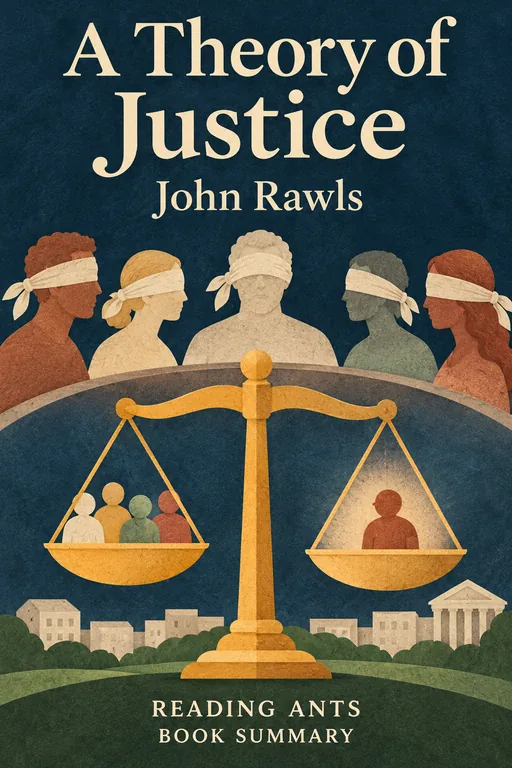
John Rawls argues that the fairest rules for a society are those we would choose without knowing our own place in it: equal basic liberties, and inequalities only when they help the worst off.
Overview
A Theory of Justice was published in 1971 by John Rawls, an American philosopher at Harvard University. It is widely regarded as one of the most influential books of political philosophy of the twentieth century. Rawls wanted to offer an alternative to utilitarianism, the view that the best society is the one that produces the greatest total happiness, which, he thought, could justify sacrificing the rights of some for the benefit of others. Drawing on the tradition of the social contract, he proposed a thought experiment to work out principles of fairness. The book is long and detailed, but its main ideas can be stated simply.
Full Summary
1. Justice as fairness
The idea: Rawls begins by saying that justice is the first virtue of social institutions, in the way that truth is the first virtue of systems of thought. A society is just if its basic structure, including its laws, economy and institutions, is organized on terms that free and equal people could agree to. He calls this view “justice as fairness.” The aim is to find principles that all could accept, and that do not depend on luck or on special advantages.
In real life: When friends share a pizza, the fairest way to cut it is to let the person who cuts take the last slice.
2. The original position and the veil of ignorance
The idea: To find fair principles, Rawls imagines a hypothetical situation called the original position, in which people choose rules for society behind a veil of ignorance. They do not know their own class, race, gender, abilities, talents or even their ideas of the good life. The people in the original position are still rational and still want the best for themselves. What they lack is knowledge of their own situation, so each person will want rules that are fair to everyone, and will not favor any group in particular.
In real life: If you had to design the rules of a game without knowing which player you will be, you would avoid unfair advantages.
3. The first principle: equal liberty
The idea: According to Rawls, people in the original position would choose, first, that everyone has the same basic liberties, such as freedom of speech, conscience and association, the right to vote, to hold office and to be treated fairly by the law. These liberties take priority and cannot be traded for economic gains. Since no one knows whether he will be in a minority, everyone would want their rights to be secure.
In real life: You would not accept a rule that lets the majority silence a minority if you could be in that minority.
4. The second principle: fair opportunity and the difference principle
The idea: The second principle has two parts. First, positions of power and advantage must be open to all under conditions of fair equality of opportunity. Second, social and economic inequalities are acceptable only if they work to the greatest benefit of the least advantaged members of society. This is known as the difference principle. Rawls puts the principles in order: the basic liberties come first, and fair equality of opportunity comes before the difference principle. It does not demand strict equality, but allows rewards, such as higher pay, if they improve the situation of the worst off, for example by encouraging productive work.
In real life: A doctor may be paid more than a clerk, if the system gives incentives that help all, including the poor, to receive good care.
5. Why not utilitarianism
The idea: Rawls argues that the people in the original position would reject utilitarianism, since it might allow the rights of some to be violated if that increased total welfare. Each person would fear that he could be the one sacrificed. They would also choose to guard against the worst outcome, a reasoning that Rawls links to a rule called maximin and defends under the special conditions of the original position, so they would prefer a society in which even the worst-off are as well-off as possible. In this way, Rawls tries to show that his principles are more reasonable than the alternatives.
In real life: Most people would not agree to a rule that could put them in a severe disadvantage, even if it produced more total wealth.
6. Stability and the just society
The idea: In the later chapters, Rawls discusses how a just society could be stable, with citizens developing a sense of justice and supporting their institutions. He discusses when civil disobedience can be justified in a society that is nearly just but has serious injustices, and how institutions can be arranged to serve the difference principle. He also considers moral psychology, the way that people come to want to be just. He aims to show that a society that is fair would also be one in which people would willingly cooperate.
In real life: A community that treats its members fairly tends to earn their loyalty and effort.
Why It Matters
A Theory of Justice revived political philosophy in the English-speaking world and set the terms of debate for decades. Its ideas, the veil of ignorance and the difference principle, are known far beyond philosophy, and have influenced discussions of law, economics and public policy. Philosophers, such as Robert Nozick, who argued for a more libertarian view, and communitarians and feminists, who criticized its assumptions, responded to Rawls, and so the book generated a rich literature. It also offered a way of thinking about fairness that many ordinary people find intuitive: ask what you would choose if you did not know your place.
Key Takeaways
- Fair rules are those we would choose without bias. The veil of ignorance removes self-interest.
- Basic liberties come first. Equal rights cannot be traded for economic gain.
- Opportunity should be fair. Positions should be open to all.
- Inequality needs a justification. It must benefit the least advantaged.
- Justice is the foundation of society. Institutions must be fair to be legitimate.
What We Can Learn
You can use the veil of ignorance as a tool in everyday ethical thinking. When you judge a rule at school or at work, ask whether it would seem fair if you did not know whether you would be a beneficiary or a victim. Think about the role of luck in your own advantages, such as the family and talents you were born with. Support policies and practices that protect basic freedoms and give opportunities to all. And be willing to listen to people who propose other ideas of justice.
Criticism and Counterpoints
Libertarians such as Robert Nozick argued that the difference principle violates individual property rights, and that it treats people’s talents as common assets. Communitarians said that Rawls’s picture of people choosing without knowing their own values is unrealistic and ignores the role of community and tradition. Feminist philosophers pointed out that the theory neglects justice within the family. Others question whether people in the original position would be so cautious, and some say that it applies only to one society, not to global justice. Rawls revised some of his ideas in later works.
Who Should Read It
This book is for students and readers of philosophy, law, politics and economics. It is very long and technical, so many people read selected chapters or a summary. Those who want the core idea can read the early chapters on the original position and the two principles.
Want the whole book?
A summary is a taste, not the meal. Here is where to find the full book.
You reached the end 🎉
Nicely done. Mark this one as read, and we will suggest what to read next.
Read this next
The Social Contract
Jean-Jacques Rousseau
Rousseau asks how people can live together under laws and still be free, and argues that legitimate government rests on an agreement in which citizens obey only the "general will" that they make together.
🕊️ Philosophy & Religion
Leviathan
Thomas Hobbes
Thomas Hobbes argues that without a strong government people would live in constant fear and conflict, and that they should therefore agree to give up some of their freedom to a sovereign power that keeps the peace.
🕊️ Philosophy & Religion
The Republic
Plato
Plato, through the character of Socrates, asks what justice is and imagines an ideal city, arguing that a just person and a just state are ruled by wisdom, with reason guiding the whole.
🕊️ Philosophy & Religion
Development as Freedom
Amartya Sen
Amartya Sen argues that development should be judged not by national income alone, but by the real freedoms people have to live lives they value, such as being healthy, educated and able to take part in public life.
💰 Money & Economics
The Road to Serfdom
Friedrich A. Hayek
Friedrich Hayek argues that when governments try to plan the whole economy from the center, they must gradually limit personal and political freedom, and that the road leads toward a dictatorship that nobody intended.
💰 Money & Economics
The Art of War
Sun Tzu
The greatest victory is the one won without fighting, achieved through careful planning, knowing both yourself and your opponent, and using deception, flexibility and timing.
🕊️ Philosophy & ReligionWant something different?
Pick another topic and we will show you three books to start with.