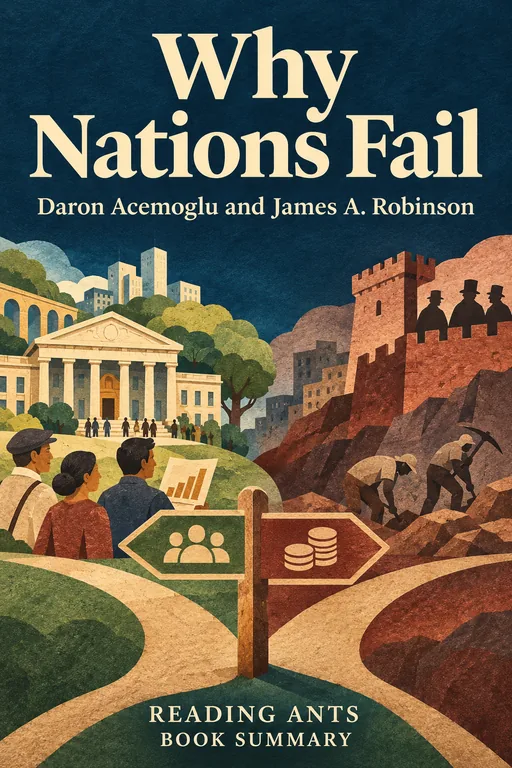
Why Nations Fail
Nations become rich or stay poor mainly because of their institutions: countries that share power and reward ordinary people's effort prosper, while those run by narrow elites for their own benefit stay poor.
Overview
Why Nations Fail was written by two economists, Daron Acemoglu of the Massachusetts Institute of Technology and James Robinson, a political scientist and economist then at Harvard University, and published in 2012. The authors ask a big question: why are some countries wealthy while others remain poor? They reject several popular answers, such as geography, climate and culture, and argue instead that prosperity comes down to institutions, the rules and structures that shape how people earn a living and how power is held. They also argue that inclusive institutions need both pluralism and a strong enough central state, and that extractive systems can sometimes bring growth for a time but rarely sustain it. They use stories from many periods and places, including ancient Rome, medieval Venice, colonial Latin America, the Soviet Union and modern Africa, to support their theory.
Full Summary
1. The two kinds of institutions
The idea: The authors divide institutions into two types. Inclusive institutions give many people a say, protect property rights, enforce laws fairly and let people start businesses and choose their work. Extractive institutions are designed so that a small elite takes wealth from the rest, using force, monopolies or unfair laws. Inclusive political and economic institutions tend to support each other, as do extractive ones, creating cycles that are hard to break.
In real life: A farmer who can keep the profit from a better crop will work to improve it, but one whose harvest is seized has little reason to try.
2. A tale of two halves of one city
The idea: The book begins with the city of Nogales, which is divided by a border between the United States and Mexico. The two halves share geography, climate and much of the same ancestry, yet the Arizona side is far richer, with better schools, healthcare and safety, than the Mexican side. The authors argue that this difference cannot be explained by culture or geography, but by the institutions on each side of the fence, which shape what opportunities people have.
In real life: Two neighbors in the same environment can have very different lives because they live under different laws.
3. Why theories of geography, culture and ignorance fall short
The idea: The authors take on popular explanations. Geography, they say, cannot explain why previously poor places, such as parts of East Asia, grew rich, or why once-wealthy regions fell behind. Culture and religion do not explain why neighboring societies with similar cultures diverge. Nor does the “ignorance” hypothesis, that leaders simply do not know what policies work. Leaders often know, they say, but choose policies that benefit themselves.
From the book: They contrast South Korea and North Korea, which share a history and culture but have very different institutions and outcomes.
In real life: The two Koreas are a natural experiment, showing how much political systems matter.
4. Critical junctures and institutional drift
The idea: Institutions change at critical junctures, big events such as the Black Death, the Glorious Revolution in England or colonization, that upset the existing balance of power. How a society responds depends on small differences in existing institutions. After the Black Death, for example, a shortage of workers in western Europe gave peasants more bargaining power, while in eastern Europe landowners tightened their control. The authors call this pattern institutional drift, in which small initial differences grow larger over time.
In real life: A crisis can open a window for change, but who benefits depends on who has the power at that moment.
5. England’s path and the Industrial Revolution
The idea: The authors argue that the Industrial Revolution began in England because of the Glorious Revolution of 1688, which limited the power of the monarch, strengthened Parliament and made property rights more secure. This created conditions in which inventors and entrepreneurs could profit from new ideas. Countries with absolutist rulers, such as Spain or Russia, feared that new technology would upset their power and often blocked change.
In real life: A ruler who fears losing control may ban a useful new invention, such as a machine that threatens old industries.
6. Vicious circles and the iron law of oligarchy
The idea: Extractive systems are hard to escape because those who take power often keep the same system, merely changing who benefits. The authors borrow the phrase iron law of oligarchy, coined by the sociologist Robert Michels, for this pattern: a new group that replaces a narrow ruling elite tends to become a narrow ruling elite itself. The authors describe how many leaders who overthrow oppressive rulers become oppressors themselves. They cite examples from Latin America, Africa and elsewhere. They also note that extractive systems can bring short bursts of growth, as in the Soviet Union, but cannot sustain it because innovation requires freedom and incentives.
In real life: A new government that promises reform but keeps the same tools of control often ends up repeating old patterns.
7. Virtuous circles and what to do
The idea: Inclusive systems can strengthen themselves, because a free press, courts and broad political participation help to defend the rules. The authors admit that there is no easy recipe for helping poor countries, and that foreign aid or advice seldom succeeds unless local institutions change. Real change, they suggest, usually comes from pressure by broad coalitions inside a country.
In real life: Reforms succeed best when ordinary citizens, not just outside experts, demand and protect them.
Why It Matters
Why Nations Fail became an international bestseller and began a major debate among economists, political scientists and policymakers. Its argument that politics and institutions drive prosperity influenced how people think about development and aid, and it fits with the research for which Acemoglu and Robinson, along with Simon Johnson, were later awarded the Nobel Prize in Economics, in 2024.
The book’s stories, from Roman history to modern Africa, make it a rare academic argument that general readers can follow. Its focus on who holds power, and whether ordinary people can hold leaders to account, has influenced how journalists, students and policymakers talk about corruption, democracy and economic reform in countries around the world.
Key Takeaways
- Institutions matter most. Rules and power shape national success.
- Inclusive systems share power. They reward effort and innovation.
- Extractive systems enrich elites. They hold back growth over time.
- History opens windows. Crises can shift the path of a country.
- Change comes from within. Outside advice alone rarely works.
What We Can Learn
The book encourages us to look at the rules behind a result. When a community or country struggles, we can ask whether people have a fair chance to earn, own and speak, rather than assuming that they are lazy or unlucky.
It also warns that power tends to protect itself. Free speech, independent courts and open elections are not just ideals but practical tools that keep a society from slipping toward rule by a few.
Finally, it shows how history can help us think about the present. The same patterns of reform and backlash recur, so knowing them helps us recognize them.
Criticism and Counterpoints
Critics argue that the theory is too broad and sometimes circular, since success is taken as evidence of inclusive institutions and failure as evidence of extractive ones. Some scholars say that geography, disease and culture play a bigger role than the authors admit, and that China’s rapid growth under a one-party system challenges the claim that extractive systems cannot succeed for long, though the authors argue that China’s growth will stall.
Others feel the book’s historical cases are selected to fit the thesis, and that it offers little practical guidance. Supporters answer that its central message, that politics and power matter for economics, remains a strong and useful insight.
Who Should Read It
This book suits teenagers and adults who are curious about history, politics and why countries differ. It is written in a clear, story-based style and doesn’t need previous knowledge. Readers who like detailed theory may want to follow it with the authors’ academic work.
Want the whole book?
A summary is a taste, not the meal. Here is where to find the full book.
You reached the end 🎉
Nicely done. Mark this one as read, and we will suggest what to read next.
Read this next
Guns, Germs, and Steel
Jared Diamond
Some societies came to conquer others not because their people were smarter or better, but because geography gave them a head start in farming, animals, germs and technology.
🏛️ History
Capital in the Twenty-First Century
Thomas Piketty
Thomas Piketty argues that when the return on wealth grows faster than the economy as a whole, wealth naturally concentrates in fewer hands, and that only policy choices such as progressive taxes can keep inequality in check.
💰 Money & Economics
The Wealth of Nations
Adam Smith
A nation's true wealth is not its stock of gold but the goods and services its people produce, and that wealth grows fastest when people specialize, trade freely and compete, with government providing justice, defense and public goods.
💰 Money & Economics
Rich Dad Poor Dad
Robert T. Kiyosaki
Schools teach people to work for money, but the rich learn to make money work for them by understanding the difference between assets and liabilities and by building businesses and investments.
💰 Money & Economics
The Intelligent Investor
Benjamin Graham
Successful investing is less about being clever than about being disciplined: buy sound businesses at a price that leaves a margin of safety, and don't let the mood of the market push you around.
💰 Money & Economics
A Random Walk Down Wall Street
Burton G. Malkiel
Burton Malkiel argues that stock prices are so hard to predict that most investors, professional or not, are better off holding a broad, low-cost index fund than trying to beat the market.
💰 Money & EconomicsWant something different?
Pick another topic and we will show you three books to start with.