 Reading Ants
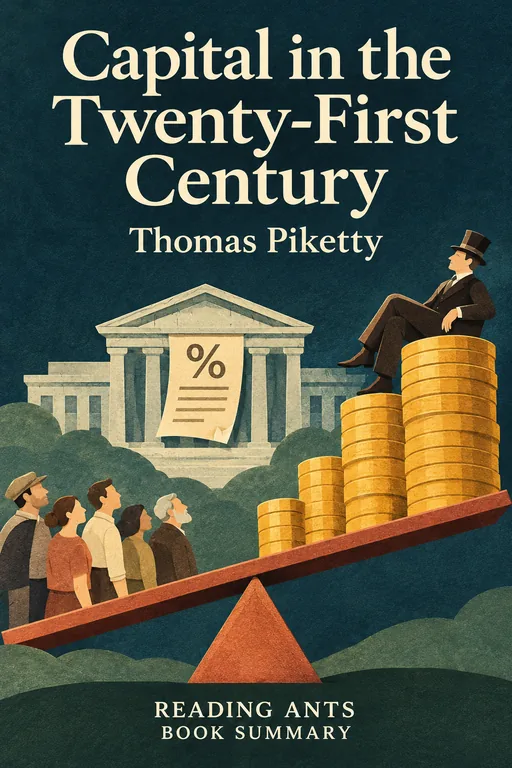
Capital in the Twenty-First Century
Original title: Le Capital au XXIe siècle
Thomas Piketty argues that when the return on wealth grows faster than the economy as a whole, wealth naturally concentrates in fewer hands, and that only policy choices such as progressive taxes can keep inequality in check.
Overview
Capital in the Twenty-First Century is a large economics book by the French economist Thomas Piketty. It appeared in French in 2013 and in English in 2014, and, surprisingly for a long, data-heavy book, it became an international bestseller. Piketty and his collaborators spent years collecting tax and inheritance records going back to the eighteenth and nineteenth centuries in countries such as France, Britain and the United States. From this evidence he describes how wealth and income have been shared out over about two hundred years, and he offers an explanation for why inequality fell in the middle of the twentieth century and has been rising again since the 1970s and 1980s.
Full Summary
1. Income and output, and the long view
The idea: Piketty starts by explaining what economists mean by income, capital and wealth. Income is what people earn from work or from owning things, while capital, which for him means net non-human wealth, is the total of what people own, minus debts, that can produce income, such as land, buildings, factories, machines and financial assets. By looking at very long runs of data, he shows that the relation between a country’s capital and its yearly income has changed over time: it was high in the nineteenth century, collapsed during the world wars, and has risen again.
In real life: A nation whose total wealth is six years of its yearly output is, in a sense, much richer in assets than one whose wealth is only two or three years of output.
2. The central inequality: r greater than g
The idea: The book’s most famous idea is a simple comparison written as r > g. The letter r stands for the average yearly return on capital, from rent, profits, dividends and interest. The letter g stands for the growth rate of the economy. When r is persistently higher than g, as it was for most of history, people who already own capital, and reinvest the returns, can see their wealth grow faster than the incomes of everyone else. Inherited fortunes then tend to grow bigger compared with fortunes earned through work.
In real life: If a family’s investments grow by five percent a year but the average wage grows by one or two percent, the family pulls away from the average worker even if nobody works harder.
3. Why the twentieth century looked different
The idea: Piketty argues that the relative equality in the decades after World War II was an exception, not a rule. Two world wars and the Great Depression destroyed much wealth and led to high taxes, new regulation and rapid growth. These forces held down the share of capital. He suggests that the postwar decades were an unusual period of catch-up growth and that, once the shocks faded, the old pattern began to return.
From the book: He documents very high top tax rates in the United States and Britain in the middle of the twentieth century, and shows how they later fell.
In real life: Many people who grew up in the postwar decades came to think rising equality was normal, when it may have been a special case.
4. Inherited wealth and the new gilded age
The idea: In his examination of old and modern societies, Piketty notes that in nineteenth-century Europe, inherited wealth was extremely important, a theme he finds in novels by writers like Jane Austen and Honoré de Balzac, where marrying money matters more than working. He argues that in the twenty-first century, inheritance is again becoming important, especially as populations age and economic growth slows. He also describes a surge in very high salaries for top managers, especially in the United States, which he sees as a second source of inequality.
In real life: A young person with a house gifted by their family may start adult life far ahead of someone with the same talent who has to rent.
5. A global tax on capital and other remedies
The idea: Piketty does not think inequality is unavoidable. He proposes a global progressive tax on capital, a yearly tax on large fortunes, together with greater financial transparency between countries so that the rich cannot hide assets. He also supports progressive income and inheritance taxes. He admits that a global wealth tax is unrealistic in the short term, but argues that it is a useful goal and that countries can move in that direction.
In real life: Sharing bank information between governments makes it harder for people to hide money abroad.
6. Data, democracy and humility
The idea: Piketty stresses that economics should be based on historical facts, not on abstract models alone, and that questions about the distribution of wealth are political, not only technical. He argues that societies should debate openly how much inequality they accept, and calls for better public data on wealth. He also points out that his r > g rule is a tendency, not a law of nature, and that its effects depend on choices about taxes, education and institutions.
In real life: Voters who can see reliable figures about how wealth is shared are better able to judge what policies they want.
Why It Matters
The book changed the public conversation about inequality. Before it, many economists focused on growth and treated the distribution of wealth as a secondary matter. After it, politicians, journalists and ordinary readers across the world debated whether the rich were pulling away. It also helped create a wave of research on top incomes and wealth, and the data Piketty and his colleagues assembled are used widely.
The book also demonstrates the value of long historical records. By looking over two centuries rather than a few decades, Piketty showed patterns that short-term studies miss, and it became one of the best-known examples of data-driven economic history.
Key Takeaways
- Wealth can outgrow wages. When returns on capital exceed growth, inequality tends to rise.
- Mid-century equality was unusual. Wars and high taxes shaped it.
- Inheritance matters again. Family wealth is becoming more important.
- Policy shapes outcomes. Taxes and transparency can limit concentration.
- Facts should guide the debate. Good data helps societies decide.
What We Can Learn
The book invites us to think about fairness in a careful way. Instead of arguing about whether some people deserve to be rich, we can ask how much of a person’s position comes from their own work and how much from the family they were born into.
It also shows the power of patient, long-term evidence. Just as Piketty looked at two hundred years of records, we can avoid jumping to conclusions from short stretches of data or from our own experience.
Finally, it reminds us that economic outcomes are partly the result of rules. Taxes, schools, laws and institutions are made by people, and so they can be changed when a society decides that the current arrangement is not working.
Criticism and Counterpoints
Many economists have challenged the central claim. Some argue that the relation between r and g is not a reliable predictor of inequality, since returns on capital fall as capital accumulates, and that wealth can be spent or divided among heirs. Others questioned the accuracy and treatment of some of the data, and there were public disputes over how certain historical series were built.
Critics on the political right say that a global wealth tax would be unworkable and would discourage investment, while critics on the left feel the book is too focused on taxation and gives too little attention to power and the structure of work. Some readers also found the book very long and repetitive. Even critics, however, usually acknowledge that it raised important questions and brought valuable data into public view.
Who Should Read It
This book suits mature teenagers and adults curious about economics, history and fairness. It is long, but much of it is readable without a background in economics, and the charts help. Readers who prefer a shorter route can start with summaries of the main argument or with chapters on inequality and taxes.
Want the whole book?
A summary is a taste, not the meal. Here is where to find the full book.
You reached the end 🎉
Nicely done. Mark this one as read, and we will suggest what to read next.
Read this next
Capital
Karl Marx
Karl Marx argues that capitalism produces wealth by making workers create more value than they are paid for, and that this built-in exploitation and the system's cycle of growth and crisis push society toward change.
💰 Money & Economics
The Wealth of Nations
Adam Smith
A nation's true wealth is not its stock of gold but the goods and services its people produce, and that wealth grows fastest when people specialize, trade freely and compete, with government providing justice, defense and public goods.
💰 Money & Economics
Why Nations Fail
Daron Acemoglu and James A. Robinson
Nations become rich or stay poor mainly because of their institutions: countries that share power and reward ordinary people's effort prosper, while those run by narrow elites for their own benefit stay poor.
💰 Money & Economics
Rich Dad Poor Dad
Robert T. Kiyosaki
Schools teach people to work for money, but the rich learn to make money work for them by understanding the difference between assets and liabilities and by building businesses and investments.
💰 Money & Economics
The Intelligent Investor
Benjamin Graham
Successful investing is less about being clever than about being disciplined: buy sound businesses at a price that leaves a margin of safety, and don't let the mood of the market push you around.
💰 Money & Economics
A Random Walk Down Wall Street
Burton G. Malkiel
Burton Malkiel argues that stock prices are so hard to predict that most investors, professional or not, are better off holding a broad, low-cost index fund than trying to beat the market.
💰 Money & EconomicsWant something different?
Pick another topic and we will show you three books to start with.