 Reading Ants
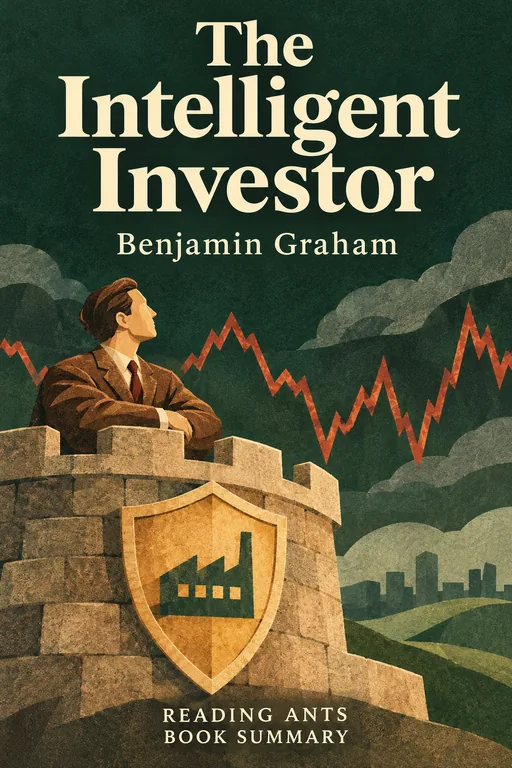
Successful investing is less about being clever than about being disciplined: buy sound businesses at a price that leaves a margin of safety, and don't let the mood of the market push you around.
Overview
The Intelligent Investor was written by Benjamin Graham, a British-born American economist and professor, and first published in 1949. Graham had lived through the stock market crash of 1929 and the Great Depression, and he wanted to teach ordinary people how to invest without ruin. The book became known as the bible of “value investing.” Its most famous reader is Warren Buffett, who studied under Graham and has called it the best book about investing ever written. Graham’s advice is cautious and practical: know what you own, expect markets to swing, and protect yourself against your own emotions.
Full Summary
1. Investing is not speculating
The idea: Graham begins by separating investing from speculating. An investment, he says, involves thorough analysis, promises safety of the money you put in, and offers an adequate return. Anything that does not meet these tests is speculation. Speculation is not forbidden, but he insists that people should call it what it is and should risk only a small amount that they can afford to lose.
In real life: Buying a share because a friend says it will “go to the moon” is speculation, while studying a company’s earnings and debts before buying is investing.
2. Mr. Market
The idea: Graham invents a character called Mr. Market, an imaginary business partner who shows up every day and offers to buy your share of a business or sell you his. Some days he is cheerful and offers a very high price. Other days he is gloomy and offers a very low one. His moods have nothing to do with how the business is really doing. The intelligent investor does not follow Mr. Market’s mood, but uses it: sell to him when his price is high, buy from him when it is low, and ignore him the rest of the time.
In real life: If a good company’s share price drops 30 percent in a panic, but its business is unchanged, the drop is a sale, not a disaster.
3. Margin of safety
The idea: The most important idea in the book is the margin of safety. Graham advises buying only when the price is well below the careful estimate of value, so that even if your estimate is somewhat wrong, or if bad luck arrives, you are unlikely to lose. He regards this as the central concept of sound investing, much like an engineer who builds a bridge to carry far more weight than it will ever bear.
In real life: If you think a used bike is worth $100, you want to pay $70, so a hidden problem won’t ruin the deal.
4. The defensive investor
The idea: Graham describes two types of investors. The defensive investor wants safety and little effort. For this person, Graham suggests dividing money between high-quality bonds and a diverse group of strong, large companies, and adjusting the mix over time. He recommends avoiding hot new issues and buying steadily in regular amounts, a practice often called dollar-cost averaging. The goal is an acceptable result without needing to watch the market.
In real life: A simple, balanced portfolio, bought gradually, suits someone who has a job, a family and no time to watch prices.
5. The enterprising investor
The idea: The enterprising investor is willing to spend time and effort studying companies to find bargains. Graham gives some rules for choosing stocks, such as a low price compared with earnings and assets, a strong financial position and a record of paying dividends. He warns that the extra effort only pays off for people willing to do real work, and that most people who think they are enterprising are really just speculating.
From the book: He describes searching for companies selling for less than the value of their liquid assets, which is one of the methods that Buffett used in his early career.
In real life: Researching small, overlooked companies can find bargains, but it requires reading financial statements, not tips.
6. Know your own psychology
The idea: Throughout, Graham stresses that an investor’s worst enemy is himself. People get greedy when prices rise and frightened when they fall, so they buy high and sell low. He argues that temperament matters more than intelligence, and that the market punishes those who follow the crowd. He also warns about inflation, high fees and the advice of salespeople.
In real life: Deciding in advance what you will do if the market falls, and sticking to it, protects you from panic decisions.
7. Look at the facts, not the forecasts
The idea: Graham is skeptical of predictions about the economy and the market. He points out that even experts are often wrong, and that tales of future growth can lead investors to overpay. He urges them to rely on present facts, such as earnings, assets and prices, and on the long record of a company, rather than on stories about the future.
In real life: A company with a glowing future story but no profits is a gamble, while one with steady profits and a fair price is safer.
Why It Matters
The Intelligent Investor is considered the foundation of value investing, and generations of investors have studied it. Warren Buffett has said that reading it at the age of nineteen was one of the luckiest moments of his life, and he has credited Graham’s ideas of Mr. Market and the margin of safety for much of his success. The book’s later editions, including one with commentary by the journalist Jason Zweig, updated its examples for new readers.
Its influence goes beyond professional investors. Its advice to be disciplined, patient and skeptical has shaped how many ordinary people think about saving and retirement. Though markets have changed, the book’s emphasis on psychology and risk has stayed relevant.
Key Takeaways
- Know what you are doing. Investing needs analysis, not guessing.
- Mr. Market serves you. Use the market’s mood, don’t obey it.
- Demand a margin of safety. Pay less than the value you estimate.
- Control your emotions. Greed and fear cause the worst mistakes.
- Be skeptical of forecasts. Rely on facts and long records.
What We Can Learn
The book teaches patience and humility. Most of us can’t predict the future, and Graham shows that good results come from avoiding big mistakes, not from brilliant guesses.
It also offers a way to think about money generally. Before buying something, whether a stock, a car or a phone, we can ask what it is really worth and whether the price leaves us some room for error.
Finally, it reminds us that setting rules in calm times helps us in stressful ones. If we decide in advance how much risk we can take, a sudden fall is less likely to push us into foolish choices.
Criticism and Counterpoints
Many readers find the book hard to read. Graham’s prose is dense and many examples refer to companies and prices from the 1940s, so the original text can feel dated. Modern editions with commentary help.
Some of his specific rules, such as looking for companies priced below the value of their assets, are harder to apply today, when such bargains are rare. Advocates of index funds argue that most investors, including professionals, cannot beat the market, so ordinary people may do better to buy low-cost funds than to pick stocks. Others note that Graham’s approach, which relies on past numbers, can be slow to recognize the value of technology companies. Even so, his core principles remain widely respected.
Who Should Read It
This book suits adults and older teenagers interested in investing and money. It is long, and the middle chapters are technical, so beginners may want to start with the revised edition or a summary. Readers who prefer a lighter introduction might begin with The Psychology of Money.
Want the whole book?
A summary is a taste, not the meal. Here is where to find the full book.
You reached the end 🎉
Nicely done. Mark this one as read, and we will suggest what to read next.
Read this next
A Random Walk Down Wall Street
Burton G. Malkiel
Burton Malkiel argues that stock prices are so hard to predict that most investors, professional or not, are better off holding a broad, low-cost index fund than trying to beat the market.
💰 Money & Economics
One Up on Wall Street
Peter Lynch with John Rothchild
Peter Lynch, a famous mutual fund manager, argues that ordinary people can beat professional investors by buying shares in businesses they understand from daily life, and he explains how to research and judge them.
💰 Money & Economics
The Psychology of Money
Morgan Housel
How you behave with money matters more than how much you know about it, and good financial outcomes come from humility, patience and avoiding big mistakes, not from being the smartest person in the room.
💰 Money & Economics
The Little Book of Common Sense Investing
John C. Bogle
John Bogle, founder of the investment firm Vanguard, argues that most people should buy and hold a low-cost fund that owns the whole stock market, because costs quietly eat up the gains from active investing.
💰 Money & Economics
The Wealth of Nations
Adam Smith
A nation's true wealth is not its stock of gold but the goods and services its people produce, and that wealth grows fastest when people specialize, trade freely and compete, with government providing justice, defense and public goods.
💰 Money & Economics
Rich Dad Poor Dad
Robert T. Kiyosaki
Schools teach people to work for money, but the rich learn to make money work for them by understanding the difference between assets and liabilities and by building businesses and investments.
💰 Money & EconomicsWant something different?
Pick another topic and we will show you three books to start with.